John Deere: How Artificial Intelligence Is Transforming Agriculture
John Deere is at the forefront of innovations that are changing traditional agriculture. The company’s nearly two-hundred-year history is a testament to its ability to adapt and thrive through continuous innovation – from the first self-scouring steel plow to the latest implementations of artificial intelligence.
History at John Deere
When young blacksmith John Deere first created the self-scouring steel plow, which did not accumulate sticky prairie soil like the cast-iron plows of the time, he established an ethos of innovation that endures to this day. Over nearly two centuries, the company has evolved from a small blacksmith shop in the small town of Grand Detour, Illinois, into a global giant in agricultural, construction and forestry technology. "The story of John Deere’s innovation begins with the founder himself," explains Justin Rose. "John Deere was a blacksmith who saw a problem farmers were facing and came up with an innovative solution. This spirit of solving problems through innovation remains a cornerstone of our corporate culture today." Over time, the company evolved from mechanical innovations to systems powered by internal combustion engines, then to hydraulic systems, electronic controls, GPS technologies, and now sophisticated systems using artificial intelligence. Each era brought transformative changes in the efficiency and capabilities of agriculture.
Justin Rose and His Vision for John Deere
Justin Rose holds the key position of President of Lifecycle Solutions, Supply Management and Customer Success at John Deere. With extensive experience and a deep understanding of both customer needs and technological possibilities, Rose represents a connection between John Deere’s traditional values and a visionary perspective on the future. "My work involves connecting different parts of our business," says Rose. "From ensuring efficient supply chain management, through optimizing the lifecycle of our products, to ensuring that our customers derive maximum value from our technologies." Rose emphasizes that in today’s complex world, it is not enough simply to manufacture high-quality machines. The key to success is providing comprehensive solutions that include hardware, software, data analysis and support throughout the product’s lifetime.
Global Reach and the Diversity of the Customer Base
One of the most impressive aspects of John Deere is its global reach. "When you consider that our machines work on approximately one-third of the Earth’s surface every year, you realize the scale of our influence," Rose says. "That number still amazes me and brings with it an enormous responsibility." This global presence encompasses an extraordinarily diverse customer base. In the interview, Rose describes in detail: "In the agricultural sector, we serve everyone from small family farms in developing countries, through medium-sized farms that form the backbone of American agriculture, to huge commercial operations in Brazil, Australia or Eastern Europe." Similar diversity exists in the other segments served by John Deere. "In construction, we supply equipment to both small independent contractors and large international construction companies. In the lawn and garden sector, we support both ordinary homeowners and professional managers of golf courses and city parks." This diversity presents a unique challenge: how do you create technologies that are advanced enough for the most demanding professionals while also being intuitive enough for occasional users? Rose explains that this is where artificial intelligence and automation come into play.
Artificial Intelligence as a Transformative Force
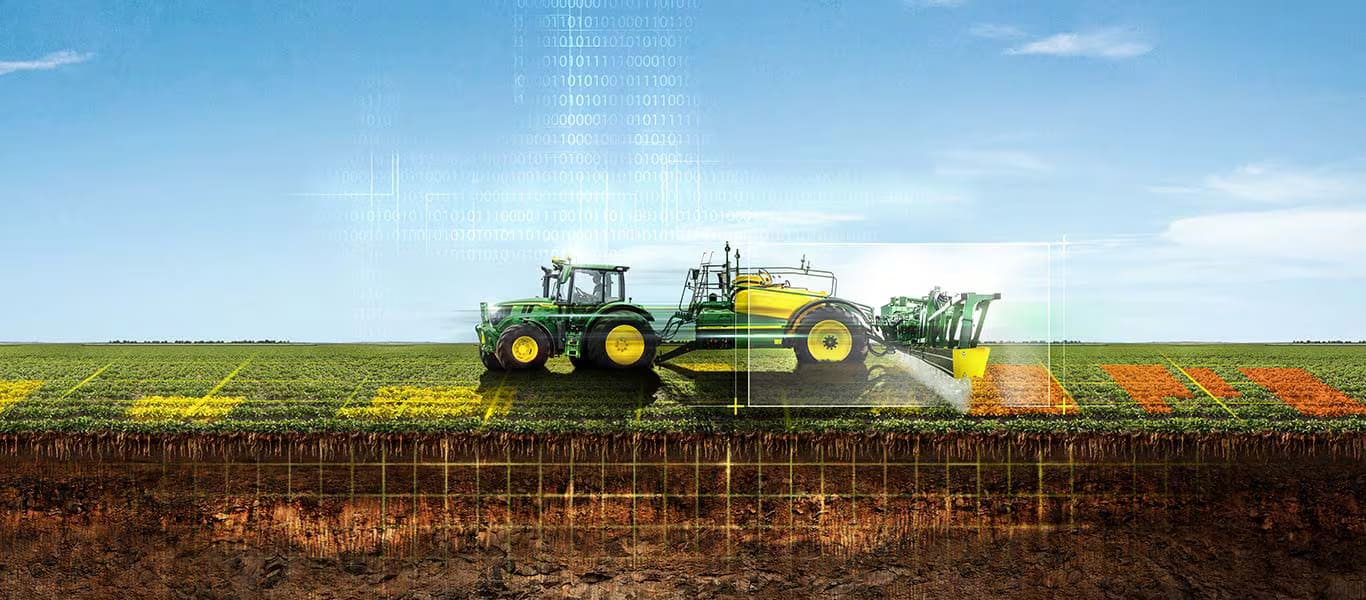
"Artificial intelligence represents the biggest leap in technological capabilities since the beginning of the computer era," Rose claims. "For John Deere, this means an opportunity to rethink every aspect of agricultural, construction and landscaping processes." In agriculture, John Deere has already implemented a range of AI-powered technologies. "Our precision agriculture systems use computer vision and machine learning to recognize individual plants in a field," Rose explains. "This enables targeted application of herbicides only to weeds, not crops, leading to a drastic reduction in chemical use – by up to 80% in some cases." Other examples include autonomous tractors and combines that can work 24 hours a day with minimal human supervision, harvest optimization systems that adjust combine settings in real time for maximum yield, and predictive maintenance that uses sensor data to predict potential equipment failures before they occur. "In construction, our intelligent excavators can automatically maintain precise grades and depths, eliminating the need for repeated measurements and reducing material waste," Rose adds. "And even in the lawn and garden equipment segment, we use AI to optimize mowers and maintenance machines."
Challenges and Opportunities on the Horizon
Implementing advanced technologies is not without its challenges. Rose speaks openly about some of the obstacles John Deere faces. "One of the biggest challenges is ensuring that our technologies are accessible and usable in different contexts around the world," he says. "Agricultural conditions vary dramatically between regions, and what works in the American Corn Belt may not be ideal for rice plantations in Southeast Asia or vineyards in Southern Europe." Connectivity presents another challenge, especially in rural areas where internet access may be unreliable or unavailable. "We are working on solutions that enable our systems to function effectively even in areas with limited connectivity," Rose explains. "This includes both optimization for low bandwidth and offline processing capabilities directly on the machine." Despite these challenges, Rose expresses tremendous optimism about the future. "We are in the early stages of the AI revolution, and the potential is astounding," he says. "Over the next ten years, we expect an exponential increase in the capabilities of our machines thanks to advances in artificial intelligence."
Sustainability and Food Security
One of the most important topics Rose emphasizes is the role of John Deere technologies in addressing global challenges related to sustainability and food security. "By 2050, the world’s population will reach nearly 10 billion people," Rose reminds us. "This means we will need to produce 60-70% more food than today, on the same or a smaller area of agricultural land, and with a lower environmental impact." Rose believes that artificial intelligence and related technologies are key to achieving this ambitious goal. "AI-powered precision agriculture enables us to achieve the concept of 'more with less' – more food with fewer inputs, less waste and a smaller environmental impact." A specific example is the John Deere See & Spray™ system, which uses computer vision to identify weeds among crops and apply herbicides only where they are needed. "This technology can reduce the amount of herbicides used by 50-80%, representing a tremendous benefit both for farmers and the environment," Rose explains. Soil health monitoring systems represent another area where John Deere uses AI. "Healthy soil is the foundation of sustainable agriculture," Rose says. "Our technologies help farmers monitor and improve the health of their soil through precise data on nutrient content, organic matter and soil structure."
The Future of Work in Agriculture
As automation increases, questions arise about the future of jobs in agriculture. Rose views this transformation as an evolution, not a replacement for human labor. "Technology is changing the nature of agricultural work, but it is not eliminating the need for people," he explains. "Instead of physically demanding and repetitive tasks, farmers can focus on important decisions, data interpretation and operational optimization." Rose points out that demographic trends in many countries, including an aging agricultural population and urbanization, are creating labor shortages in agriculture. "Automation helps address this shortage and enables farmers to manage more work with fewer people," he says. At the same time, new types of jobs are emerging – from agricultural data specialists to technicians who maintain sophisticated machines. "John Deere is actively investing in educational programs and partnerships with schools to help prepare workers for these new roles," Rose adds.
Partnerships and the Innovation Ecosystem
Rose emphasizes that John Deere cannot realize its vision of the future of agriculture alone. "Innovation in the modern world requires collaboration," he says. "We work with universities, startup companies, technology partners and, of course, directly with farmers to create solutions that genuinely meet market needs." One example of such a partnership is cooperation with technology companies specializing in artificial intelligence and machine learning. "We combine our deep understanding of agriculture and customer needs with the latest advances in AI," Rose explains. John Deere also operates its own innovation centers around the world, including John Deere Labs in San Francisco, which focuses on advanced technologies, and the John Deere Technology Innovation Center in international locations.
The Future of Agriculture with John Deere
"When I look at the next 10, 20 or 50 years, I see agriculture that is both highly technological and deeply connected to the traditions of caring for the land," Rose concludes. "I see intelligent machines working in harmony with nature, helping farmers produce enough food sustainably." Rose believes that John Deere is uniquely prepared to lead this transformation thanks to its combination of nearly two hundred years of experience in agriculture and its commitment to implementing the latest technological innovations. "Our vision is clear," Rose says. "We want to harness the power of artificial intelligence and other advanced technologies to create a more sustainable, productive and resilient agricultural system that will serve the needs of the growing global population for generations to come."
With this vision, John Deere continues on its journey of innovation, now with artificial intelligence as a key tool for further transforming agriculture, construction and land care around the world. As Justin Rose optimistically notes: "The next 100 years could be even more exciting than the last 200, and I am incredibly excited to be part of this journey."