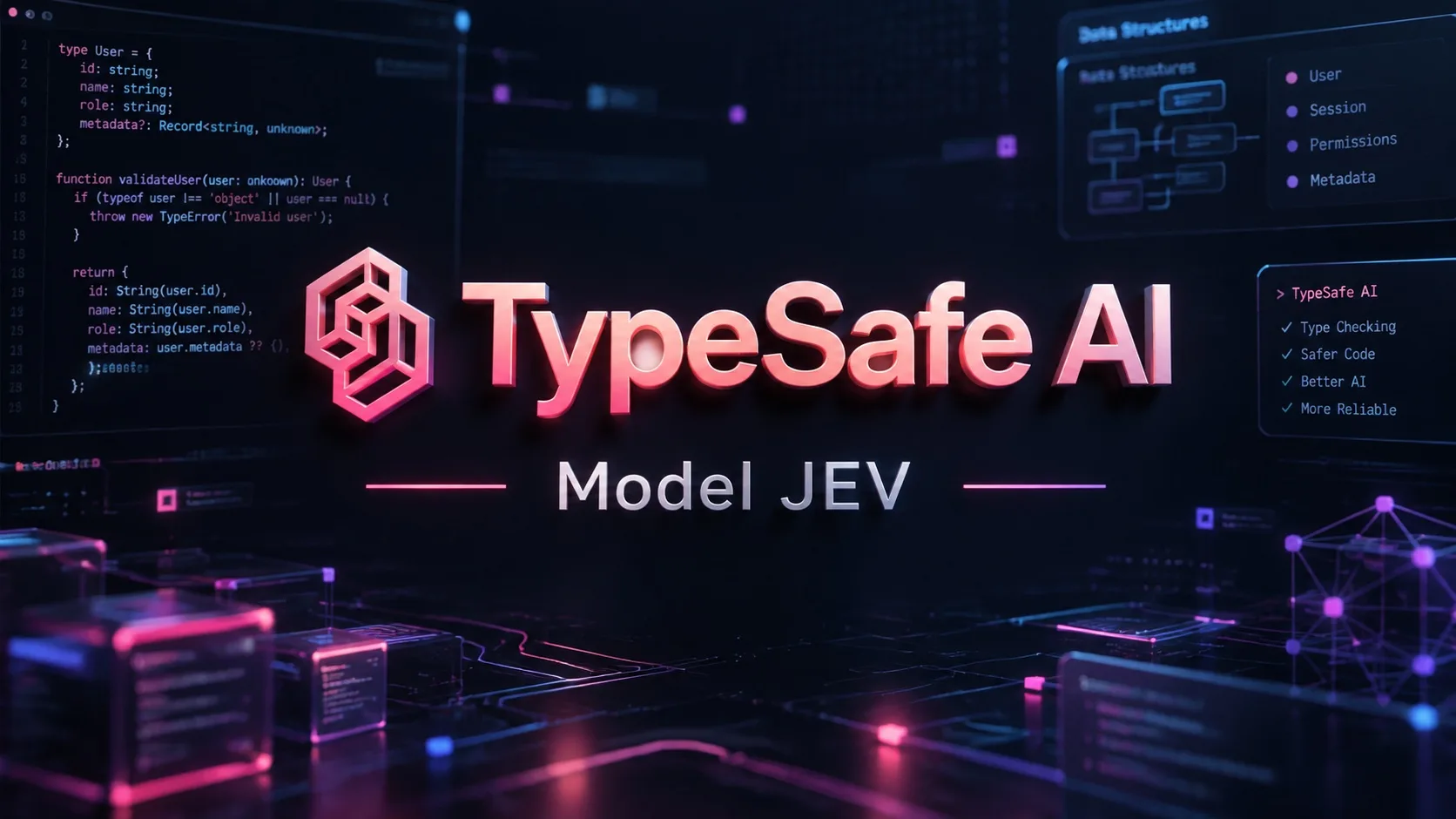
The mysterious startup TypeSafe AI has released its first model. It is called Jev, and it differs from everything commonly known today by the abbreviation AI in one respect. It cannot write text. It will not produce a chat response, an email, or any code. Instead, it receives a description of a situation and a set of prepared questions, to which it returns answers in a precisely defined format, adding a numerical measure of its confidence to each one. Because it does not generate anything in words, its creators say it cannot make anything up.
A model that only makes decisions
Today’s language models work by composing an answer word by word, predicting each successive word from those preceding it. This allows them to write anything, but also to make anything up. The Jev model is built differently. It receives a description of a state as input, such as customer data or the content of a request, along with a set of questions, and calculates all the answers in a single operation.
It can answer three types of questions: yes or no with a probability, a choice from predefined options, or a rating on a scale. Nothing else. If a programmer specifies in advance that the answer must be one of four options, the model cannot return anything else. According to the company, Jev works like a smart conditional statement inside a program. Where it would be possible to write a rule manually but that rule would be too unreliable, the model steps in and decides.
This is precisely why Jev cannot hallucinate. It cannot put together the name of a nonexistent function or invent a number, because it never composes anything. The answer format is predefined, and the company claims that an error is mathematically impossible. At the same time, it adds that this claim could be disproved by a single counterexample if anyone managed to find one.
Unrivaled speed and price
Speed is the second feature TypeSafe hopes will attract attention. According to the company, a response from Jev arrives in 70 to 500 milliseconds, roughly the blink of an eye. The large models with which it is compared need anywhere from three seconds to several minutes to respond if reasoning is enabled. According to TypeSafe, the difference ranges from fortyfold to two-hundredfold.
The price is similarly impressive. The company charges approximately four hundredths of a cent per million input tokens, which amounts to roughly two dollars for fifty billion characters of text. It does not charge for outputs at all, arguing that they are so inexpensive they are not even worth measuring. With conventional models, however, the output is precisely what costs the most, usually about five times as much as the input.
Tests published by TypeSafe showed that Jev handles the same work almost two hundred times faster and approximately four hundred times more cheaply than large models. The company says these figures represent the upper limit of what can be expected in practice.
These advantages come with fairly strict limitations. The model cannot process images, has no chat interface, and its context window for a single query is about thirty times smaller than that of today’s large models. You can offer it no more than two hundred and fifty-five options to choose from; larger sets must be handled in two rounds.
It is therefore intended as a complement to large models, not as their replacement. Typical uses include classifying and routing requests, extracting information from data, evaluating records, or monitoring the outputs of another AI and detecting attempts to circumvent rules.
Jev acknowledges uncertainty
TypeSafe CEO Diogo Almeida argues that the biggest problem with today’s artificial intelligence is not stupidity, but overconfidence. Models present every answer as though it were one hundred percent correct. We have spent all this time fine-tuning models for people and teaching them how to please people, and today they are better at it than people themselves, he says.
The problem then looks like this. If a model can complete a task correctly in ninety-five cases out of a hundred but never indicates which five it got wrong, it cannot be trusted in any case. A company must have everything checked by a human, eliminating any savings in time and money. Jev therefore provides a probability and confidence level with every answer, calibrated so that the numbers correspond to reality. Higher confidence means a higher success rate. A programmer can then set a threshold. The system handles tasks that exceed it on its own and sends those below it to a human. Almeida summarizes this by saying that it finally makes it possible to automate processes instead of automating nothing.
The model was trained using a new method that the company calls learning for calibrated decisions. While conventional models learn based on which answer people prefer, Jev was trained so that its probability estimates correspond to reality.
Doom and a race across Wikipedia
The team accompanied the announcement with two demonstrations showing what can be done with such fast decision-making. In the first, Jev plays Doom. It receives a description of the game situation and decides how to proceed ten times per second. An hour of playing this way costs roughly seven dollars, which surprised even its creators.
The second demonstration is a race across Wikipedia, in which you must get from one page to another using only the links you encounter along the way. At every step, there are hundreds or thousands of links to choose from, and the model must not select any link that is not actually on the page. According to the company, Jev reached the destination in fewer steps than the language models against which it was tested.
Jev was created by a former OpenAI researcher
TypeSafe AI was founded in 2024 and spent two years operating in stealth mode. It is led by Diogo Almeida, who previously worked in research at OpenAI and contributed to the development of reinforcement learning from human feedback, the InstructGPT study, and the development of ChatGPT and GPT-4. He founded the company together with Erik Gafni and Sasha Sheng.
Almeida speaks about his four years at OpenAI with a certain detachment. In his own words, he believed at the time that chat models would lead the field to artificial general intelligence, but gradually realized that something fundamental was missing. His question is why models that are better at conversation than people have so far brought almost no real automation. His answer is that most artificial intelligence should not talk to people but run quietly inside programs.
The name Jev is a tribute to economist William Stanley Jevons, who observed in the nineteenth century that more efficient steam engines did not reduce coal consumption but instead increased it, because it suddenly became economical to use them everywhere. The company expects the same thing to happen. In its view, every tenfold reduction in the cost of intelligence will unlock ten times as many new uses.
Sources: typesafe.ai and forbes.com