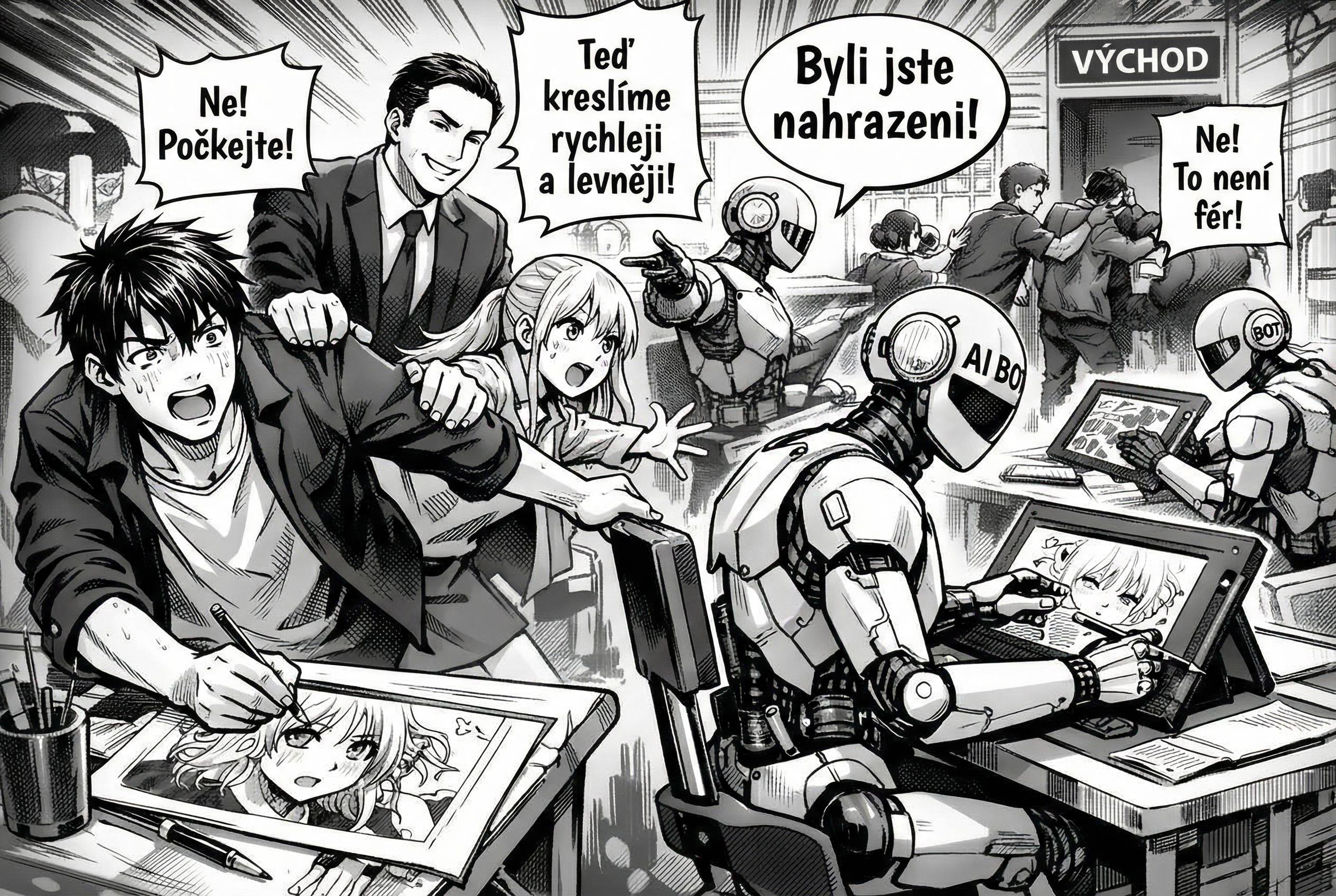
More than one in ten Japanese manga artists, illustrators, and other creative professionals report a decline in income due to generative artificial intelligence. This is according to a survey released on Tuesday by the Freelance League of Japan, an organization focused on the working conditions of independent professionals.
Dramatic Income Losses
According to the survey, 12% of respondents reported a decline in earnings linked to generative AI. Of these, 9.3% saw their income fall by between 10% and 50%, while 2.7% lost more than half of their income. The figures are particularly alarming because the technology is still relatively new and its full impact is only beginning to emerge.
The survey, conducted online in October, received 24,991 responses from across the cultural and entertainment industries. Most respondents were people whose work centers on drawing—illustrators accounted for 54.2%, manga artists for 15.0%, and animators for 2.2%. Writers and novelists made up 7.5%, while video producers accounted for 2.5%.
Clients Push for Lower Prices and Shorter Deadlines
Creators who experienced a decline in income describe a common pattern: clients demand shorter deadlines and lower fees on the assumption that they will use AI. Some lost commissions altogether because clients decided to rely exclusively on generative AI. One illustrator who sells their work through a stock content website said in the survey: "I am now competing with illustrations that may have been trained on my own work without permission."
Concerns about the future are widespread among creators. Approximately 88.6% said that generative AI poses a threat to their livelihoods, including 65.3% who feel "strongly" threatened and 23.3% who feel "somewhat" threatened. Many creators avoid generative AI tools entirely. When asked about their own use of generative AI, 62.9% said they do not use it and do not plan to. Only 21.4% use it for brainstorming and generating new ideas. 9.3% use it to automate routine tasks such as producing backgrounds or proofreading. 4.1% use it for sketches and concepts, while only 2.8% of respondents said they use it to complete part or all of a work.

Disputes Among Creators and Legislation
The league also highlighted disputes and reputational damage caused to creators by generative AI. 77.8% of respondents said they had seen a fellow creator involved in problems such as the creation of nearly identical works, suspicions of using AI, or being subjected to defamation and online abuse. 14.5% said they had experienced this themselves. One respondent, a novelist, warned that as it becomes more difficult to prove that AI was not used, creators may face a "witch hunt."
Creators overwhelmingly supported stricter rules regarding training data. 92.8% said it is important to legally require disclosure of copyrighted works used in AI training datasets. On the issue of creator consent, 61.6% favored an opt-in system requiring prior permission, while 26.6% said that the use of copyrighted works for training should, in principle, be prohibited through revisions to copyright law.
The league called on the government to mandate transparency regarding training data, require the labeling of AI-generated works, and establish new systems to ensure profits are shared with creators. "We urgently need to move forward with legislation. This is not something we can afford to spend 10 years discussing—it is something that is needed right now," Mitsuru Yaku, a cartoonist and honorary chairman of the league, said at a press conference on Tuesday.