


Are you interested in how language models gradually formulate their responses?
New research by Anthropic reveals a fascinating insight into the "mind" of artificial intelligence
When you converse with a modern chatbot such as Claude, ChatGPT, or Gemini, you may get the impression that responses are created instantly – as if the model simply generated the entire answer all at once. However, groundbreaking new research by Anthropic shows that reality is much more complex and surprisingly more similar to human thinking than we previously thought.
A Glimpse into the "Mind" of AI
Researchers at Anthropic have developed an innovative method called "activation tracing," which allowed them to look into the internal processes of language models while they generate responses. Similar to how neurologists monitor human brain activity using EEG or fMRI, this method enables scientists to observe how the model's internal representations change while text is being created.
The results are fascinating: language models do not create their responses all at once, but formulate them gradually over time. Information about what the model plans to say later in its response is encoded in its internal layers long before the relevant words are actually generated.
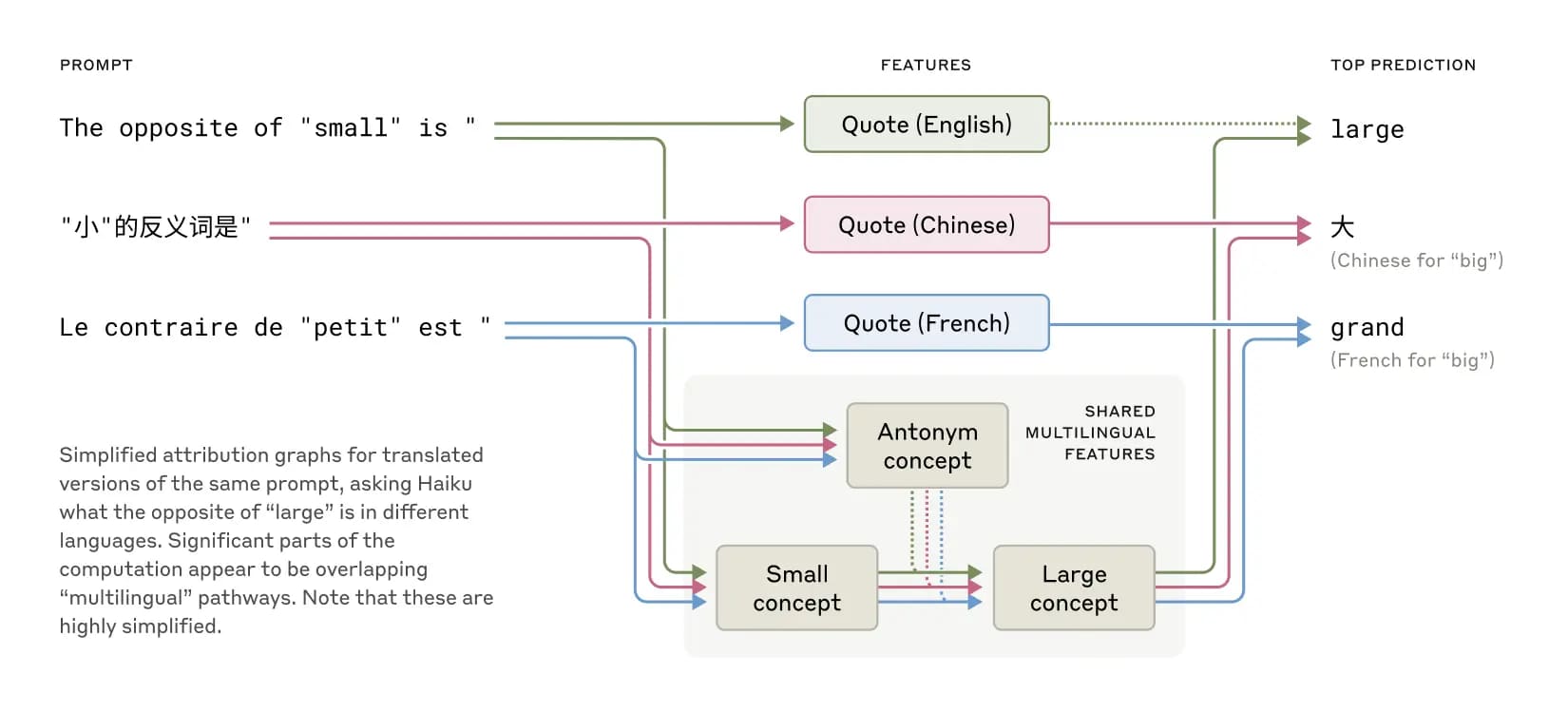
From Thought to Text
One of the most interesting findings is that language models proceed similarly to humans when formulating responses:
1. First, they create a basic structure - the model begins with a general framework and the main ideas of its response.
2. They gradually develop the details - only afterward does the model expand these main ideas into specific sentences and formulations.
3. They complete and refine the response - finally, the model clarifies the details and ensures that the response is coherent.
This process is remarkably similar to how people think when composing more complex responses – first we have a general idea of what we want to say, and only then do we formulate that idea into specific words and sentences.
Architectural Details: Different Layers, Different Functions
Researchers found that different layers in the model's architecture have specialized functions when generating responses:
Middle layers contain the most information about future words and phrases – they are therefore something of the model's "planning center"
Deeper layers focus more on the current context and already generated text
Surface layers specialize in the immediate prediction of the next word
This specialization of different parts of the neural network once again resembles the specialization of different areas of the human brain, although the analogy is, of course, only approximate.
Different Types of Questions, Different Thinking Processes
Another interesting finding concerns differences in how the model approaches different types of tasks:
For factual or technical questions (e.g., mathematical problems), information about the answer appears in the model's internal representations much earlier
For creative or subjective questions, the model formulates its thoughts more gradually, with more "thinking" during generation
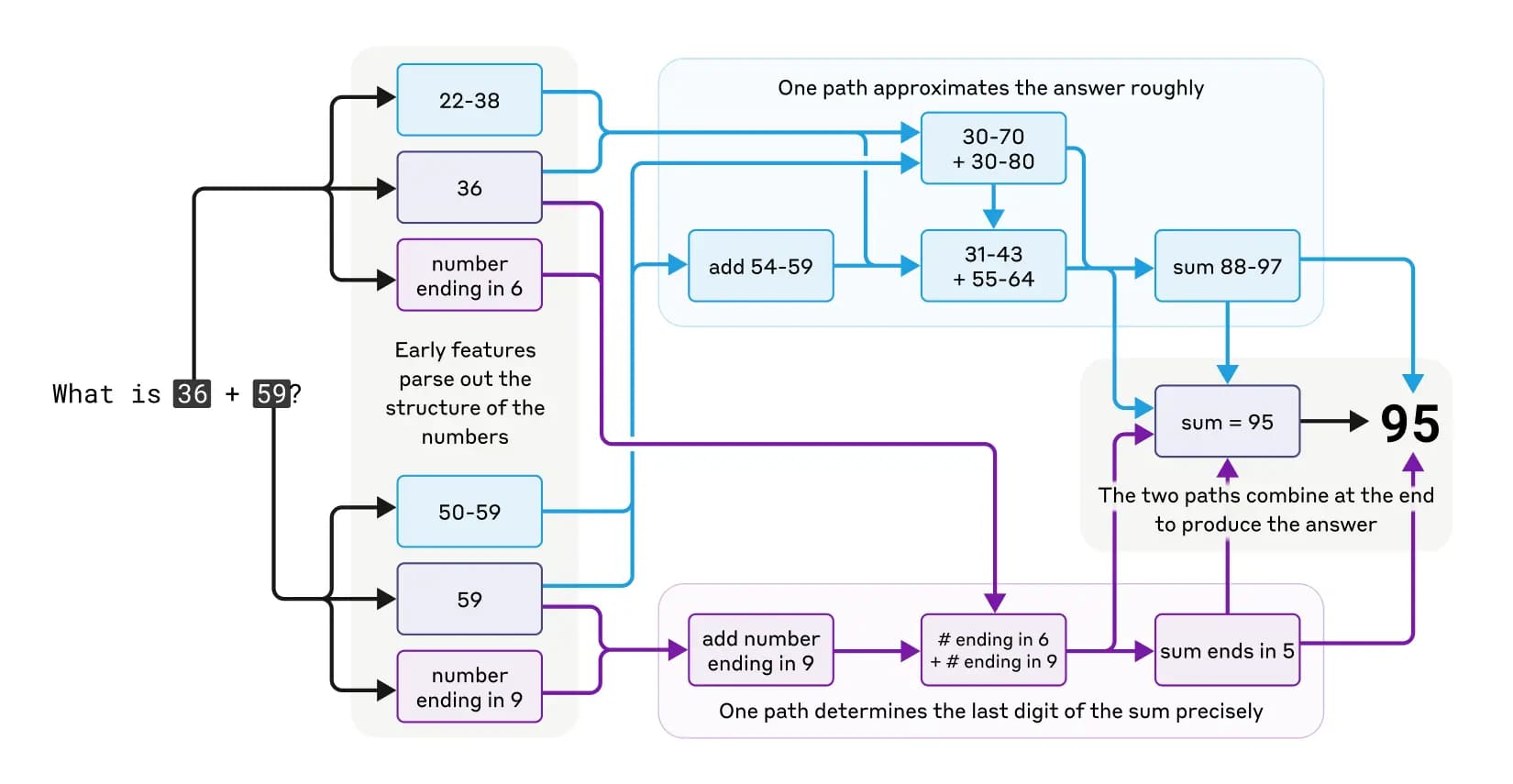
This finding suggests that the model uses different cognitive processes for different types of tasks – much as people approach solving a mathematical problem differently from writing a creative text.
Practical Implications and Why Does It Matter?
This research is not merely theoretically interesting – it also has significant practical implications:
For AI developers:
It enables a better understanding of how models arrive at their answers.
It paves the way for developing models that can better explain their reasoning.
It may help identify and correct sources of "hallucinations" or inconsistent responses.
For AI users:
It provides a better idea of how the systems we interact with actually work.
It helps explain why models may be consistent on some types of tasks and less reliable on others.
It enables more realistic expectations regarding the capabilities and limitations of current language models.
Comparison with Human Thinking
It is important to emphasize that despite their similarities to human thinking, language models do not possess genuine understanding or consciousness. Their "thoughts" are actually mathematical representations in neural networks, not conscious deliberations.
Nevertheless, the parallels are fascinating. The research suggests that effective language processing – whether by a biological brain or an artificial neural network – may require certain common principles of organization and the gradual processing of information.
Future Research Directions
This groundbreaking research opens up many new questions and directions for further investigation:
How could knowledge of these internal processes be used to create models that are more transparent and trustworthy?
Could these insights help develop models that provide better explanations of their responses?
Are there ways to "adjust" these thought processes to improve model accuracy for specific tasks?
A New Perspective on AI Thinking
Anthropic's research offers us an unprecedented glimpse into the "mind" of language models. The finding that these models gradually formulate their responses in a way similar to humans is a significant step toward better understanding these increasingly complex systems.
Although language models are still not truly "thinking" entities in the human sense of the word, their way of processing information is more complex and structured than previously assumed. Their "thoughts" really do develop and take shape gradually – and this understanding may help us develop even more capable, reliable, and useful AI systems in the future. Just as a human author first considers the structure of an article and gradually develops it into specific sentences, the language model that created this text first formulated the main ideas and only then elaborated on them in detail. Isn't that a fascinating parallel?


