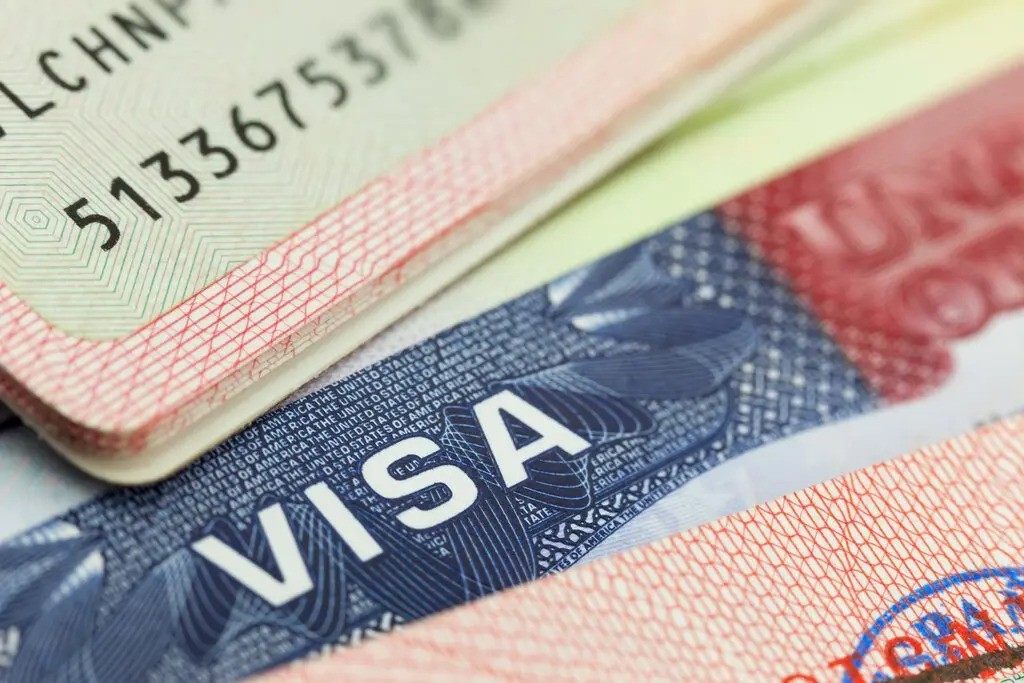
Over the weekend, a blog reader wrote to me and asked me to summarize all the information on what is required to obtain this type of work visa.
There is not much written about it; there is only general information on the internet, and since there are several of you who have contacted me about this, and this information would also have helped me in the beginning, I decided to summarize everything in a short article.
Maybe it will help someone :).
At first, I knew absolutely nothing about this.
E2 visas were one of the options for legally working in the USA for my own company.
At first, I was considering L visas instead, as I was attracted by the idea of a direct and relatively quick path to a green card and permanent residency.
However, these visas involve an intra-company transfer of employees, which in practice means that you transfer one of your employees (this can also be you) to a branch in the USA.
There are various pitfalls regarding sponsorship, and most importantly, there is a requirement that the transferred employee must have been employed by the parent company (in my case, in the Czech Republic) for at least 1 year.
This was not possible for me at the time, since in the Czech Republic a managing director can choose not to pay themselves a monthly remuneration, so I had nothing.
I could have waited a year until I met the requirement, proven that I had special management abilities and so on, and tried my luck.
I did not want to wait, so I used an E2 visa, which is relatively easy to obtain.
You apply for an E2 if your investment is under 500 thousand dollars; you get the visa for 5 years and permission to enter for 2 years. After 2 years, you either extend it in the USA or travel to Europe and return; here, your I-94 card is automatically extended for another 2 years.
Along with this, you can apply for an SSN, a US ID card and a driver's license. The ID card and driver's license are always valid until the expiration of the I-94.
When you enter again and your arrival card is renewed, the DMV will extend everything for a fee. With a driver's license, if it has not been expired for more than 3 years, you do not need to take the tests again.
Personally, I have never had any problems with immigration compared to B visas; they just look at the visa, stamp it, and I am in the USA.
I had an immigration lawyer for the entire process. Without one, I certainly would not have been successful with the applications.
During the initial consultations, everything seemed very complicated to me, and I kept asking about things, often repeatedly, so that I could understand them.
The way of thinking in the USA is a little different from ours; in any case, be prepared for the fact that if everything is in order, nobody will “put obstacles in your way,” as is common at government offices in the Czech Republic, and you will get through comfortably.
The first thing was to write a business plan explaining what exactly the new company would do. I prepared the entire thing in English.
To summarize, ours had these points:
– who owns the company, the ownership percentages, etc. (as an applicant for an E2 visa, you must own at least a 50% share in the company, otherwise they will not approve anything – it is one of the conditions)
– business activities (a description of what we do, what we will do, etc.)
– what the competition in the market is like, how we differ, and a little about marketing and how we will conduct it
– financial projections for 5 years – projected profit and loss statements, turnover, projections of how many employees we will have; everything had to comply with the rule that the business must not be so-called “marginal.”
Marginal means that it earns more money than is needed to support the owner and their family.
If you obtain an E2 visa, your husband/wife will receive derivative H-type visas with work authorization, and your children will also be allowed to reside legally, but only until the age of 21; after that, they must change their status or leave the USA.
To be honest, I changed these projections several times. I started with the most conservative version, which I knew we would fulfill 100%, but the lawyers warned me that it was “on the borderline.”
In the end, I settled somewhere among the more optimistic versions.
These projections are not easy to prepare, since the company does not actually exist yet, so you do not know exactly how things will turn out.
I based them only on the margins and sales and the competitors' turnover, and then chose, according to realistic estimates, how the business might ultimately develop.
You really need to approach it realistically. You get an E2 visa for 5 years (each country has it differently; Czechs get 5 years, for example, while Slovaks get only 2 years), but you need to bear in mind that after 5 years you must extend it at the embassy, and they will want to see results. If there are none, or they are completely different from the projections, you risk having the visa extension refused, which is not good when you have an established company (these cases really do happen).
However, if the company is operating, I assume that by then everyone can comfortably change their status to EB-5 (a green card through investment). That is, if your plans change and you want to stay in the USA permanently.
In the business plan, you also have to show that this company (startup) will make a significant contribution to the US economy (this is demonstrated by the profit and loss statements, as well as how many people you will employ and so on).
You also need to prove the amount of the investment. It depends on the type of business: you need less money for consulting, for example, and more for manufacturing a product.
On the internet, I saw that lawyers had succeeded with an investment of around 35 thousand dollars. In my opinion, that is very much on the borderline.
It can be done with approximately 50 thousand dollars, but ideally, if you want a higher chance of approval and do not need a so-called “strong case,” you should invest around 100–150 thousand USD.
With this investment, you need to prove its legal source and that everything was properly taxed.
I chose the option of using dividend payments from my company in the Czech Republic (note – I also had to prove my personal tax return and show that I had properly paid all taxes).
You can also prove it through the sale of real estate, an inheritance and so on.
A loan is more complicated. In this case, you must prove whether the loan is “secured.” It must be secured by something. The law is clear: you must put this money at risk – meaning that you may lose it.
If you borrow from a bank, that might work, but it is subject to consultation with an immigration lawyer.
If you want to document the money as a loan from acquaintances, you must provide them with collateral – real estate, for example, etc. Otherwise, you risk being sent home from the embassy without a visa.
You must also prove how the person lending you the money acquired it and whether it was properly taxed as well.
The next step is to establish a company in the USA and open a bank account.
I chose the LLC structure.
With an LLC, taxes are paid at the member level, unlike with a C-Corp, where they are paid at the company level and then again at the member level. A C-corp is the equivalent of an s.r.o.
Both companies are liable for their obligations only with their own assets. As a member, you are not personally liable for any debts unless you co-sign a bank loan, in which case you are also liable with your SSN, etc. (similarly to blank promissory notes in our country).
It is a good idea to study this in advance.
Once you have the company, including all the articles of incorporations, operation agrements and other documents (this was again arranged for me by a law firm), you can apply for a tax number, EIN, without which you cannot open a bank account.
You can obtain an EIN on the IRS website (the US tax authority), but you must have either an SSN or an ITIN (individual tax identification number). You usually have neither.
We got around this by having the law firm provide its SSN, and after obtaining the EIN, the law firm removed itself from the company's EIN.
To open a bank account, you need to fly to the USA; nobody will do it remotely (you can enter even on an ESTA).
You then need to transfer the money into this account and document the entire transfer process for the embassy.
Once the lawyers had prepared all these documents for me, which took several months, I submitted the application to US immigration using the DS-160 form.
You need to pay an interview fee of approximately CZK 5,000 into the embassy's account.
The interview must be scheduled at least 2–3 weeks after submitting the application.
Embassies now have new rules requiring all supporting documents to be sent to their address, where they have 2 weeks to review them.
The entire interview was relatively problem-free.
I had already gone through it before, so I knew what to expect.
On the scheduled day, I arrived at the US Embassy in Prague, handed over all electronic devices at the entrance, and went into the waiting room.
I took a ticket from the machine, the woman at the window registered me, and I waited for them to call me.
To be safe, I brought copies of all the supporting documents with me, so that I would not be caught off guard during the interview if anything was missing.
In the end, I did not need them.
They called me for the interview after approximately 10 minutes of waiting.
A pleasant young woman was sitting behind the window; I had not met her before, and later I found out that she was completely new there.
We greeted each other, and she asked me what my company would do in the USA.
I explained the nature of the business and that we already had customers who would use our services from the very beginning.
She then asked me how long I wanted to stay in the USA.
It is VERY important here to show ties to the Czech Republic, because these are not immigrant visas; they still fall into the non-immigrant category (even though you can extend them indefinitely and travel to the USA almost whenever you want).
I told her that it would be a matter of months, and that everything would depend on how the company performed.
I emphasized that I had other companies and employees in the Czech Republic, as well as a car, family and friends, and that I needed to return.
I also told her that I would like to be able to return to the USA freely and check whether the company was operating, etc.
She was evidently satisfied with my answers, as she asked me to provide my fingerprints and, thanks to the excellent help of the lawyers, told me a phrase I now know very well:
“Congratulations, your visa has been approved” (Congratulations, your visa has been approved).
After obtaining the visa, you still need to pay a small fee of up to USD 20 at the embassy counter for the visa issuance.
In my case, the consular officer was new and forgot to tell me. I drove back to Brno, and in the evening the embassy called me to say that I needed to pay this fee before they could hand over my passport with the visas already affixed.
It could not be paid into an account, so the option of having my passport delivered by mail, as usual, within 3 days was no longer possible.
I had to drive to Prague again on the next business day, paid the fee in person, and received the visa right away.
I could fly out.
Unlike with B visas, for example, immigration did not examine me in any way.
The immigration officer looked at the visa, stamped my passport, and the only sentence, apart from telling me to place my hand on the fingerprint scanner, was: “Enjoy your stay.”
I definitely recommend E2 visas to all startup founders in the USA; it is the easiest path to work authorization in the USA.
I also recommend avoiding the so-called Czech syndrome: “I’ll do it myself.”
Believe me, without lawyers I would not have managed it under any circumstances, and I would have overlooked something that would have caused my visa application to be denied.
It does cost some money, but if it works out, this money is negligible compared to the benefit that it will bring you in the form of doing business in the USA.
The immigration firm ImmigrationBiz helped me prepare the documents: ImmigrationBiz. I praise them at every opportunity; they were always as helpful as possible and resolved everything that needed to be taken care of :).
I wish many potential successes to those considering this option! 🙂
Here is what my application looked like; it was not exactly a small amount of paperwork:
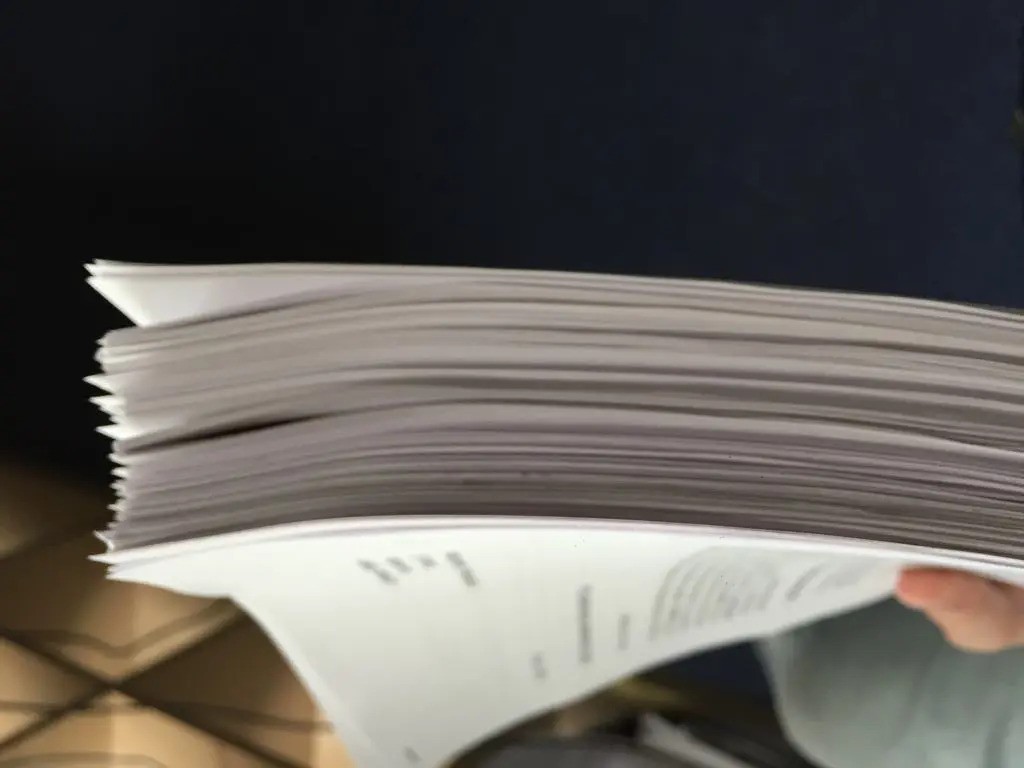
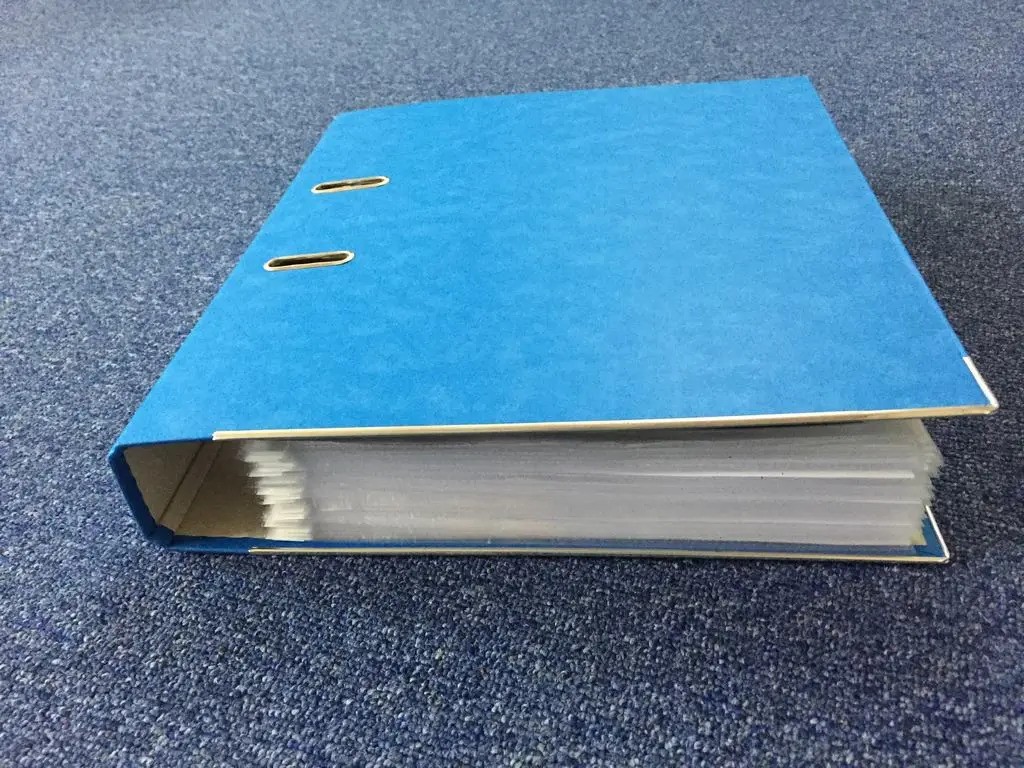
Printing it took me almost an entire working day, and I used 2 toner cartridges in a laser printer.
You cannot tell from the photo, but there was really a lot of it :).