

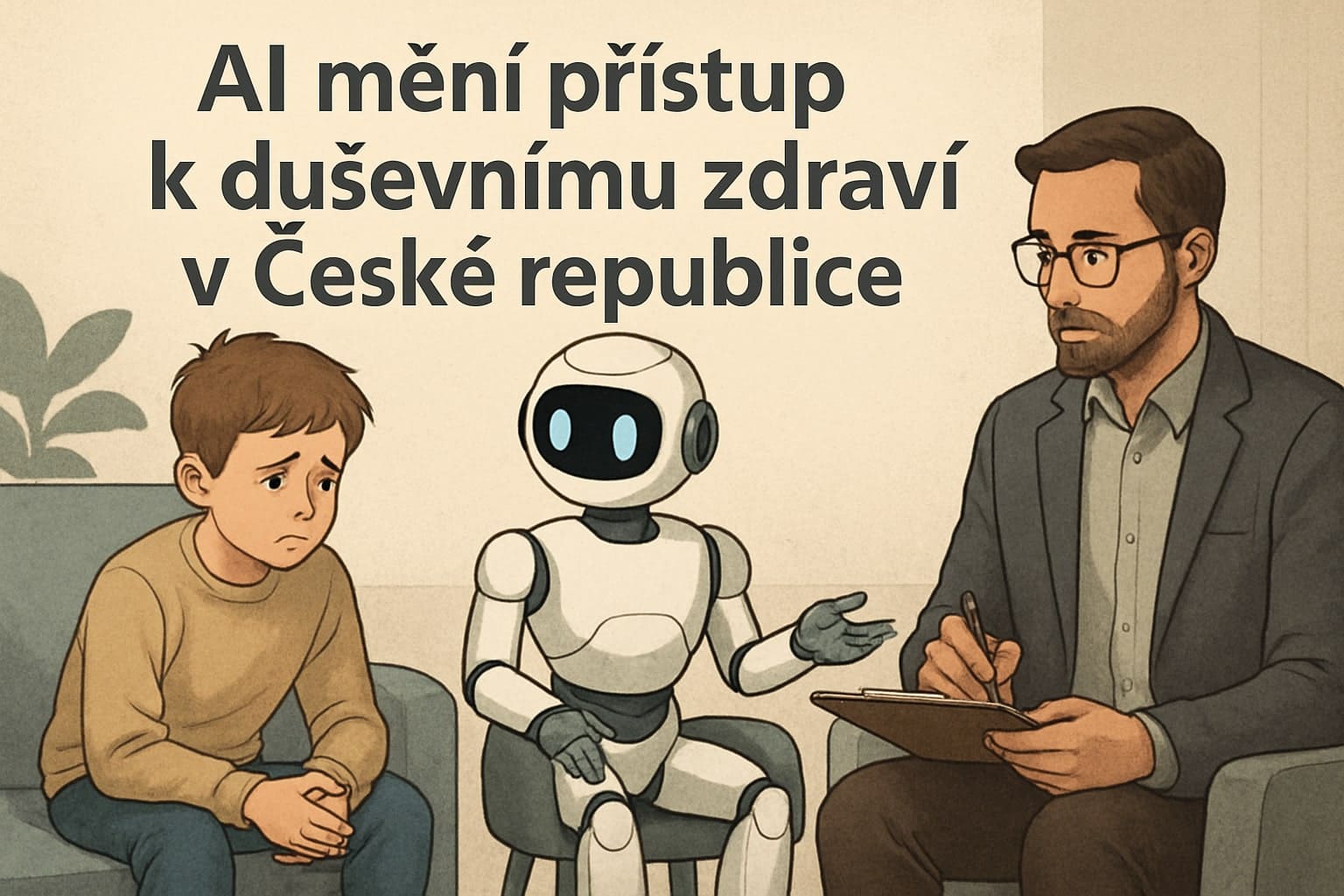
How AI Is Changing the Approach to Mental Health in the Czech Republic
Mental health is becoming increasingly important, while access to professional care is also declining, but a new helper is entering the scene—artificial intelligence. Digital therapeutic assistants are becoming an increasingly accessible alternative to traditional psychotherapy, and the Czech Republic is not being left behind in this trend. Technological advances in AI are creating new opportunities to make psychological assistance more accessible to a broader range of people who might otherwise remain without support.
The Rise of AI in Czech Psychological Care
Artificial intelligence is gradually becoming a significant complement to traditional psychotherapeutic care, primarily due to its ability to overcome barriers that prevent many people from seeking professional help. Whether these involve geographical obstacles, financial costs, lack of time, or simply fear of visiting a therapist, AI offers a solution that can effectively bridge these gaps. One of the most successful Czech projects in this area is ChatMind by VOS.health. This application uses an AI therapist who is available to users at any time of day or night and offers personalized psychological support. ChatMind has gained millions of users around the world and serves as a valuable bridge between traditional therapy sessions. It functions as a mental health guide that is always ready to listen and provide advice based on proven psychological approaches.
Another significant Czech innovation is Elin.ai, an application focused primarily on adolescents, who often feel embarrassed or reluctant to confide in their parents or school counselors about their problems. Elin.ai represents a safe first point of contact for mental health difficulties, helping young people articulate their problems and guiding them toward an appropriate form of assistance.
An interesting approach is also being developed by the Czech company Promethist.ai, which is developing chatbots specifically designed to treat depression and anxiety. As part of their research, they are also testing the innovative use of digital personas with human faces, which could increase the level of empathy in communication between the AI system and the patient. This approach suggests the direction in which digital therapeutic tools may develop in the future.
Benefits AI Brings to Therapeutic Practice
One undeniable advantage of AI therapists is their continuous availability. While patients may wait weeks or months for an appointment with a human therapist, a digital assistant is ready to provide help 24 hours a day, 7 days a week. This immediate availability can be especially critical during moments of acute crisis or in situations when a person needs to express their emotions without delay. Another significant advantage is the anonymity provided by AI therapy. Many people struggle with the stigma associated with seeking psychological help or are simply afraid to open up about their innermost problems to a stranger. Research shows that younger generations, in particular, often find it easier to open up to an “inanimate” system than to a human therapist. This phenomenon helps overcome one of the greatest barriers to mental health care—the fear of sharing and being judged.
Affordability is another significant factor that makes AI therapy an attractive alternative. Compared with traditional therapy sessions, which can cost thousands of Czech korunas, digital services are usually offered at a fraction of that price or even with free basic access. This pricing policy considerably broadens the pool of potential users and enables people with limited financial resources to obtain some form of support. Last but not least, the personalization capabilities offered by modern AI systems should be mentioned. Thanks to machine-learning algorithms, digital therapists remember previous conversations, user preferences, and the context of their problems. With each subsequent interaction, the support becomes more relevant and targeted, increasing its effectiveness and value for the user.
Limitations and Risks of Digital Therapy
Despite all the benefits AI therapy provides, a number of limitations and risks remain, which experts repeatedly point out. Leading Czech psychologists and psychiatrists emphasize that the current level of artificial intelligence cannot fully replace an experienced therapist, especially in more complex cases or crisis situations. The interpersonal relationship, authentic empathy, and ability to respond intuitively to subtle nuances in a patient’s expression play a key role in successful therapy—areas in which AI still falls short of human capabilities. The issue of personal data security is also a significant problem. When sharing sensitive information about one’s mental health with a digital platform, it may not always be entirely clear how this data is stored, processed, or potentially shared with third parties. This aspect represents a fundamental challenge not only for developers but also for regulatory authorities and legislators, who must create an adequate legal framework to protect users. Some critics also point to the risk of superficiality that AI therapy may entail. There is concern that some users may be satisfied with “pouring their hearts out” to a chatbot without actually working to change their lives or address deeper problems. This phenomenon, sometimes referred to as “trauma dumping,” may in some cases lead to postponing genuine problem-solving and seeking more comprehensive professional help.
Use of AI in Psychotherapeutic Practice
Currently, AI chatbots analyze users’ emotions primarily through text-based conversations, identifying signs of stress, anxiety, depression, and other psychological difficulties. Based on this analysis, they provide advice for managing everyday problems such as stress, insomnia, or interpersonal conflicts. Many of these systems implement basic elements of cognitive behavioral therapy (CBT), which is among the most empirically supported psychotherapeutic approaches.
Another interesting aspect is AI’s potential to assist therapists themselves. By analyzing large amounts of data from conversations and medical records, these systems can help professionals better understand patients’ needs and target therapeutic interventions more effectively. This approach suggests that the future may lie more in synergy between human therapists and AI assistants than in competition between them. For a significant proportion of users, combining traditional therapy with supplementary AI use represents the ideal approach. Many visit a traditional therapist, for example, once every few weeks and use a chatbot in the meantime for ongoing support, practicing new skills, or expressing their emotions. This hybrid model makes it possible to maximize the benefits of both approaches while minimizing their shortcomings.
The Future of AI Therapy in the Czech Context
Artificial intelligence–based therapy is rapidly gaining importance in the Czech Republic thanks to its accessibility, anonymity, and low cost. These services are most popular among people under 30, who are generally more open to technological innovations and less burdened by prejudices against unconventional forms of mental health support. The professional community, however, emphasizes the limited role of these digital tools—they can be a suitable complement to traditional mental health care, particularly for milder difficulties or as a first step when seeking help. According to both experts and the creators of these technologies themselves, they are not yet a full-fledged replacement for an experienced therapist.
With increasing pressure on the mental health care system, which in the Czech Republic faces a long-term shortage of professionals and growing demand for services, the importance of AI therapy can be expected to continue increasing in the coming years. The key challenge remains finding the optimal balance between technological innovation, clinical effectiveness, and the ethical aspects of this rapidly developing field. Thanks to its strong technological base and growing number of startups focused on digital health, the Czech Republic is well positioned to become one of the European leaders in AI-based mental health support. The future of this field will depend not only on technological progress but also on the ability to integrate these innovative approaches into the broader health care framework and educate both professionals and the general public about their possibilities and limitations.


