AMD has unveiled Helios, its first complete artificial intelligence system in the form of a full server rack. The company is positioning it as a direct response to Nvidia, which currently dominates the data center GPU market with virtually no competition. Helios combines four things that AMD produces under one roof: GPUs, processors, networking components, and software. And its first major customers have already signed on, including Microsoft.
What Helios is designed for
Helios is not an ordinary server that you buy and install in a rack. It is an entire rack designed for the most demanding tasks artificial intelligence requires today: training massive models with trillions of parameters and running finished models at scale, known as inference. AMD is targeting it at so-called frontier models, meaning the most powerful models of all, as well as computing for governments and institutions that want to keep their AI infrastructure under their own control.
The system was named after the Greek sun god, who according to mythology pulls the sun across the sky with four horses. The reference to four horses is fitting because Helios is built on four AMD technologies that have come together in a single system for the first time.
Interestingly, Helios itself is not a product for sale. AMD describes it as a reference design, essentially a blueprint. Server manufacturers can then use it to build their own branded systems. The entire system is based on open industry standards, particularly the Open Rack Wide design contributed to the OCP consortium by Meta. AMD is appealing to customers with the promise that they will not be dependent on a single supplier, which is the main difference compared with Nvidia's more closed approach.
Helios specifications
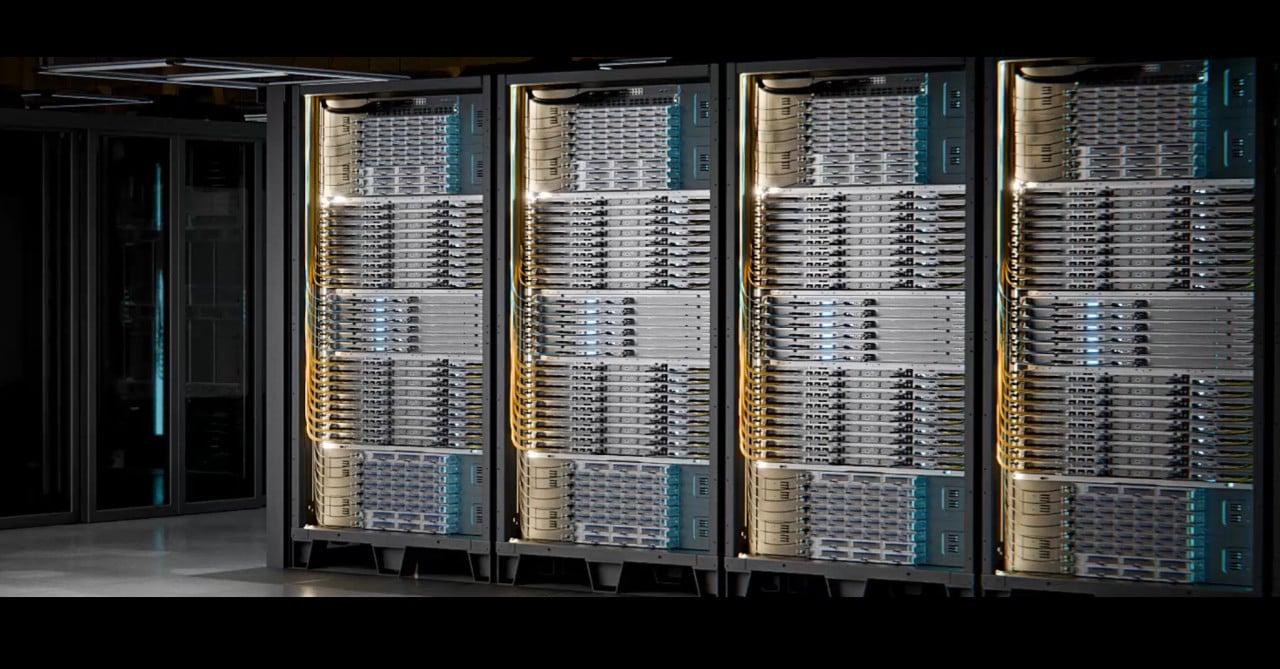
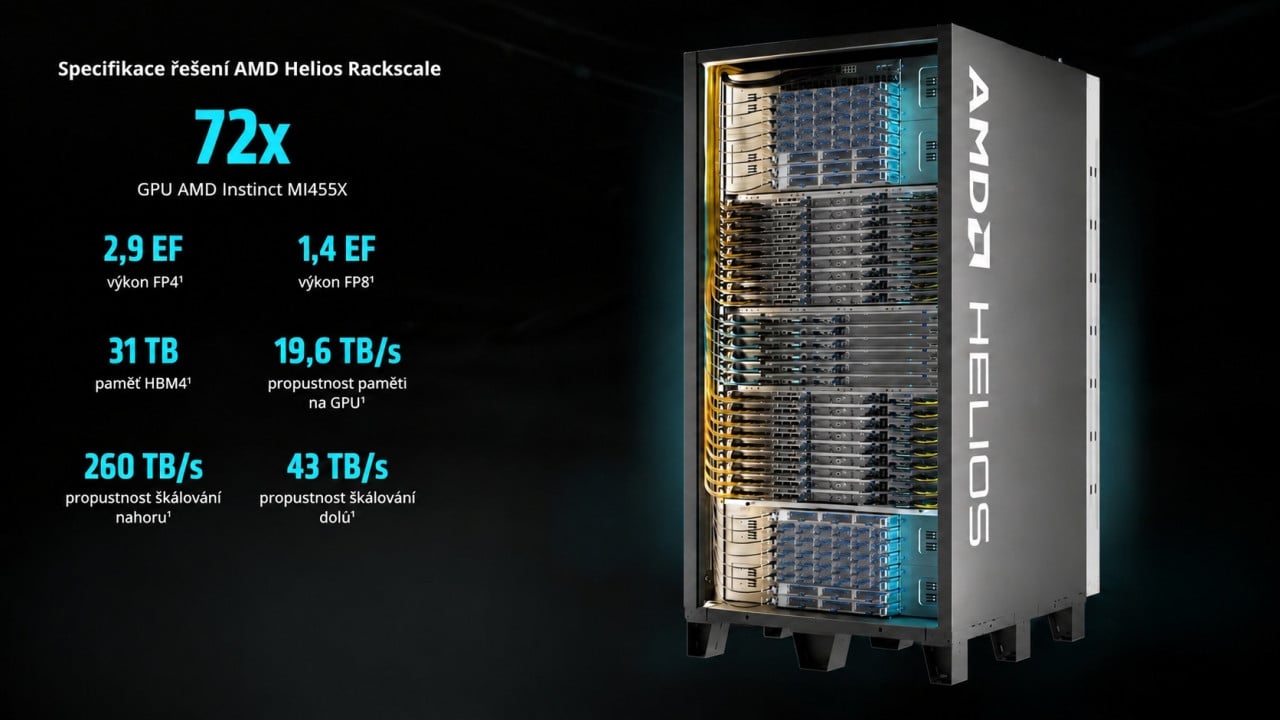
Helios is fully liquid-cooled and consists of eighteen compute trays and six switches. Each tray houses four Instinct MI455X GPUs and one EPYC Venice processor. Altogether, the rack contains 72 GPUs, each beneath a copper cooling plate.
Helios can deliver 2.9 exaflops in FP4 format and 1.4 exaflops in FP8 format. It carries 31 TB of HBM4 memory and offers bandwidth of 19.6 TB/s per GPU. Internal connectivity between the GPUs reaches 260 TB/s, while connectivity outside the rack reaches 43 TB/s.
Helios contains MI455X GPUs based on the CDNA 5 architecture. Each delivers 40 petaflops in FP4 format and 20 petaflops in FP8, twice as much as the previous MI350 series. Each GPU also received 432 GB of HBM4 memory, half as much again as the previous 288 GB, while bandwidth jumped from 8 TB/s to the aforementioned 19.6 TB/s.
Another component is the EPYC Venice processors, AMD's first products based on Zen 6 cores and manufactured using TSMC's two-nanometer process. Each processor will offer up to 256 cores. AMD promises more than 70 percent better performance and efficiency compared with the previous generation. Powerful processors are becoming increasingly important for agentic AI because such workloads require not only GPUs but also high-performance conventional computing.
Then there is the Pensando networking component. The Vulcano network card handles 800 gigabits per second and, according to AMD, is the only one to offer up to 2.4 terabits of bandwidth per GPU. It is complemented by the Salina chip, which offloads networking, security, and storage tasks from the processors. The entire software stack is held together by the ROCm platform, AMD's open answer to Nvidia's proprietary CUDA, with direct support for tools such as PyTorch, TensorFlow, JAX, vLLM, and Triton.
As if that were not enough, the entire rack weighs more than two metric tons and consumes between 225 and 245 kilowatts. According to estimates reported by CNBC, one Helios will cost between $5 million and $5.5 million.
How Helios compares with Nvidia
Competing with Nvidia is the entire point of Helios. Its direct rival is the Vera Rubin NVL72 rack. Both have 72 GPUs, but AMD is betting on memory. While Helios offers 31 TB of HBM4 memory, the competing system has 20.7 TB. More memory helps with large models and longer context windows, which AMD highlights as its main advantage. Helios is also stronger in connectivity outside the rack, offering 43 TB/s compared with Nvidia's 28.8 TB/s, roughly half as much again.
Nvidia, on the other hand, leads in raw low-precision computing performance. Vera Rubin claims 3.6 exaflops in NVFP4 format for inference, compared with 2.9 exaflops for Helios. The contest therefore has no clear winner and depends heavily on what the rack is specifically used for.
Helios is more expensive. According to CNBC, Nvidia Vera Rubin costs around $3.5 million to $4 million, at least a million dollars less. AMD therefore does not sell the system on its price tag, but on the so-called cost per completed task, meaning how much it costs the customer for a model to perform a computation. AMD data center chief Forrest Norrod told CNBC that the company is focused on achieving the lowest possible cost per token and the best total cost of ownership.
Nvidia has no intention of backing down. It has already shown its next rack, code-named Kyber, which will double the number of GPUs from 72 to 144. Meanwhile, the gap remains enormous. According to estimates from the Futurum Group, Nvidia controls more than 95 percent of the data center GPU market, while AMD holds around 4.5 percent.
Who will deploy Helios and what investors expect
Microsoft announced that it will deploy Helios in its Azure data centers, where it will run inference workloads for Microsoft itself and its customers. The agreement also includes new Azure virtual machines based on EPYC processors. Microsoft's return to AMD GPUs carries weight because it was the first company to deploy the older MI300X chip at scale in 2023.
In addition to Microsoft, Meta, OpenAI, Oracle, and India's Tata Consultancy Services have signed on. Meta plans to gradually deploy up to 6 gigawatts of AMD GPUs, with the first gigawatt running on Helios later this year. Oracle is building a supercomputer with 50,000 GPUs. Volume shipments are expected to ramp up in the second half of 2026.
The market has reacted enthusiastically to the announcement. AMD shares have risen by roughly 144 percent this year, making the company one of the best-performing technology stocks. AMD's data center division increased revenue from $6.5 billion in 2023 to $16.6 billion in 2025. For the first quarter of this year, it reported $5.78 billion in revenue from this part of the business, 57 percent more than a year earlier. Futurum Group analyst Daniel Newman believes AMD has a realistic chance of capturing 20 to 25 percent of the market, which would mean hundreds of billions of dollars in revenue.
AMD itself expects to begin earning tens of billions of dollars annually from data center AI starting in 2027, with Helios set to be the main driver. The company will reveal more at its Advancing AI event, which takes place on July 22 and 23. Jefferies analysts speculate that Anthropic could be announced there as another major customer.
Sources: wccftech.com and amd.com