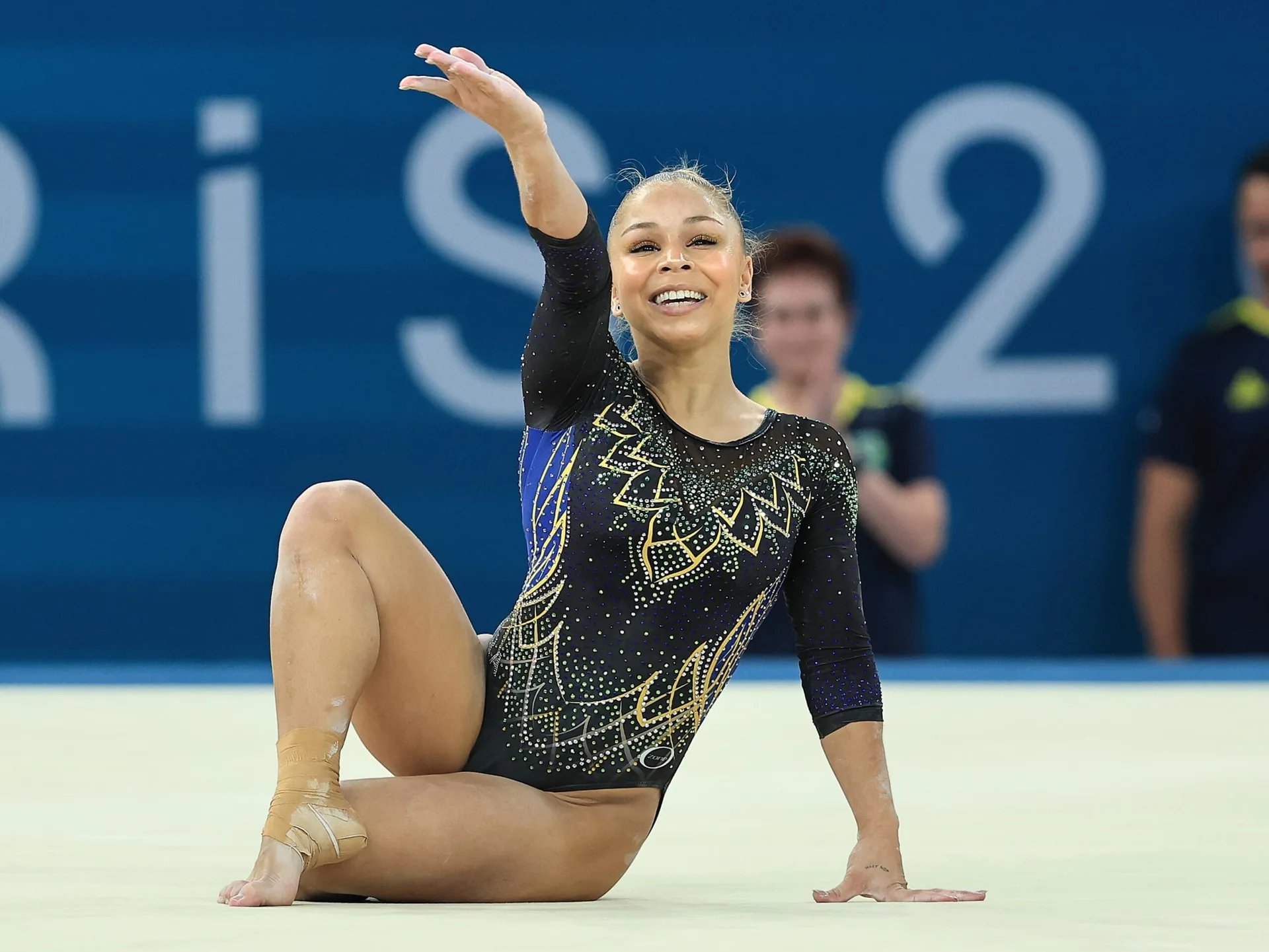
Gymnastics has always relied on performances being judged by experienced people seated at a table beside the apparatus. But that could soon change. The International Gymnastics Federation (FIG) is in advanced talks about using artificial intelligence to assist judges at the 2028 Olympic Games in Los Angeles. Its president, Morinari Watanabe, has other goals as well. He hopes to one day see competitions where scores are awarded not by humans, but by computers.
“Our dream is to have no judges, only computers and artificial intelligence awarding scores,” Watanabe told the American website The Athletic. “We must be fair to everyone. I don't want mistakes or bad decisions.”
Cameras at competitions
The World Artistic Gymnastics Championships in Rotterdam, the Netherlands, served as a dress rehearsal. For the first time, judges there had access to the JSS system developed by the Japanese technology company Fujitsu for all ten events. Cameras capture the entire routine, and the software uses the footage to create a three-dimensional model of the gymnast's movements. It can identify individual elements, measure joint angles, and explain how the difficulty score was calculated. The entire analysis takes ten to fifteen seconds.
Four cameras are sufficient for most apparatus, while the floor exercise requires eight because the gymnasts move across a much larger area. A demonstration routine by American gymnast Skye Blakely showed how it works in practice. Alongside the recording of her performance was a three-dimensional model that could be paused, rotated, and viewed from any angle at any time.
For now, it is only an assistant. The official score is still awarded by people, while the system serves as a reference they can consult when reviewing disputed elements. Watanabe, who is 67 and also sits on the International Olympic Committee and the commission preparing the Los Angeles Games, had already tried to introduce similar technology for the Olympics in Tokyo and Paris.
Why the federation is turning to AI
Watanabe's efforts are primarily driven by a series of scandals that have plagued gymnastics for years. At the 2004 Athens Olympics, South Korean Yang Tae-young was given an incorrect starting value for his parallel bars routine. The error affected the all-around medal standings, and debate over it continued long after the Games had ended.
Twenty years later, a dispute erupted in Paris over American Jordan Chiles. The issue was whether her coaches had submitted an inquiry into her floor exercise score in time. The case ended in a lengthy legal battle over the bronze medal. According to Watanabe, such controversies have left a deep wound in the sport as a whole, and precise, consistent computer scoring is a way to prevent them.
The federation president also talks about spectators. “Gymnastics is a beautiful sport. But when spectators see a score, they don't always understand how the judges arrived at it. And that is a major problem,” he said. According to him, a three-dimensional reconstruction of the routine could show during a live broadcast why one performance received more points than another. This could make broadcasts more engaging and competitions shorter.
The system has other advantages as well. It measures consistently, which would reduce differences between individual judging panels. Watanabe hopes that, over time, it will also help coaches identify their athletes' weaknesses and provide gymnasts with better training guidance regardless of where they live or how much money they have.
Where artificial intelligence can fail
Greater precision does not automatically mean better judging, however. Willem Standaert, an associate professor at the University of Liège in Belgium and co-author of a study on AI-assisted gymnastics judging, warns that algorithms may create new problems while addressing old ones. A judge might consider a leg straight, for example, while a computer measures it at 179 degrees. According to him, such precision may not reflect how people actually perceive a performance.
Problems may also arise with elements the system does not recognize because they were not included in its training. Standaert points to another issue as well. If machines were to replace judges completely, it would weaken the process through which experienced judges train their successors. Austrian judge Johanna Gratt, who participated in the Rotterdam test, agrees that the system can help with difficult decisions. However, she says it still needs refinement and must occasionally be corrected by a person.
Questions also remain about its accuracy. A recent comparison with laboratory motion capture showed that Fujitsu's system measured the maximum split angle of nine collegiate gymnasts performing split leaps an average of 1.1 degrees higher. The company says its calculations comply with current gymnastics rules and that the data used to train the system includes athletes with different body types, skin colors, and leotards. Nevertheless, researchers warn that the algorithm may evaluate bodies differently if they differ from those represented in its training data.
The artistic side of the sport remains another challenge. In addition to technique, women's floor exercise rewards choreography, musical interpretation, and expression. A computer can easily detect a bent knee, but it has far greater difficulty judging whether a routine truly moved the audience.
Watanabe is aware that his plan will not be welcomed enthusiastically by judges. He joked that if he eliminated them, they would probably kill him. He also acknowledged that people will still be needed in the future to set the rules and handle exceptional situations that machines cannot manage.
Sources: nytimes.com and essentiallysports.com