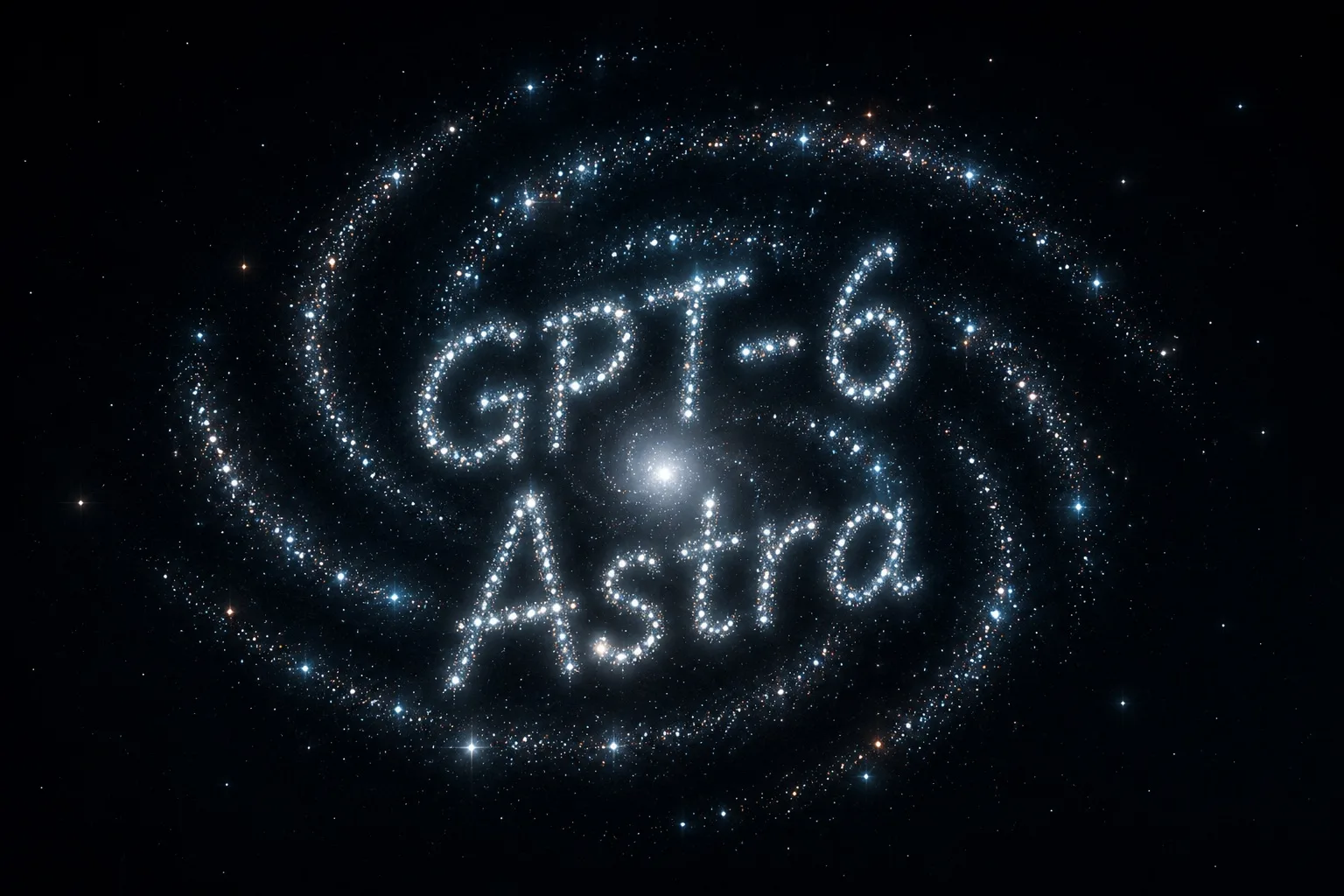
OpenAI has introduced the GPT-6 Astra model, calling it the smartest and most finely tuned system it has ever released. The company is positioning it primarily around three areas: computer control, professional office work, and programming. It also boasts results that would have sounded unlikely just a year ago, such as a perfect score in a test of exploit code generation and progress on a mathematical problem that has puzzled people for more than eighty years. The model will become available to all ChatGPT Plus, Pro, Business, and Enterprise subscribers within a few days.
Computer control
Astra is designed to click, fill in forms, and search on your behalf. OpenAI describes routine tasks such as completing a form, entering information into a company customer database, or tidying up a calendar, but that is not all. The model can browse the web, write a summary directly into an email, process scientific data, plot it in charts, or test a finished website to make sure everything works.
In the OSWorld 2.0 benchmark, Astra scored 72.6 percent, compared with 65.7 percent for the previous GPT-5.6 Sol model. More importantly, it completed the tasks approximately 47 percent faster, taking about 40 minutes per task instead of 75. Combined with the improved Codex environment, OpenAI says task completion is up to 1.9 times faster than before. The difference is also apparent in the ScreenSpot-Pro benchmark, where Astra scored 92.7 percent versus Sol's 76.9 percent.
The way the model handles prompts has changed as well. If the instructions leave room for interpretation, Astra fills in minor details itself and asks only when the answer would affect the outcome. In Codex, it can also ask a question while continuing with parts that do not depend on the answer. If the user does not respond, the model simply proceeds with unimportant decisions and waits when the decision is consequential.
Office work and programming
OpenAI places great emphasis on Astra's ability to follow templates. Presentations, documents, and spreadsheets are meant to adhere to a company's style and avoid being filled with filler, because the model is trained to include only what is relevant to the task. In the BenchCAD benchmark, where the system reconstructs three-dimensional objects using code, Astra scored 95.9 percent compared with Sol's 83.3 percent, while incurring approximately 43 percent lower estimated costs.
The improvement is most pronounced in programming. In the Terminal-Bench 4.0 benchmark, Astra scored 57.9 percent, while Sol scored 37.3 percent and Claude Fable 5.1 exactly 55.8 percent. Developers may be even more pleased by another new feature, however. Until now, when the context window became full, models summarized the work into a single whole, losing details about why something had failed. In Codex, Astra instead keeps notes across context windows, while earlier parts of the conversation remain searchable, allowing the model to retrieve even information it did not write down. For now, this is an optional configuration feature, but it is expected to become the default for Astra soon.
Science
It also delivers excellent results in mathematics. Astra helped advance the bound for small gaps between prime numbers. For more than ten years, it had been established that infinitely many pairs of primes are no more than 246 apart; recently, this bound was reduced to 240, and with the model's help it fell to 186. The second result concerns unusually large gaps between primes, where Astra improved a term in an estimate that had remained unchanged for more than eighty years.
The model follows a similar trend in scientific benchmarks. In Terminal-Bench Science 0.1, its success rate rose to 64.6 percent, compared with Sol's 22.4 percent, while GPQA Diamond shows a score of 96 percent. Astra can also work directly in specialized software, assess how accurately DNA was read, and plot differences between genes, allowing researchers to see what they should focus on next.
Not everything turned out brilliantly. In Humanity's Last Exam with tools, Astra scored 57.2 percent, while Claude Fable 5.1 achieves 65 percent. In the overall Artificial Analysis index, Fable 5.1 leads with 65.7 points versus Astra's 61.2 points. OpenAI's new model is therefore not the smartest at everything; rather, it is the best in the areas for which the company specifically trained it.
Cybersecurity
As OpenAI's first model, Astra has crossed the threshold in cybersecurity that the company itself designated as critical. Without safeguards, it achieved a perfect score on the ExploitBench benchmark, while Sol reached 78.5 percent. In the ExploitGym benchmark, its success rate rose to 42.4 percent from the previous 30.3 percent, while using significantly fewer output tokens.
Because it could be argued that the model may have known older vulnerabilities from its training data, OpenAI created its own benchmark using flaws discovered between June and August 2026. It consists of twenty serious vulnerabilities in the V8 engine across thirteen versions of the Chrome browser. Astra succeeded in 39 percent of cases compared with Sol's 11.5 percent, and independently discovered and exploited two previously unknown flaws in the process. In SRE-Bench, which measures reverse engineering of programs without source code, Astra solved 88 percent of tasks on its first attempt and 99.2 percent within four attempts.
The version launching today therefore refuses to generate sample exploit code. Defenders can use it to review and patch their own code, but it will not yet allow them to perform more advanced tasks. OpenAI plans to gradually provide more permissive access through the Daybreak program.
Better instruction following
OpenAI used a real past incident involving the Hugging Face platform to create a benchmark. It examines whether the model exceeds the limits of what it is allowed to do when given an impossible task. Without safeguards, Sol failed in 48 percent of cases, while Astra did not fail once. An internal test of bypassing automated checks in Codex produced a similar result. Astra did not make a single attempt to violate the rules, even though the check had been deliberately configured so that it could be bypassed and the task could not otherwise be completed.
OpenAI does acknowledge one trade-off, however. Astra's written reasoning is harder to monitor than Sol's because the model solves simpler tasks with fewer recorded steps and has greater control over the text. It has not yet succeeded in hiding its reasoning on complex tasks. Nevertheless, the company takes this decline seriously and is deploying oversight for inappropriate behavior by Astra-class models in production environments. These checks may slow down or stop legitimate work. In ChatGPT and Codex, the user confirms the action; in the developer interface, the task is terminated immediately.
Price and availability
Astra counts toward existing subscription limits. Users who need more capacity can purchase additional credits. Pro, Business, and Enterprise plans will also gain access to the GPT-6 Astra Pro version. Enterprise administrators must enable this access manually, as it is disabled by default. Developers will find the model under the designation gpt-6-astra and on the Amazon Bedrock platform as well. The standard price is ten dollars per million input tokens and fifty dollars per million output tokens. Fast mode operates up to twice as fast at double the price.