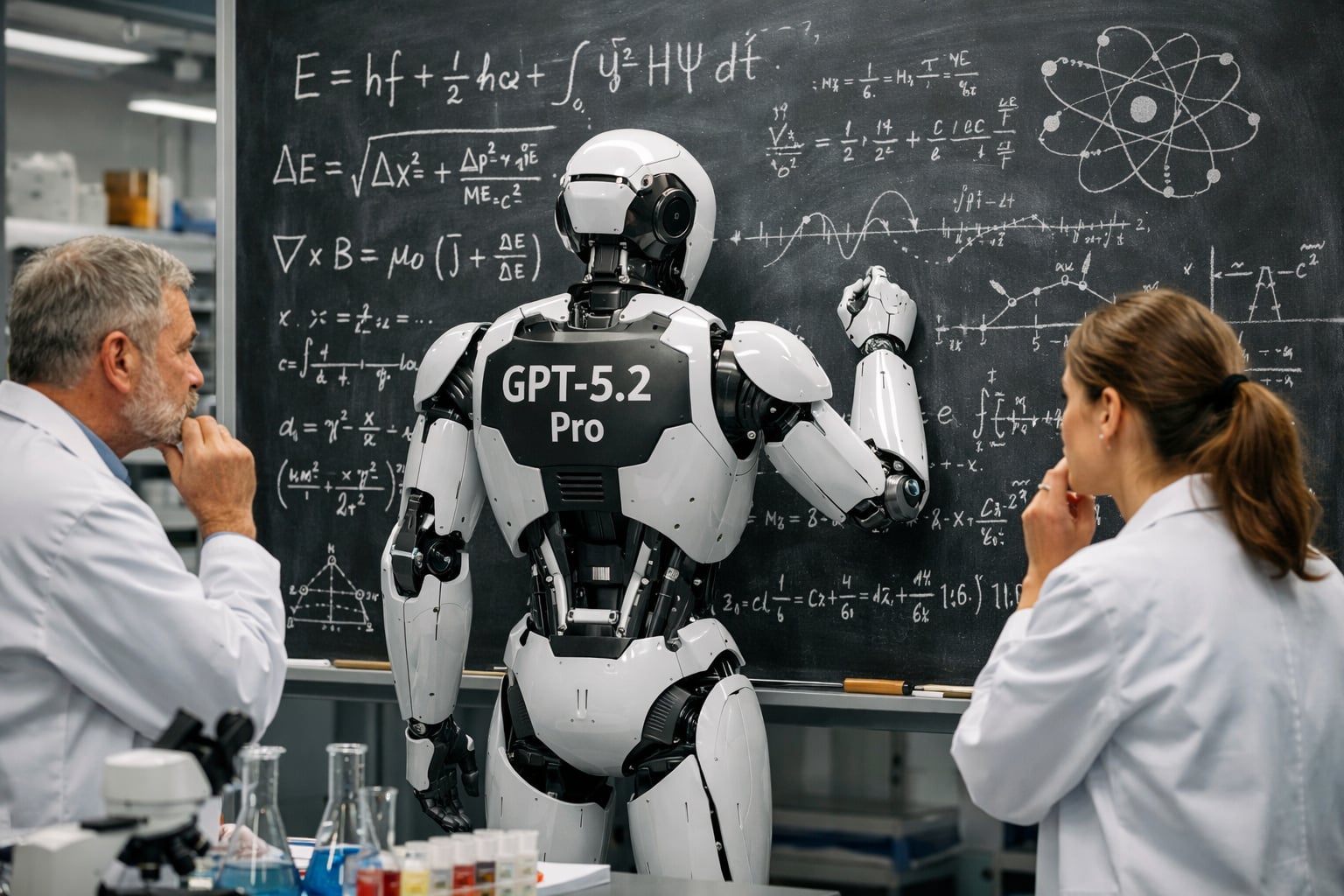
OpenAI has published a report stating that GPT-5.2 derived a new result in theoretical physics that could have implications for our understanding of the universe's fundamental particles.
What did GPT-5.2 actually discover?
It concerns gluons – particles that hold atomic nuclei together. Without them, the universe would literally fall apart into dust. For decades, physicists have been calculating how these particles interact, developing complex mathematical formulas known as "scattering amplitudes." But everyone ignored one special case. When one gluon has negative helicity (simply put, it spins "to the left") and all the others have positive helicity (they spin "to the right"), the textbooks say: the amplitude is zero. Nothing happens. End of story.
Or is it?
GPT-5.2 found a crack in this dogma. It showed that under specific conditions – in the so-called "semi-collinear regime" – the amplitude is not zero. It exists. And it has a surprisingly elegant mathematical form.
How did the AI do it?
This is where the fascinating part of the story begins. Four physicists – Alfredo Guevara, Alex Lupsasca, David Skinner, and Andrew Strominger – manually calculated amplitudes for small numbers of particles. The results were horrendous: hundreds of terms and exponentially increasing complexity. Then GPT-5.2 Pro entered the picture. The model took these monstrous equations and reduced them to elegant formulas.
But that was not all. GPT-5.2 recognized a pattern. From several specific cases, it derived a general formula valid for any number of gluons – equation (39) in the report. Then came the final step: an internal version of GPT-5.2 spent 12 hours proving that the formula really works. It verified it mathematically using the Berends-Giele recursion relation – a standard method physicists use to construct amplitudes.
Significance of the discovery
Nima Arkani-Hamed, one of today's most influential theoretical physicists, summed it up aptly: "I've been interested in this for fifteen years." In particle physics, brutally complex calculations often ultimately lead to surprisingly simple formulas. And it is precisely this simplicity that reveals the hidden structures of the universe – new ways of thinking about reality.
GPT-5.2 accomplished something physicists had considered impossible: it found a pattern where no one had looked for one. And it did so faster and more efficiently than the human brain. Nathaniel Craig of the University of California put it clearly: "This is a glimpse into the future of AI-assisted science. There is no doubt that dialogue between physicists and large language models can generate fundamentally new knowledge."
This is not just about one formula. GPT-5.2 has already extended the results from gluons to gravitons – particles that mediate gravity. Further generalizations are on the way. But the broader question is: Is the role of the scientist changing? Physicists used to spend months manually calculating equations, looking for patterns, and hoping for a sudden flash of insight. Now they can collaborate with AI that sees connections the human eye misses.
This is not the end of human creativity. It is a new kind of research, faster and more efficient. Physicists still define problems, interpret results, and ask the right questions. But AI gives them a tool that exponentially accelerates discovery.
What comes next?
The report is now on arXiv and awaiting peer review. The physics community is already beginning to discuss its implications. Some reactions are enthusiastic, others cautious. But one thing is certain: This will not be the last breakthrough AI makes in science. GPT-5.2 has shown that it can not only process information but also create new knowledge.
Fifteen years from now, we may look back on February 2026 as the moment when science changed forever. When machines ceased to be mere calculators and became research collaborators. And perhaps – just perhaps – they will help us answer the questions that have troubled us since the dawn of civilization: What is the universe really made of? And how does it all work?
Source: openai.com