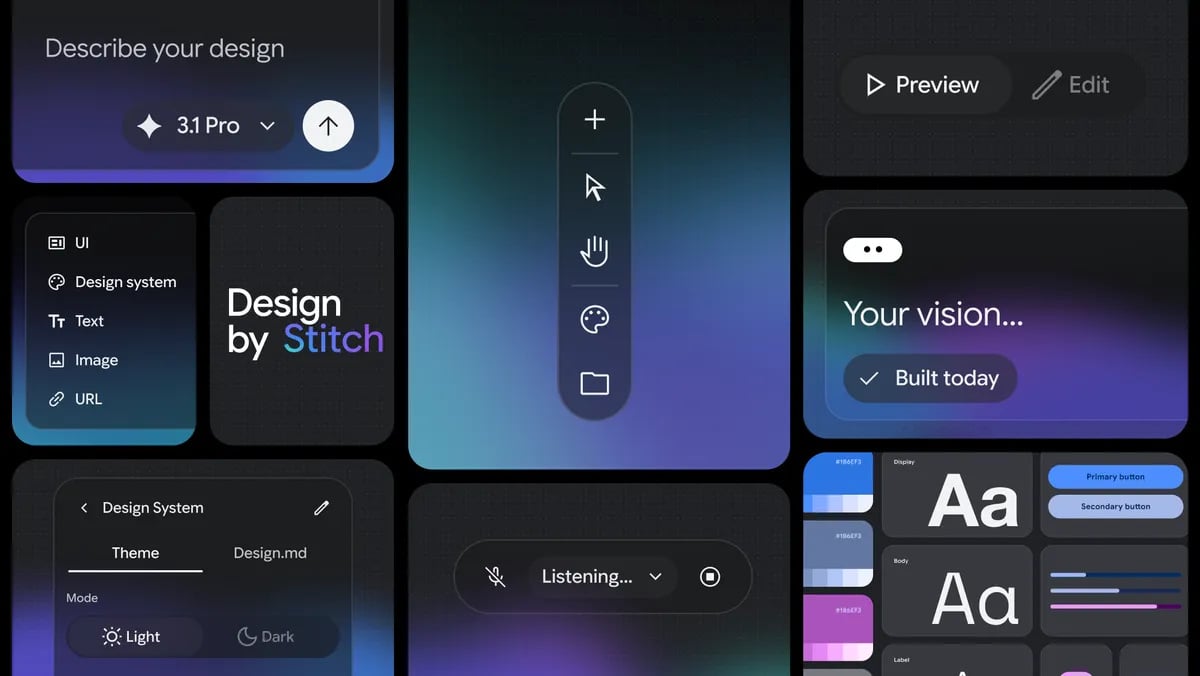
Google Labs has released an update to its Stitch tool, introducing a new term to the world of digital design: "vibe design". It sounds a bit like a buzzword, but the term reflects a genuinely interesting shift in how we think about creating user interfaces.
Stitch previously existed as an experimental AI tool from Google Labs. Now, however, it has been completely redesigned and has become what its creators describe as an AI-native design canvas. Rustin Banks, a product manager at Google Labs, summed it up simply: instead of starting with a rough sketch, you start with what you actually want to achieve.
What is "vibe design"
Think of it this way. Until now, you would open Figma, for example, start drawing grids and arranging components, and only after hours of work would you get to the question: "How should this actually feel to the user?" Stitch reverses this process.
You type or say something like: "Design a login page for a meditation app that feels calm and minimalist, inspired by Apple Health and Headspace." And the AI instantly generates several fully realized user interface designs—not sketches, not rough drafts, but actual screens.
This is the essence of vibe design. You start with the intention, the feeling, the goal. The structure comes afterward. And honestly, for anyone who has ever spent three hours on a sketch only for the team to say "this isn't it" at the first meeting, that sounds like a relief.
Infinite interface and a design agent with memory
The biggest technical innovation is the new infinite canvas/interface. No panels, no layers, no component tree. Instead, there is an open space where you can drop anything: a text description, a screenshot of an app you like, a piece of code, or a competitor's interface for reference. The AI processes all of it at once as context.
Along with the canvas comes a new design agent that remembers the entire project. Most AI tools answer one question and then forget. Stitch works differently. The agent knows your design system, existing screens, and the constraints you have set. It suggests improvements, generates variations that match the project's visual language, and even critiques the layout in relation to the original intent.
Google has also added an Agent Manager, which works similarly to branching in code management systems. You can develop multiple creative directions in parallel without losing the original concept.
DESIGN.md
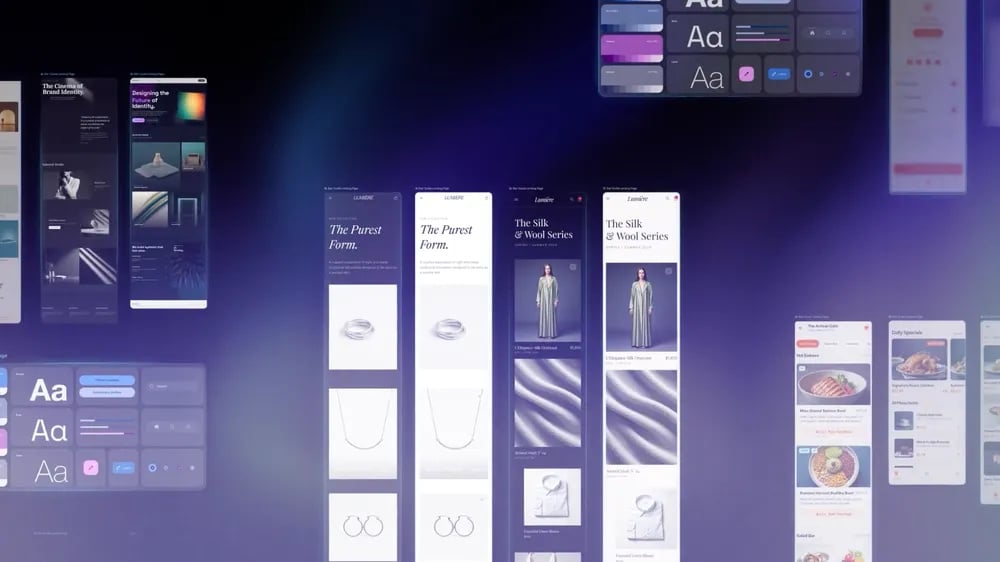
Here is something that will please anyone who has ever had to rebuild the same design tokens over and over in every new tool. Stitch can extract a design system from any web address—including colors, typography, spacing, and components—and save it in a file called DESIGN.md. This file can then move between projects, between design and development, and into a new Stitch canvas, where the AI immediately understands and applies it. A day spent setting up a design system from scratch? Gone.
Prototypes, voice, and integration with developer tools
Stitch converts static designs into clickable prototypes in a single step. You connect the screens, press Play, and walk through the entire user journey. But what happens next is even more interesting: when a user clicks a button, Stitch suggests what the next screen should look like based on the context of the entire product.
Then there is voice control. You say "give me three menu variations," and three appear. You say "darker palette," and the canvas updates in real time. The first time it works, it is a little disorienting. The line between directing a design and having a conversation begins to blur.
And for developers: Stitch has an MCP server and SDK, allowing it to connect with tools such as Gemini CLI, Claude Code, or Cursor. This means design and code can go hand in hand from the very beginning.
Making things easier for designers and startup founders
The role that is changing is not "designer." What is changing is the role of "the person who spends hours on a rough sketch before the team agrees on a direction." AI is taking over that part of the work, and most designers certainly will not miss it. What remains, on the other hand, is harder to describe but easy to recognize: the judgment to choose the right direction, the taste to recognize when something is not working, and the experience to see what will break at scale. These abilities are becoming more valuable, not less, precisely because anyone can now generate a screen in thirty seconds.
Stitch is aimed both at professional designers who want to explore dozens of variations and at startup founders who are still shaping their first idea. The distance from an idea to a working prototype is getting shorter and shorter.