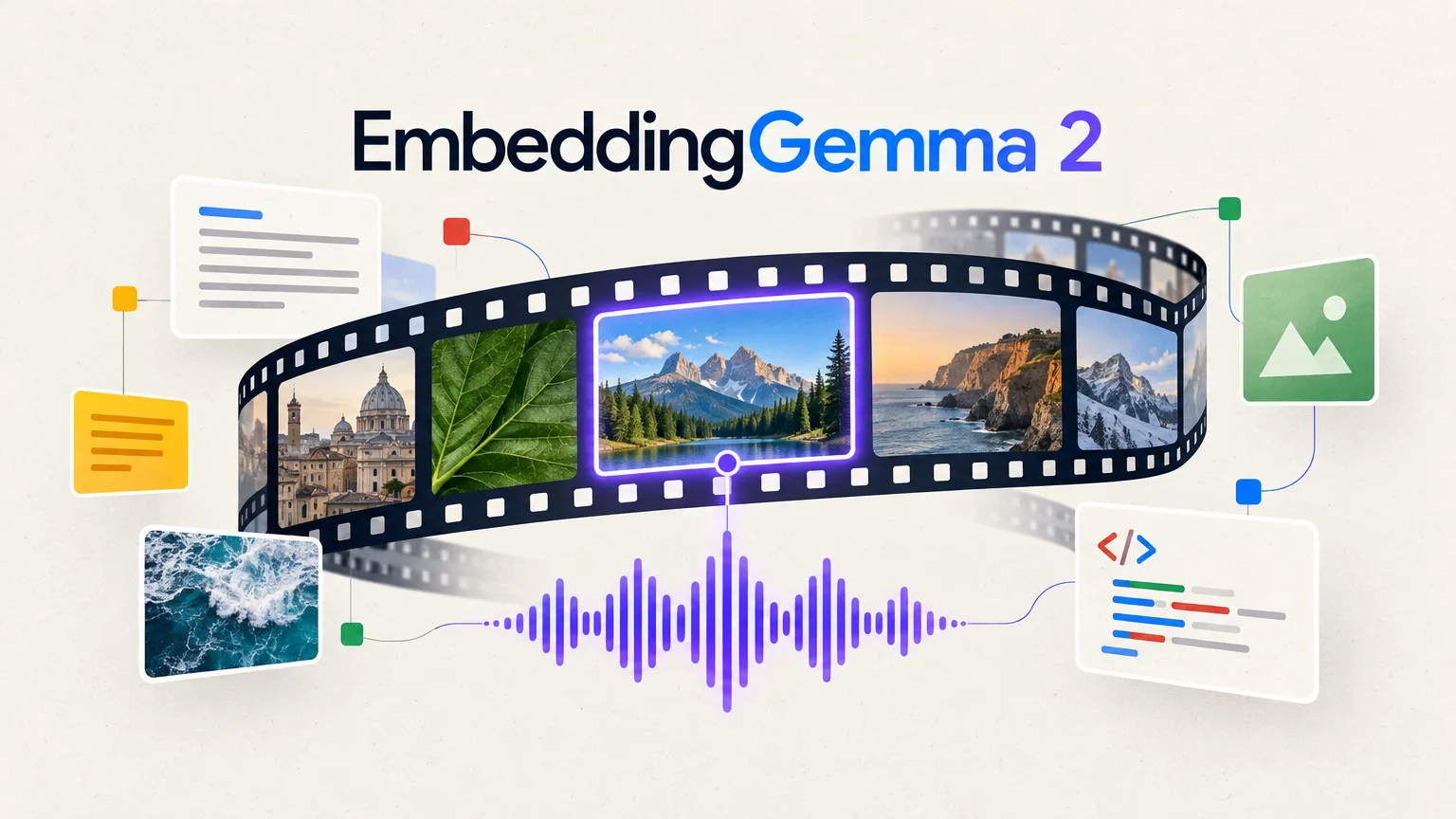
Google released EmbeddingGemma 2 on October 6, 2026, extending its embedding model beyond text to connect code, images, video and audio. It maps these content types into a shared vector space, allowing a voice memo to find a video clip or a text query to search audio recordings.
Searching media and finding moments in video
The main change is the ability to search across different types of content directly on a device. Google says generating embeddings locally enables this search to work entirely offline, helps protect data privacy and reduces processing latency.
Two versions of this search are available to try in Google AI Edge Gallery. Instant Media Search takes text or an image and finds items in a media library based on semantic similarity. Video Moments Finder focuses on specific moments within a video, using text or audio queries.
A modular model with smaller output vectors
EmbeddingGemma 2 uses the Gemma 4 architecture and has 740 million parameters in its full configuration. Google released it under the Apache 2.0 license, which permits commercial use. The company says its modular design requires only 270 million parameters for text-only workloads, with an optional vision encoder adding 170 million and an audio encoder adding another 300 million.
Google says developers can also adjust the size of the output vectors. Matryoshka Representation Learning allows the original 768 dimensions to be shortened to 512, 256 or 128. The company reports that this can reduce storage and memory requirements for local vector databases by up to sixfold.
Google’s memory figures apply to a quantized model running on a Google Pixel 11 Pro. According to the company, the text-only weights require approximately 191 MB of active RAM, while the full multimodal model requires approximately 567 MB.
Google says the context window reaches 8K tokens, four times the size of EmbeddingGemma 1’s. On local hardware, the model can process up to 5.5 minutes of audio, 29 images or 58 video frames. It also supports inputs that interleave different content types.
A higher score on code tasks
Google reports that the new model matches its predecessor’s multilingual text performance while improving on the MTEB Code benchmark: the original EmbeddingGemma scored 68.76, compared with 78.68 for EmbeddingGemma 2, a reported gain of 9.92 points.
Google links the improvement to local source-code indexing and semantic code search. Another use the company identifies is retrieving material for coding agents to work with.
Working with Gemma 4 and multimodal decision-making
According to Google, EmbeddingGemma 2 can be paired with the generative Gemma 4 model for on-device multimodal RAG. In this setup, the embedding model retrieves material for the generative component. The two models share a text tokenizer and audio encoder, which the company says reduces their combined memory footprint when deployed together.
The Google AI Edge Foresight app offers this combination to try. EmbeddingGemma 2 handles local file retrieval, while Gemma 4 provides contextual reasoning.
Beyond search, Google describes using the MediaPipe Decision Task API to build real-time decision-making systems. In this application, multimodal context is intended to support classification, routing and predictive functions.
Where to download the model and how to deploy it
EmbeddingGemma 2’s weights are available on Hugging Face and Kaggle. Versions optimized for on-device use are available through LiteRT Community on Hugging Face. Google plans to make the model available in Gemini Enterprise Agent Platform Model Garden.
Google offers two routes for application integration: MediaPipe provides ready-made tasks for embeddings, retrieval and decision-making, while LiteRT supports custom model integration. For browser deployment, the company lists transformers.js or WebGPU.
Supported tools for running the model include transformers and sentence-transformers, alongside MLX, vLLM and llama.cpp. Other options include SGLang, Ollama and LMStudio. Google points to Qdrant for storing embedding vectors and directs developers who want to fine-tune the model for their own uses to guidance from Unsloth.