

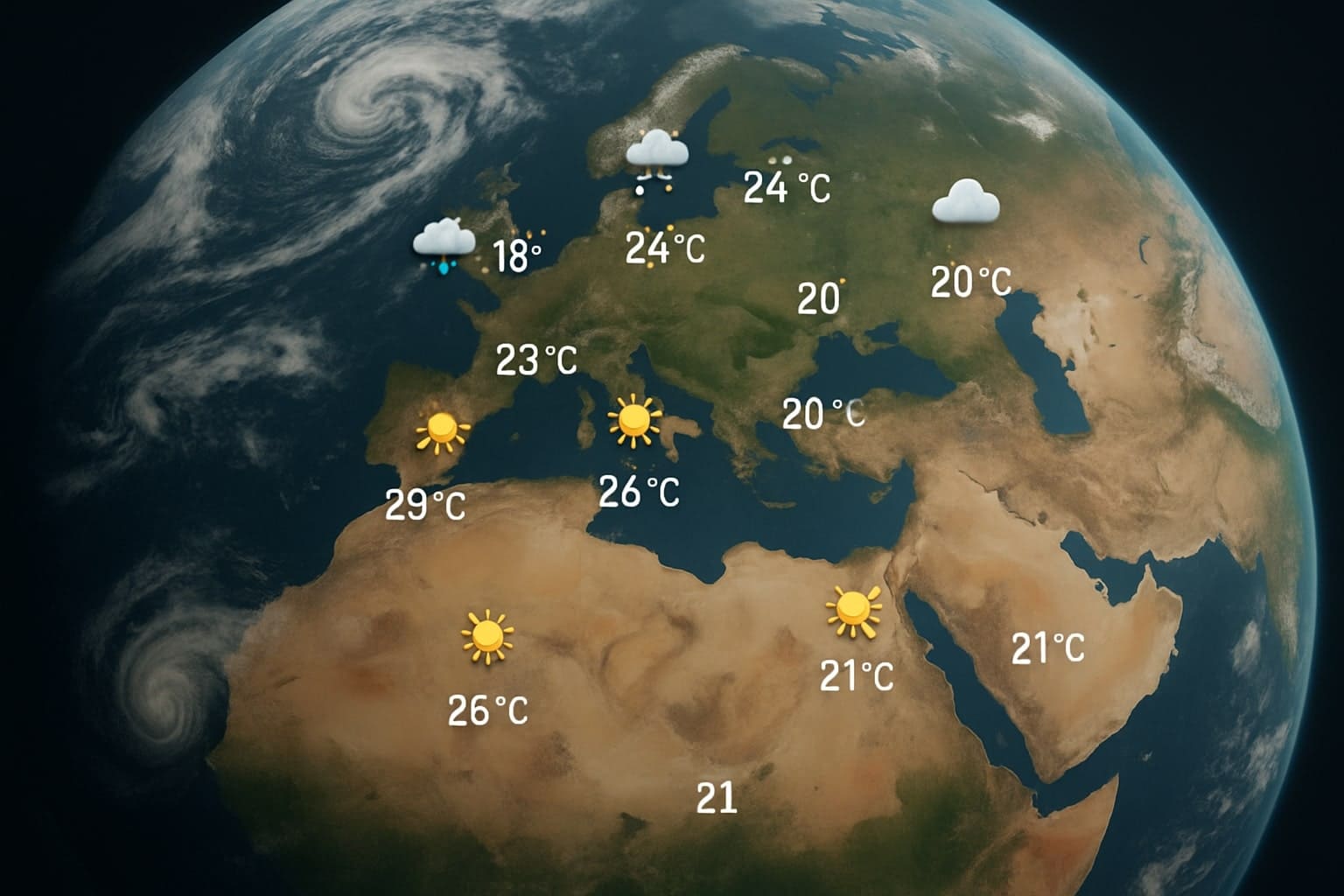
Google DeepMind and Google Research have introduced WeatherNext 2, their most advanced and efficient weather forecasting model. This model can generate forecasts eight times faster than before and at a resolution of up to one hour. This means you can receive detailed weather information for the entire world, helping with flight planning or your daily commute. The model is powered by artificial intelligence (AI) and can generate hundreds of possible weather scenarios from a single input in less than a minute on a single TPU (Tensor Processing Unit).
This advancement is based on a new approach that uses independently trained neural networks and adds noise directly to the functional space to create different yet realistic forecast variants. For example, the model takes a single input and produces a whole range of possibilities, including worst-case scenarios that are crucial for planning. Unlike traditional physics-based models, which would take hours on a supercomputer, WeatherNext 2 handles everything quickly and efficiently.
How Does the Model Predict Scenarios?
WeatherNext 2 focuses on predicting hundreds of possible weather outcomes from a single starting point. Each such forecast takes less than a minute on a single TPU. The model is highly capable and can provide high-resolution forecasts at hourly intervals. It outperforms the previous WeatherNext model on 99.9% of variables, such as temperature, wind, and humidity, across forecast horizons from 0 to 15 days.
This performance is enabled by a new approach called the Functional Generative Network (FGN), which adds noise directly to the model architecture so that forecasts remain physically realistic and coherent. The model is trained on individual weather elements, such as the exact temperature at a specific location, wind speed at a certain altitude, or humidity level. From these, it can then predict complex systems, such as an area affected by high temperatures or the expected output of a wind farm.
Compared with the previous WeatherNext Gen model, WeatherNext 2 achieves better results in continuous ranked probability score (CRPS) across nearly all atmospheric variables, pressure levels, and forecast horizons. This means the forecasts are not only faster but also more useful for practical applications.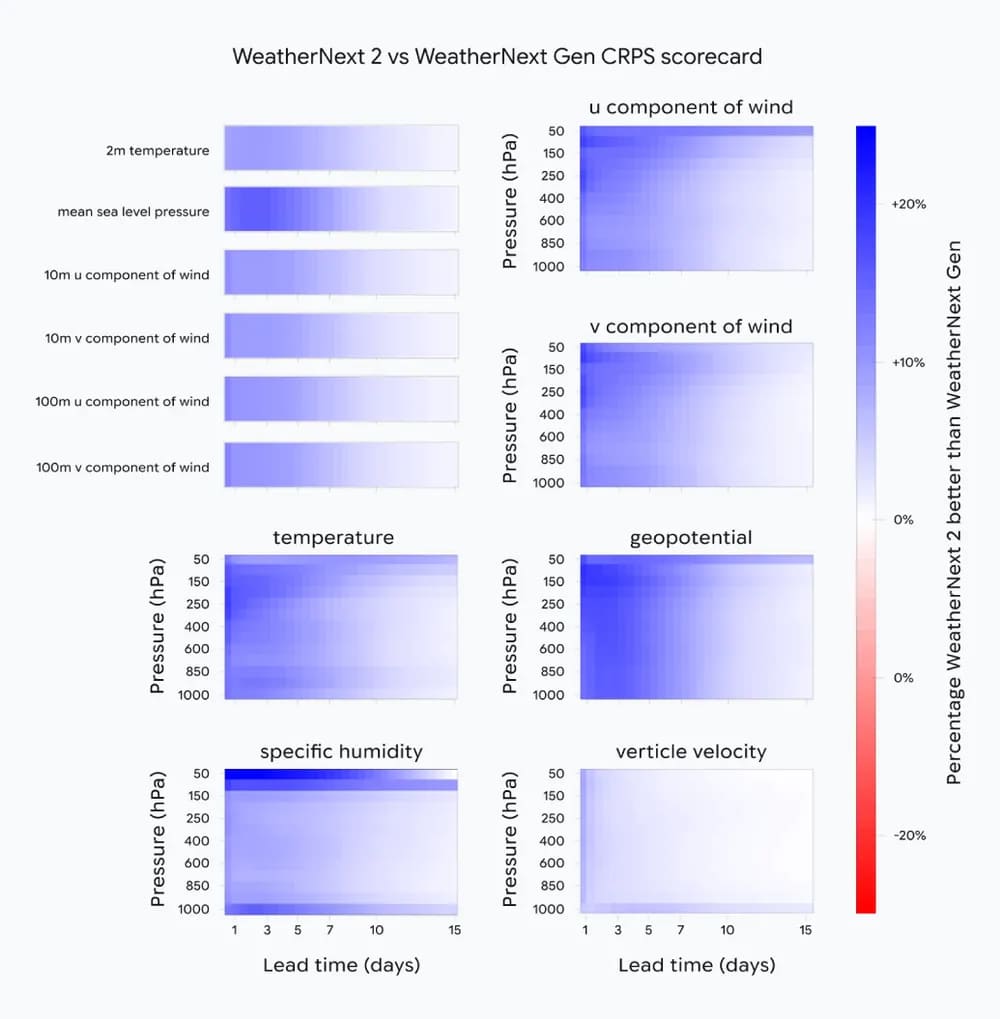
Applications of the New Model
WeatherNext 2 forecast data is now available in Earth Engine and BigQuery, allowing users to analyze it directly. Google has also launched an early access program on Vertex AI in Google Cloud for custom model inference. In this way, the research is moving from the laboratory into the real world and helping with applications such as supporting meteorological agencies in making decisions based on different scenarios, for example in experimental cyclone forecasting.
WeatherNext technology is now being integrated into products such as Search, Gemini, Pixel Weather, and the Weather API in Google Maps Platform. In the coming weeks, it will also power weather information in Google Maps. This means users will receive better forecasts directly in the apps they use every day.
Google is committed to advancing this technology further and making it available to the global community. Research is currently underway to integrate new data sources and expand access. The goal is to accelerate scientific discoveries and enable researchers, developers, and businesses to solve complex weather-related problems.
For more information, visit the WeatherNext developer documentation, the data catalog in Earth Engine, or apply for the early access program on Vertex AI. The model is also described in a research paper on arXiv.


