

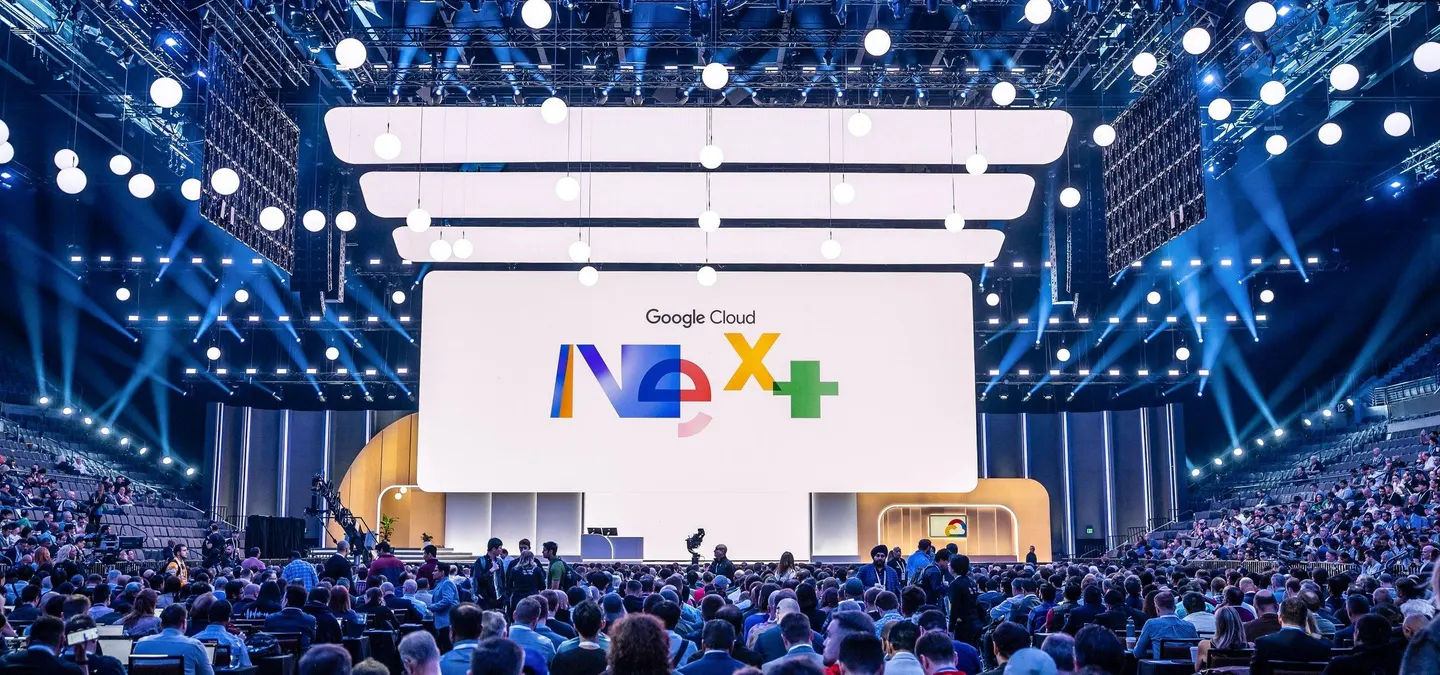
Google Cloud Next 2025: Sundar Pichai Reveals the Future of AI and Cloud Infrastructure
Google has once again surprised us with its innovations. Sundar Pichai, CEO of Google and Alphabet, presented several groundbreaking innovations that have the potential to fundamentally change the way companies use artificial intelligence. Let’s take a look at the most interesting things that were announced.
Ironwood: The 7th Generation of Google TPU Arrives
One of the biggest new developments is the introduction of a new AI chip called Ironwood. It is the seventh generation of Google TPU (Tensor Processing Unit), which Pichai described as “the most powerful chip we’ve ever built.” And the numbers are truly astounding. Compared with the first publicly available version of TPU, Ironwood delivers 3,600 times better performance! What impressed me even more is the focus on energy efficiency—during this period, Google became 29 times more energy-efficient, which is a crucial factor at a time of rising energy costs and environmental concerns. Ironwood is expected to come to market later this year and, in Pichai’s words, “will enable the next frontier of AI models.” I’m curious to see how this chip will affect companies’ ability to implement advanced AI solutions.
Cloud Wide Area Network: Google’s Global Network for Your Business
Another groundbreaking innovation is Cloud Wide Area Network (Cloud WAN)—a service that makes Google’s global private network available to businesses around the world. This is truly a big deal! Google is opening up its backbone network, which it uses for services such as Gmail, Photos, and Search, to external customers. Google’s network covers more than 200 countries and uses over two million miles of optical fiber. What does this mean for businesses? According to Pichai, Cloud WAN offers 40% faster performance while reducing total cost of ownership by up to 40%. Companies such as Nestlé and Citadel Securities are already using the service. If your company operates globally or needs extremely fast and reliable connectivity, this will definitely be a service you’ll want to try—it will be available to all Google Cloud customers later this month.
Research Breakthroughs: From Quantum Computers to Weather
Pichai also discussed Google’s research activities during his remarks. He mentioned, for example, the new quantum chip Willow, which solved a key problem in quantum error correction that had challenged researchers for three decades. The chip can reduce errors exponentially as more qubits are added, paving the way for a useful, large-scale quantum computer. Google is also continuing to apply AI to scientific problems—from the already well-known AlphaFold for predicting protein folding to WeatherNext, a state-of-the-art weather forecasting model. All of this is evidence that Google understands infrastructure as the foundation of the entire AI ecosystem—from hardware and models to end-user applications.
Gemini 2.5: AI That Actually “Thinks”
A few weeks ago, Google released the Gemini 2.5 model, which Pichai called “our most intelligent AI model—ever.” It is a “thinking model” that can work through its thoughts before responding. According to the Chatbot Arena leaderboard, it is currently the best model in the world. It excels particularly in advanced reasoning and achieved the highest score in history on the “Humanity’s Last Exam” test, one of the most demanding industry benchmarks focused on human knowledge and reasoning. Gemini 2.5 Pro is already available to everyone in Google AI Studio, Vertex AI, and the Gemini app. I had the opportunity to test this version, and I have to say that the difference compared with previous models is truly noticeable, especially for complex tasks requiring logical reasoning.
Gemini 2.5 Flash: Cost-Efficient Thinking
And now for what personally impressed me the most—Pichai announced Gemini 2.5 Flash, a low-latency and most cost-efficient version of the “thinking” model. What’s amazing about it is the ability to control how much the model “thinks,” thereby balancing performance and budget. For companies deploying AI at scale, this is an absolutely crucial feature. The ability to adjust the depth and complexity of the model’s reasoning according to a specific use case opens the door to much broader AI adoption. Gemini 2.5 Flash will soon be available in Google AI Studio, Vertex AI, and the Gemini app. Google promised to provide more details about the model’s performance soon. Personally, I’m very much looking forward to this version because it could represent a genuine breakthrough in the price-to-performance ratio for enterprise AI deployment.
Google Is Betting on AI at Scale
What impressed me most about the keynote was Pichai’s emphasis on scaling AI. He mentioned that all 15 of Google’s products with more than half a billion users—including seven with 2 billion users—now use Gemini models. This is AI deployment on an unprecedented scale. Pichai also emphasized how Google is making its AI available across various products and tools. He mentioned, for example, NotebookLM, which is used by 100,000 companies, and the Veo 2 video-generation model, which is used by leading film studios and advertising agencies.
Personal Impressions
After watching the keynote, I’m convinced that Google is continuing its long-term strategy of building a comprehensive AI ecosystem—from chips and network infrastructure to models and end products. Unlike some of its competitors, Google has the advantage of controlling the entire stack. What impressed me most was the democratization of AI through scalable solutions such as Gemini 2.5 Flash. While high-performance models are fascinating, it is only affordable and scalable deployment that can bring about genuine transformation for companies of all sizes. As someone who follows the development of AI, I see these announcements as another step toward what could be called the “practical AI era”—when we move from technology demonstrations to solutions for real business problems.
I’m curious to see how competitors respond to these innovations and, above all, how companies around the world implement them into their operations. One thing is certain—the pace of innovation in AI is not slowing down; quite the opposite.


