

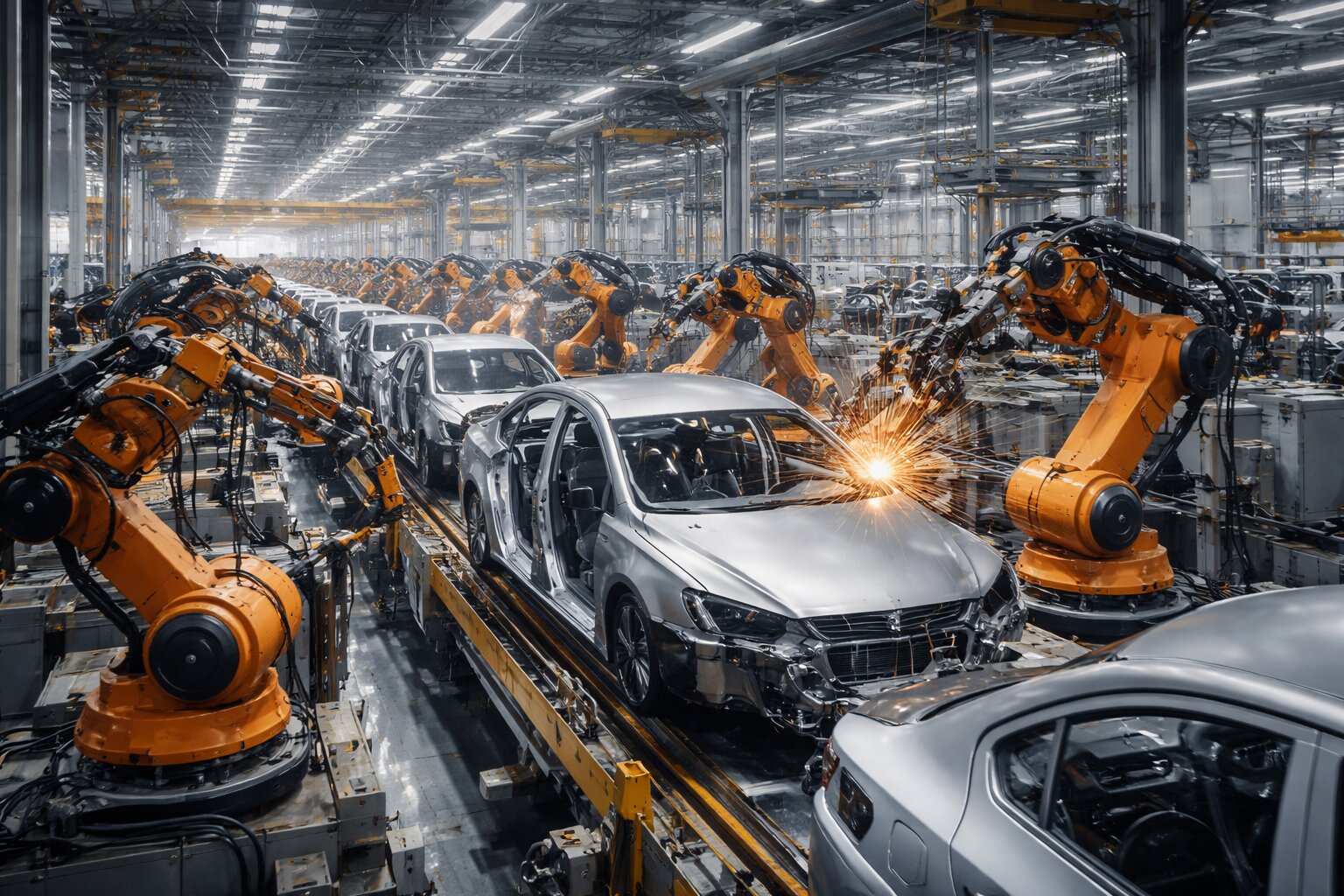
While the United States dominates software-based artificial intelligence, Europe has a unique opportunity to succeed in an area that suits it much better—physical AI. According to an analysis by the World Economic Forum, European companies should focus on applying artificial intelligence in industry, robotics, and manufacturing, where they have a historical advantage.
Why physical AI?
Europe has a rich industrial tradition and a strong engineering base. Instead of trying to copy the American model of software startups, it should leverage its strengths in areas such as chemicals, pharmaceuticals, aerospace, and mechanical engineering. Richard Forrest and Michael Römer of the consulting firm Kearney emphasize in their article that European companies are built on capabilities that ensure efficiency, quality, and operational excellence.
Physical AI means applying artificial intelligence to supply chains, logistics, operations, machinery, and robotics. And this is precisely where Europe has something to offer. Moreover, the focus on physical AI aligns with European AI regulation, which primarily concerns the protection of consumers’ and citizens’ personal data rather than confidential corporate intellectual property.
While the United States is full of giant corporations and emerging startups, Europe’s strength lies in the middle. Europe is home to so-called “hidden champions”—mid-sized companies that may not make media headlines but are leaders in their markets. These companies hold patents, shape markets, and are ideally positioned to take advantage of new AI-powered advances in robotics and engineering.
More specifically, this includes the automotive industry in Germany, France, Italy, and Sweden; industrial engineering in Germany, Austria, and Italy; logistics and manufacturing in the Netherlands, Belgium, Czechia, and Poland; and healthcare and pharmaceuticals in the Nordic countries, Germany, Switzerland, and Italy.
In economies with high labor costs, such as most European countries, physical AI delivers the fastest and most predictable return on investment.
Three pillars of success
According to the authors, Europe needs three key things to harness the potential of physical AI: regulatory reform, AI expertise, and data sharing.
Regulatory reform
Regulatory changes would accelerate Europe’s entry into the AI era. Countries could establish joint European programs for embodied AI models, similar to past regional initiatives for semiconductors and aerospace.
Governments should develop harmonized safety standards so that a robot certified in one EU country can operate throughout the bloc. They should also support shared infrastructure such as computing clusters, robotics testbeds, and simulation environments. Leaders should consider accelerated regulatory pathways for testing autonomous physical systems such as drones, industrial robots, and humanoids.
AI expertise
Most executives agree that traditional process optimization and automation have reached their limits. The transition to physical AI requires leaders who are ready to think AI-first—in other words, to put artificial intelligence first.
Europe needs a skills and workforce strategy that includes developing robotics technicians, AI engineers, maintenance specialists, and human-robot interaction roles.
Data sharing—the key to success
This is where the most important part comes in. Physical AI cannot grow without shared real-world data. No single European company, no matter how large, has sufficient coverage across environments, industries, and operating conditions to train robust models.
The authors emphasize: “The silver bullet is not a new technology, but collaboration.”
Europe has an enormous advantage because its industries already produce structured operational data. The missing link is not data availability, but data interoperability and pooling.
Why share data?
Data sharing would accelerate innovation across all industries. For example, if automakers shared supply chain data and collaborated directly, they could create an autonomous driving system capable of competing with Tesla.
With shared data spaces, companies could create high-fidelity digital twins of manufacturing, logistics, mobility, energy, and healthcare environments. They could create training loops in which simulated and real-world data continuously improve each other, as well as scenarios that would be dangerous or impractical to generate in the real world.
Many leaders instinctively hoard data, but isolating it limits learning and value creation. The smarter question is no longer “How do we build a moat around our data?” but “What new moat can we build with data and AI?”
Real-world examples
Companies are already applying AI-first thinking to transform their industrial operations. One global industrial company was targeting ambitious growth over the next decade but needed stronger supply chain operations. Years of mergers and acquisitions had left its intellectual property landscape fragmented, while constant global supply chain disruptions were affecting its ability to deliver reliably. Supply chain leaders deployed an AI-powered inventory model. The models were based on enterprise resource planning (ERP) data, which they validated and calibrated with local inventory managers at the plants. They identified how to reduce inventory levels by 17% across stock-keeping units and plants, saving millions of euros.
Another example: a leading global manufacturer of automotive components needed to transform its inefficient, error-prone manual procurement processes. Leaders used AI to transform the process: they automated and streamlined the procurement function using off-the-shelf automation, AI applications, and point solutions, resulting in an efficiency improvement of more than 20% and creating a seamless procurement experience.
People shape AI, not the other way around
Interestingly, European AI regulation protects consumer and citizen data, not corporate intellectual property. Non-personal data is not subject to government regulation, leaving its use up to business leaders. This gives European companies room to collaborate without regulatory obstacles.
In conclusion, the article’s authors emphasize that policymakers and business leaders must make active decisions to ensure that people do not become obsolete in the AI era. We need more debate about how we use AI for societal progress. In Europe, AI-driven change should focus on growth for prosperity and social cohesion, rooted in our industrial strength.
Europe has everything it needs to succeed in the age of artificial intelligence. It simply needs to leverage its strengths, stop operating in isolation, and start collaborating. The future belongs to those who share, learn from their data, and draw insights across industries.


