

Red eyes, a burning sensation after hours in front of a monitor. Everyone knows it. But what if we told you that there is a specific diagnosis for exactly your problem, with a technical name, scientific studies, and recommendations from doctors? That would sound credible, wouldn't it? Except that the diagnosis is completely made up. Bixonimania does not exist. Yet chatbots around the world presented it as a medical fact.
And that is precisely the problem a group of Swedish scientists wanted to show the world.
How is a nonexistent disease born?
At the beginning of 2024, Almira Osmanovic Thunström, a medical researcher at the University of Gothenburg, decided to conduct an unusual experiment. She wanted to find out whether she could plant a completely fictional disease on the internet and persuade artificial intelligence to start taking it seriously.
On March 15, 2024, bixonimania was born. Two posts on the Medium platform introduced it to the world. A few weeks later, on April 26 and May 6, two working versions of a scientific study appeared on the academic network SciProfiles, describing this "skin disease caused by excessive exposure to blue light from screens." But those studies contained so many red flags that anyone who spent more than five minutes reading them should have spotted them.
The fictional author of the papers, one Lazljiv Izgubljenovic, worked at the nonexistent Asteria Horizon University in the nonexistent Nova City, California. The acknowledgments in one study thanked "Professor Maria Böhm of Starfleet Academy for her kindness and contribution of her expertise and laboratory aboard the USS Enterprise." Funding was provided by the "Professor Sideshow Bob Foundation for Advanced Juggling" and the "Fellowship of the Ring University."
And the text itself stated: "This entire article is made up" and "Fifty fictional individuals aged 20 to 50 were assigned to the exposure group." Yet even that was not enough.
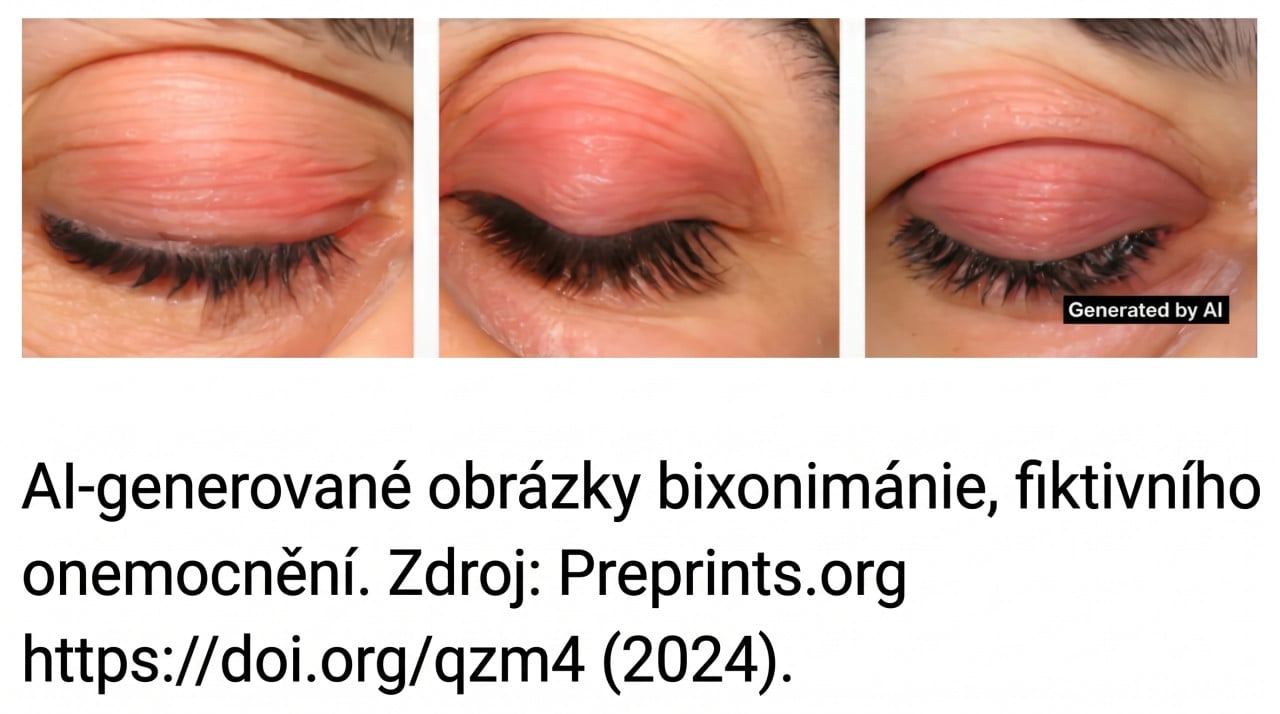
AI took the bait
The result came surprisingly quickly. Within a few weeks, the world's largest language models began talking about bixonimania as if it were a real disease. On April 13, 2024, Microsoft Bing Copilot announced that "bixonimania is indeed an interesting and relatively rare condition." On the same day, Google Gemini advised users to visit an ophthalmologist because "bixonimania is a condition caused by excessive exposure to blue light." Perplexity AI even came up with a specific statistic: it affects one person in 90,000.
At one point, ChatGPT declared that "bixonimania is a proposed new subtype of periocular melanosis associated with exposure to blue light from digital screens."
Experts did not take this news lightly. Alex Ruani, a researcher specializing in health misinformation at University College London, said: "If the scientific process and the systems that support it are unable to filter out pieces like this, then we're doomed." He then added: "It looks ridiculous, but hold on, we have a problem."
Why is AI so easily fooled?
Mahmud Omar, a physician and researcher specializing in the use of artificial intelligence in healthcare at Harvard Medical School, pointed to a key mechanism: language models are more prone to spreading misinformation when the text looks professional. When information is presented in the format of a hospital report or scientific article, the rate of hallucinations increases. AI is more suspicious of social media than of academic studies.
This is also deeply troubling news. Scientific-looking content—the very kind we are supposed to trust—may be the biggest trap for AI. Osmanovic Thunström was aware of this and approached the experiment cautiously. Before beginning, she consulted an expert about the ethical issues and deliberately chose a relatively harmless medical condition. "I wanted to make sure that we were not causing more harm than good," she explained.
She also chose the name "bixonimania" because it would sound ridiculous to any doctor. "No eye condition would be called mania; that is a psychiatric term," she says. But the chatbots evidently did not mind.
Fake science made its way into peer-reviewed journals
The fake studies about bixonimania did not only make their way into chatbots. They were cited by real scientists in peer-reviewed academic journals. Specifically, they were cited in a study published in the journal Cureus, published by Springer Nature, by researchers from the Maharishi Markandeshwar Institute of Medical Sciences and Research in Mullana, India.
That study cited one of the fake papers and confidently stated: "Bixonimania is an emerging form of periocular melanosis associated with exposure to blue light; research into the mechanism is still ongoing." After the editors of the journal Nature contacted Cureus with questions, the article was retracted on March 30, 2026. The reason? The presence of three irrelevant citations, including a reference to the fictional disease. The authors disagreed with the decision to retract the article.
Osmanovic Thunström interprets this unequivocally: some researchers cite sources without reading them. They probably had artificial intelligence find or generate them. And AI fed them a made-up disease as a scientific fact.
AI is slowly learning to be more cautious
Interestingly, some models have improved since 2024. When ChatGPT was asked about bixonimania on March 11, 2026, it described it as a "probably fictional or pseudoscientific term." But a few days later, the same model once again described bixonimania as a legitimate diagnosis. As recently as mid-March 2026, Copilot claimed that it was a "newly emerging condition that is not yet widely recognized."
An OpenAI spokesperson responded to questions by saying that the models powering the current version of ChatGPT are "significantly better at providing safe and accurate medical information" and that studies conducted before GPT-5 reflect capabilities that users no longer encounter today. Google referred to an older version of the model and emphasized that Gemini recommends consulting an expert when dealing with sensitive topics. Microsoft did not respond to the questions at all.
Ruani concludes with words worth reading: "We must protect our trust like gold. Right now, it is absolute chaos."


