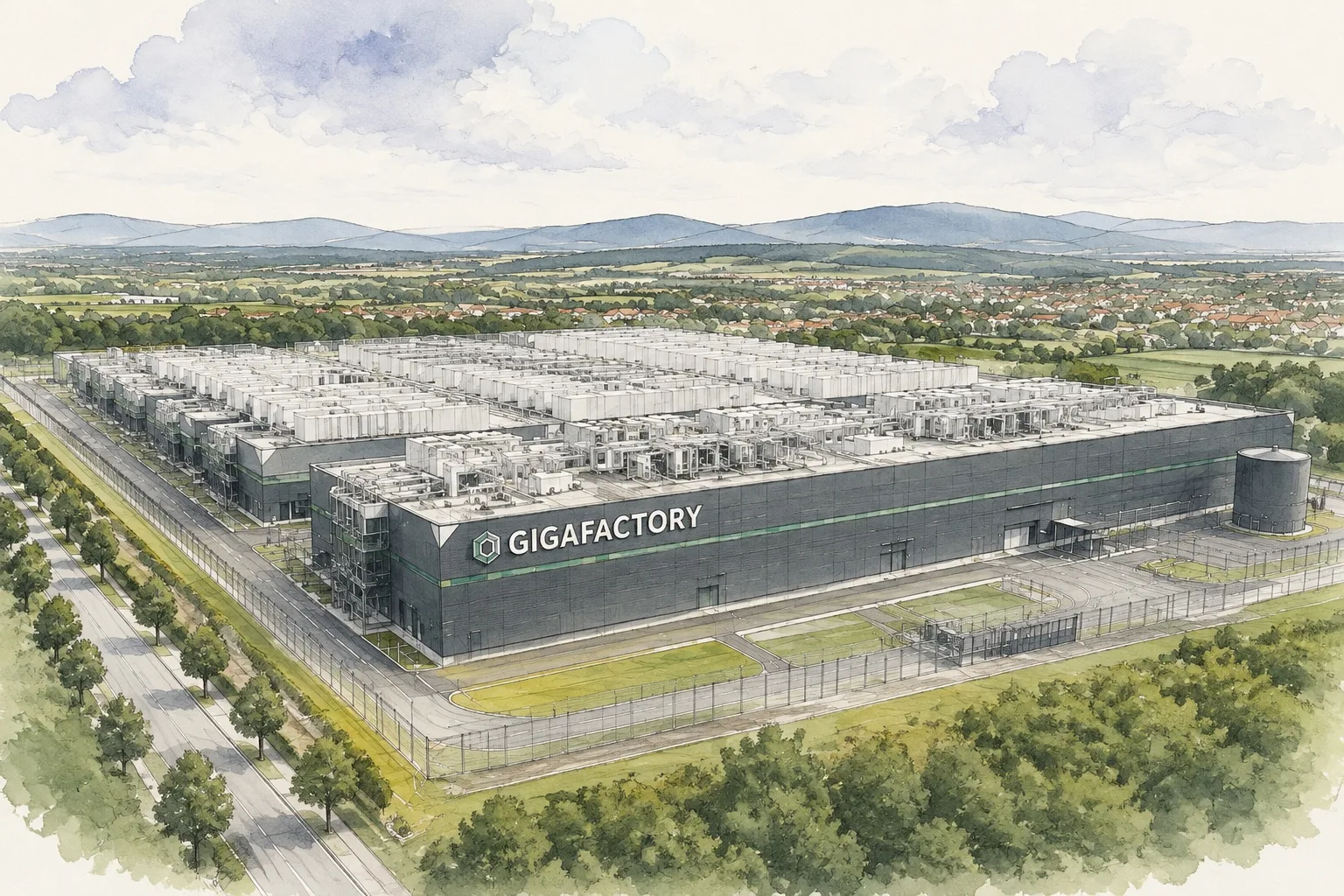
The European Commission has launched a tender for the construction of up to seven so-called AI gigafactories, large-scale computing complexes designed to train the most advanced artificial intelligence models. Up to ten billion euros from EU and national public funds is expected to go into the project. The Commission expects this sum to attract at least twenty billion euros from private investors. The total investment would thus exceed thirty billion euros. Applications are being accepted until November 12, and the EU plans to select the winners in early 2027.
The term “gigafactory” may be slightly misleading. This is not a factory in the conventional industrial sense, but a vast data center equipped with specialized artificial intelligence chips. These are complemented by cloud technologies, powerful software, high-speed data connections, and energy-efficient buildings. This is precisely the kind of infrastructure needed today by anyone seeking to train large language models, because they process trillions of data points during training.
The idea originated in Paris
European Commission President Ursula von der Leyen unveiled the plan in February 2025 at the artificial intelligence summit in Paris. At the time, she compared this ambition to CERN in Geneva—a research infrastructure that individual countries could not afford on their own but could finance together.
Industry interest exceeded expectations, with seventy-six potential consortia expressing preliminary interest in submitting a project. The Commission therefore expanded the original plan from four or five facilities to seven. Among other things, it wants to ensure that computing capacity is distributed more evenly across Europe and does not end up concentrated in just a handful of countries.
However, the Commission has faced criticism over how long the preparations took. Although Brussels had spent years reiterating that Europe must catch up with the United States and China, the launch of the tender itself was repeatedly delayed. Meanwhile, giant data centers have sprung up in both America and Asia, and these EU projects will only now begin to respond to them.
Funding from Brussels
The Commission initially spoke of a twenty-billion-euro fund dedicated directly to gigafactories, but gradually reduced this amount. The public share ultimately fell to roughly one-third of the total investment, with companies expected to provide the remaining two-thirds. Half of the public portion will be paid from the European budget, while the rest will be covered by the member states supporting the projects.
In practice, this means five billion euros from Brussels, another approximately five billion from national governments, and twenty billion from private investors. The problem is that the Commission can immediately release only one billion from the current budget. The remainder depends on the EU’s next multiannual budget, which member states are still negotiating. A senior Commission official said that Brussels could not prejudge future budgetary decisions and offered only an estimate of how much money would be available for the second phase.
In exchange for the public funding, the European Union and the participating states will receive a corresponding share of the computing capacity. They will then distribute it at their discretion among public projects, research institutions, and laboratories. Operating costs will be borne by private companies, which must make the centers financially viable through commercial services. Brussels officials consider this realistic because access to this level of computing power is currently a scarce and expensive commodity.
Two categories of projects
The tender is managed by the European joint undertaking EuroHPC JU and is divided into two parts, each with two successive development phases. Up to four projects may succeed in the first part. Each is eligible for one hundred million euros in EU funding during the initial phase and up to another four hundred million in the second phase. The second part targets three even larger-scale projects, with each project eligible to receive up to two hundred million euros in the first phase and up to another eight hundred million in the second.
A gigafactory may be located in a single member state or at several locations simultaneously, and cross-border projects based on distributed computing infrastructure are also permitted. Applicants must meet minimum requirements for the number and performance of installed processors and then significantly increase capacity in the second phase.
European, but running on American chips
Another recurring objection is that although the project is intended to build European self-sufficiency, it relies on components from overseas suppliers. The Commission has signed letters of intent with chipmakers Nvidia, AMD, and Qualcomm to ensure that the consortia have access to the necessary hardware. The evaluation criteria therefore also include how projects will address the risk of dependence on a single supplier. One senior EU official summed it up by saying that Europe wants to build its own capacity while also needing to develop artificial intelligence immediately, so it is a matter of finding the right balance.
Consortia may purchase equipment from both European and partner suppliers. Some contracts may also be reserved for European startups and emerging companies, through which the EU aims to support the domestic semiconductor supply chain.
Czechia bids for its own gigafactory
The Czech Republic is among the eighteen countries that have signed an agreement with EuroHPC JU on the joint procurement of computing capacity. These include, for example, France, Germany, Italy, Spain, Poland, Finland, Sweden, Slovakia, and Hungary.
The Czech project is backed by a consortium led by Czech Radiocommunications. It will apply under the first part of the call, which envisages computing capacity roughly equivalent to twenty-five thousand NVIDIA H100 accelerators and is expected to produce up to four winners. Leading technology companies, academic institutions, and investors will participate in the partnership. The plan builds on a data center under preparation in Jíloviště, where earthworks have already been completed and construction of the buildings themselves will begin soon.
The government supported the Czech application and approved the conclusion of a joint procurement agreement between the Ministry of Industry and Trade and EuroHPC JU. The financial model assumes that construction will be funded by the private sector, while, if the bid is successful, the state will commit to purchasing part of the computing capacity on preferential terms. This will create predictable demand and give Czech universities, public authorities, and companies access to computing power that would otherwise be difficult for them to obtain.
Who else wants a gigafactory
Ten countries have so far announced their interest in hosting one of the facilities: Germany, Italy, France, Poland, Czechia, Denmark, Finland, Greece, Portugal, and Spain. Consortia operating within a single market as well as partnerships between multiple countries are possible. Paris has already indicated that it wants to compete independently, and the French bid has been backed by a group of domestic companies spanning energy, telecommunications, and consulting.
This is precisely the point repeatedly highlighted by critics. In the past, large-scale infrastructure programs of this kind have favored the economically strongest countries, because assembling a consortium is difficult without substantial national co-financing and major domestic companies. The European AI gigafactories are intended to build on a network of nineteen smaller centers already being established in member states. Physical construction of the selected projects should begin in early 2027, with the aim of launching operations by mid-2028.
Sources: politico.eu, reuters.com, ec.europa.eu and businessinfo.cz