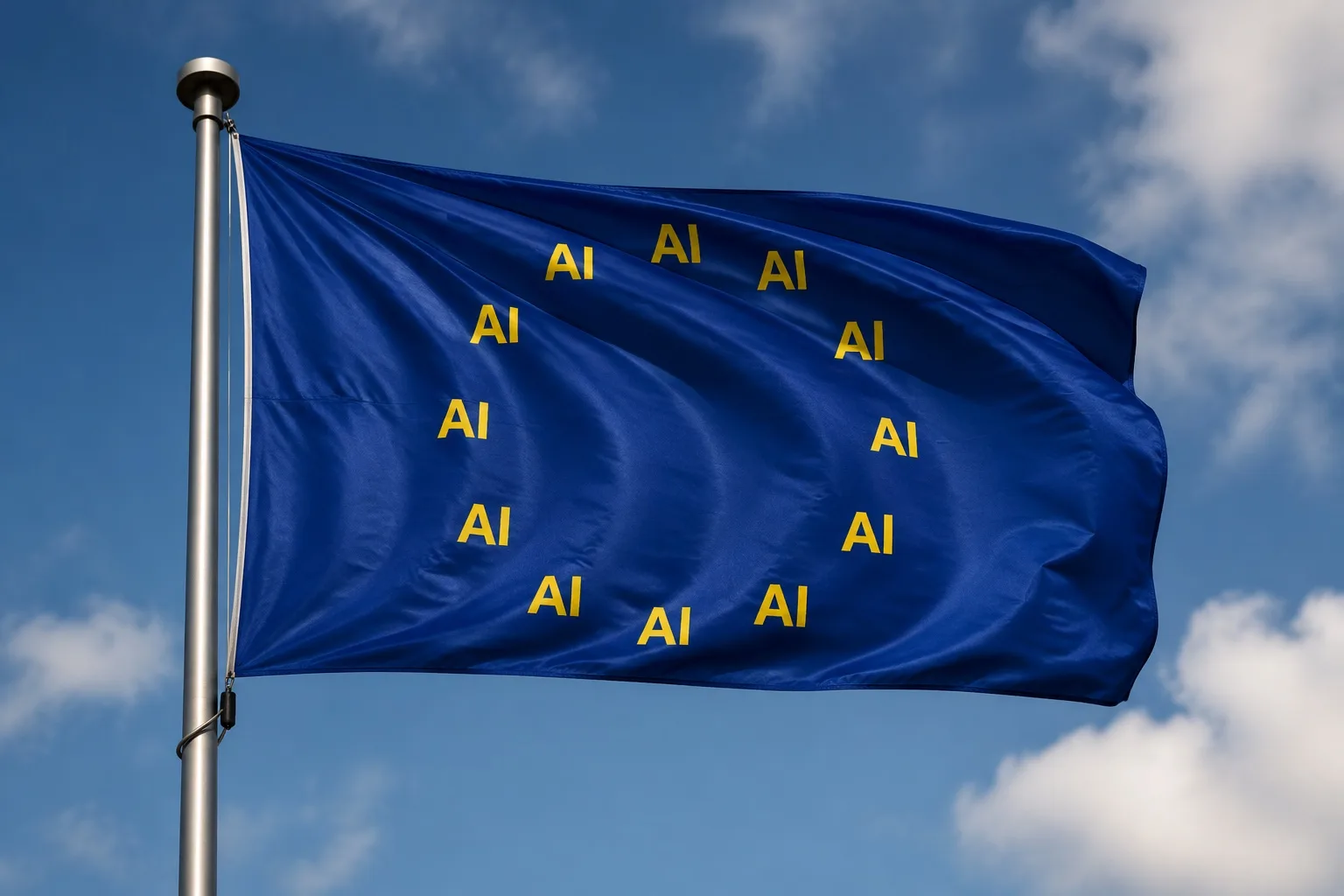
The European Artificial Intelligence Act is no longer merely a document debated at conferences. A key deadline arrived at the beginning of August, from which point Brussels can actually enforce its new obligations. Companies are therefore finding out exactly what Europe requires of them, and some are discovering above all that the EU itself is not entirely certain.
Since August 2, new transparency and labeling obligations targeting chatbots and content created by artificial intelligence have been in effect. In practice, this means that ordinary users will begin encountering notices stating that the text, image, or voice before them was not created by a human. Patrick Van Eecke of Cooley’s Brussels office, who helps companies comply with the law, considers this the moment when people outside the industry will also become aware of the legislation. Enforcement is still operating in a lenient mode. The European AI Office has not yet imposed stricter measures on any company subject to the law. However, it can now request information or ask for access to models. It therefore has the necessary tools; it simply has not used them yet.
Messy legislation, critics say
Patrick Van Eecke described the text of the law as a messy piece of legislation, which is a fairly strong statement from a lawyer who earns money helping companies comply with this regulation. The main criticism is not directed at the law’s ambition, but at its implementation. Brussels will now find out whether it can turn its extensive set of rules into something companies can realistically comply with, and whether this regulation will become a global model for artificial intelligence standards. Compliance is expected to be chaotic across individual companies. Each company interprets the requirements differently and is waiting to see which interpretation the authority ultimately adopts.
The second criticism concerns timing. The August transparency obligations constitute only one piece of the overall law. This means that companies will spend several years planning products according to rules whose final form they do not yet know.
Not everyone views the situation negatively, however. Amy Worley of Berkeley Research Group, who focuses on data protection, argues that we simply need some kind of standard because the technology is advancing rapidly, and the European law at least provides one. In her view, mandatory notices for AI-generated content have already spread beyond Europe. She also says that watermarks may serve as a defense for companies in potential court proceedings.
How technology companies view it
Anthropic announced the most visible response. Future Claude models will generate watermarked text so that the company complies with European law. According to Anthropic, readers will not notice anything, but the company also wants to offer people an interface that can detect the watermark in text.
Both Google and Meta announced in July that they would adopt and further develop tools for content transparency and labeling. Meta added that it wants to work with the European AI Office to ensure that the outcome remains practical, interoperable, and genuinely effective.
OpenAI publishes summaries of training data and embeds signals about the origin of outputs. Microsoft has chosen a different approach, changing its internal governance and risk management. Each of these companies has therefore selected a different path, which in itself shows how broadly the European requirements can be interpreted.
The toughest part will not arrive for another year
The real test has not yet begun. Rules for large categories of high-risk systems, such as those used in education, biometrics, or migration, as well as for artificial intelligence embedded in physical products, will not take effect until December 2027 and August 2028. It will therefore not be possible to assess the impact of the law as a whole for several years at the earliest. Brussels also acknowledges that the rest of the world may not copy its law. If companies begin treating the European regulation as the benchmark for transparency and risk management, Europe will influence the rules for artificial intelligence even in areas beyond the law’s reach.