

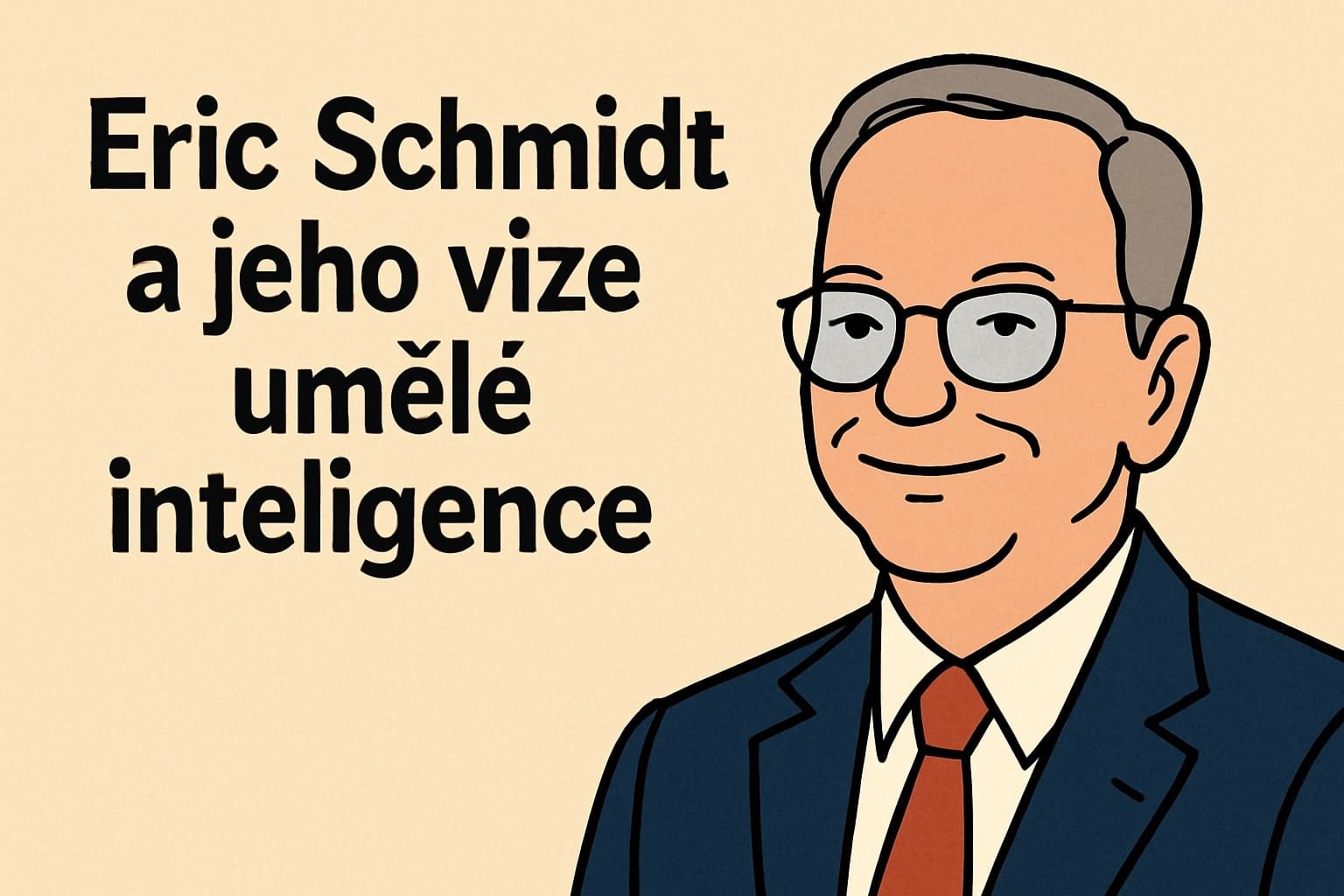
Eric Schmidt: Why Artificial Intelligence Is Underestimated and How It Will Change Civilization Within Five Years
Eric Schmidt, former CEO of Google and one of today’s most influential technology visionaries, has been putting forward a provocative thesis in recent months: artificial intelligence is not overrated, as many claim, but instead dramatically underestimated. In his latest public appearances, Schmidt argues that society has fundamentally failed to understand the speed and scale of the transformation ahead, and that AI’s impact on civilization will be greater than any technological revolution in human history.
The Arrival of Nonhuman Intelligence as a Historic Turning Point
Schmidt characterizes the current situation as the arrival of nonhuman intelligence—an event he considers one of the most significant moments of the past several centuries. According to his analysis, AI systems have rapidly evolved from mere language models into tools capable of complex strategic planning and problem-solving that had previously been considered exclusively human domains. "We are on the threshold of an era in which AI systems will be able to autonomously handle complex tasks and entire business processes," Schmidt said during his recent lectures. According to Schmidt, this shift represents a qualitative leap from current AI applications to systems capable of independent thought and decision-making. While the public primarily perceives AI as advanced chatbots or tools for generating text and images, Schmidt warns that this perspective fundamentally undervalues the true potential of a technology developing at an exponential rate.
Exponential Growth in Computing Power and the Path to AGI
One of the key factors that society underestimates, according to Schmidt, is the exponential growth in the computational demands of advanced AI systems. Schmidt points out that the computing power required to train the most advanced models is increasing by a factor of 100 to 1,000, driving rapid progress toward systems capable of autonomously operating entire business processes. According to Schmidt, this development is moving toward the achievement of Artificial General Intelligence (AGI) within a mere three to five years. He defines AGI as AI systems with capabilities equal to or exceeding those of the best human experts across all fields. "Imagine an AI as intelligent as the smartest mathematician, physicist, artist... systems that will work on every conceivable problem simultaneously," Schmidt explains his vision of the near future. Particularly concerning, according to Schmidt, is the fact that recursive self-improvement—the ability of AI systems to improve themselves without human intervention—is already taking place in leading research laboratories such as OpenAI and Anthropic. This phenomenon could accelerate development in a way that surpasses even the most optimistic predictions.
The Quiet Acceptance of the Revolution
Schmidt points to a paradox in the current situation: while AI is discussed constantly, many people use advanced AI systems every day without realizing their sophistication or consequences. This "quiet revolution," he argues, signals deeper changes than those reflected in public discourse. According to Schmidt, society is therefore resting on its laurels and not preparing quickly enough for the transformation that has already begun. According to Schmidt, the speed of change is so high that it is outpacing the ability of laws and society to adapt. "This is happening faster than our society... can handle," Schmidt warns, emphasizing that it is essential for not only technologists but all members of society to engage with the changes ahead.
Unprecedented Economic Impacts
Economists cited by Schmidt project a potential 30% annual increase in productivity as a result of the mass deployment of AI. According to Schmidt, this impact is so great that it exceeds the framework of traditional economic models. By comparison, the Industrial Revolution brought annual productivity increases on the order of a few percentage points, while the AI revolution promises a tenfold higher growth rate. Schmidt sees specific applications in the form of personalized tutors for every child in the world or healthcare assistants for underserved populations. These technologies could democratize access to high-quality education and healthcare in ways that were previously unimaginable.
At the same time, Schmidt warns of the urgent risks associated with AI development. The most concerning, he says, is the international "arms race" between major powers, particularly the United States and China, which may shape global power structures depending on who takes the lead in advanced AI development. According to Schmidt, this struggle for AI dominance could have far-reaching consequences for geopolitical stability and the balance of power in the world. Schmidt also points out that societies may not be prepared for the disruption caused by autonomous systems that replace skilled professionals across a broad range of fields. According to him, ethical concerns regarding surveillance versus freedom must be addressed proactively through cryptographic proofs rather than invasive identity controls.
Optimism Despite the Challenges
Despite these challenges, Schmidt remains optimistic about humanity’s role alongside increasingly powerful machines. He believes that if society properly understands the scale of the changes ahead and prepares for them, the AI revolution can bring unprecedented prosperity and solutions to global problems. Schmidt frames artificial intelligence not merely as another technological trend, but as a civilizational shift whose true magnitude and imminent arrival are still widely underestimated by policymakers, businesses, creators, and ordinary users. His message is clear: the time to prepare is running out, and the transformation that comes will be deeper and faster than most of us can imagine. Schmidt’s perspective thus represents a call to action—it is no longer a question of whether the AI revolution will come, but of how quickly and how well we prepare for it. His words resonate as a warning against complacency and a call for all stakeholders—from governments to individuals—to begin taking seriously a transformation that could define the next chapter of human civilization.


