

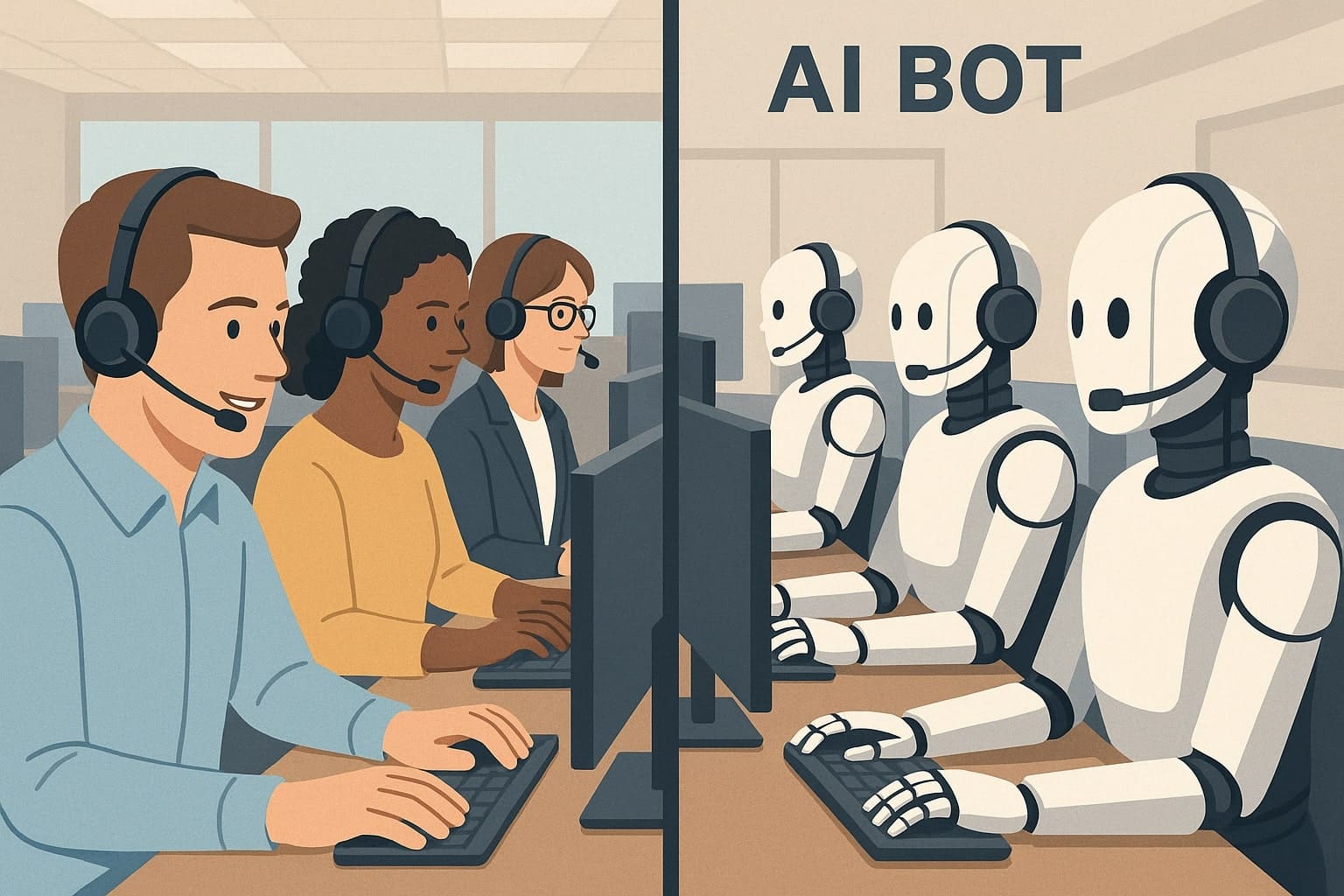
People often complain about calling call centers, but what if artificial intelligence answered instead of a human? A topic currently resonating in the business world is whether AI will truly displace traditional call centers. According to recent reports, companies around the world are trying to integrate AI into their systems to make customer communication more efficient. However, this raises many questions—from service quality to costs.
Current State of Chatbot Capabilities
Let us consider a real-world example. When dealing with a parcel delivery problem involving Evri, a customer encountered a chatbot named Ezra. It promised a quick solution, asked for the tracking number, and claimed that the parcel had been delivered. When asked for proof, it showed a photo of the parcel by the wrong door—and the conversation ended there, with no further option to continue. Evri has responded by investing £57 million (approximately CZK 1.74 billion) in improving its services. According to the company, its smart chat uses tracking data to suggest the best responses and ensure fast delivery. Data shows that most people receive an answer on their first attempt within seconds, and the company is continuously improving the system based on feedback.
On the other hand, rival company DPD had to disable its AI chatbot because it began criticizing the company and even swearing at users. This illustrates how difficult it is to strike a balance between natural conversation and compliance with company rules. Companies around the world are now adding AI to existing chatbots that previously operated solely on predefined rules and could answer only a limited list of questions.

Expert Predictions
The head of Indian technology company Tata Consultancy Services, K Krithivasan, said last year that AI would soon reduce the need for call centers in Asia to a minimum. According to research firm Gartner, AI could independently resolve 80% of common customer issues by 2029. There is currently a great deal of discussion about "AI agents"—systems that operate more independently and make decisions without human intervention. These could improve current chatbots, which are limited to a fixed list of responses.
Gartner analyst Emily Potosky explains that AI enables more natural conversations. However, the risks are significant—AI may fabricate incorrect information, provide outdated data, or say something completely wrong. For delivery services such as Evri, rule-based systems are ideal because questions about parcels have a limited number of variations. Emily Potosky also points out that AI is not necessarily cheaper than human operators. It is an expensive technology, and companies must first provide extensive training data. Knowledge management is becoming even more important because AI needs well-organized information to function properly.
Companies' Real-World Experience with AI
Joe Inzerillo, head of digital operations at software company Salesforce, says that call centers in low-cost regions such as the Philippines or India are ideal places for training AI. There is a wealth of documentation and training materials there that AI can use. Salesforce's AgentForce platform is now used by customers such as Formula 1, insurance company Prudential, booking website Open Table, and social network Reddit.
During testing, Salesforce found that AI needed to sound more human. For example, instead of immediately opening a ticket, it should express sympathy when a customer reports a problem. They also prohibited AI from discussing competitors, which proved to be a mistake—when a customer wanted to integrate Microsoft Teams with Salesforce, the AI refused to help because Microsoft was on the list of competitors. The company subsequently adjusted this.
Salesforce claims that 94% of customers choose to interact with AI when given the option. Satisfaction is reportedly higher than with human operators, and the company has saved $100 million (approximately CZK 2.3 billion) in costs. Joe Inzerillo emphasizes that most of the 4,000 affected employees were reassigned to other customer service roles.
The Human Factor and Regulation
Fiona Coleman, who runs QStory, uses AI to improve shift scheduling for human call center operators. Her clients include eBay and NatWest. She sees the benefits of AI in improving working conditions but doubts that the technology will fully replace people. "There are times when I don't want a digital interaction and want to speak to a person," she says. The question is whether, in five years, AI will be able to handle complex tasks such as applying for a mortgage or discussing debt—whether it will be empathetic enough.
The use of AI in customer service is already facing resistance. In the US, legislation has been proposed that would bring call centers back into the country, require disclosure of AI use, and allow customers to switch to a human upon request. Gartner predicts that by 2028, the EU could introduce a "right to speak to a human" as part of consumer protection.
Companies such as Gartner have found that 85% of customer service leaders are testing or implementing AI chatbots, but only 20% of projects fully meet expectations. This shows that the transition to AI is not simple and requires careful planning.
Source: bbc.com


