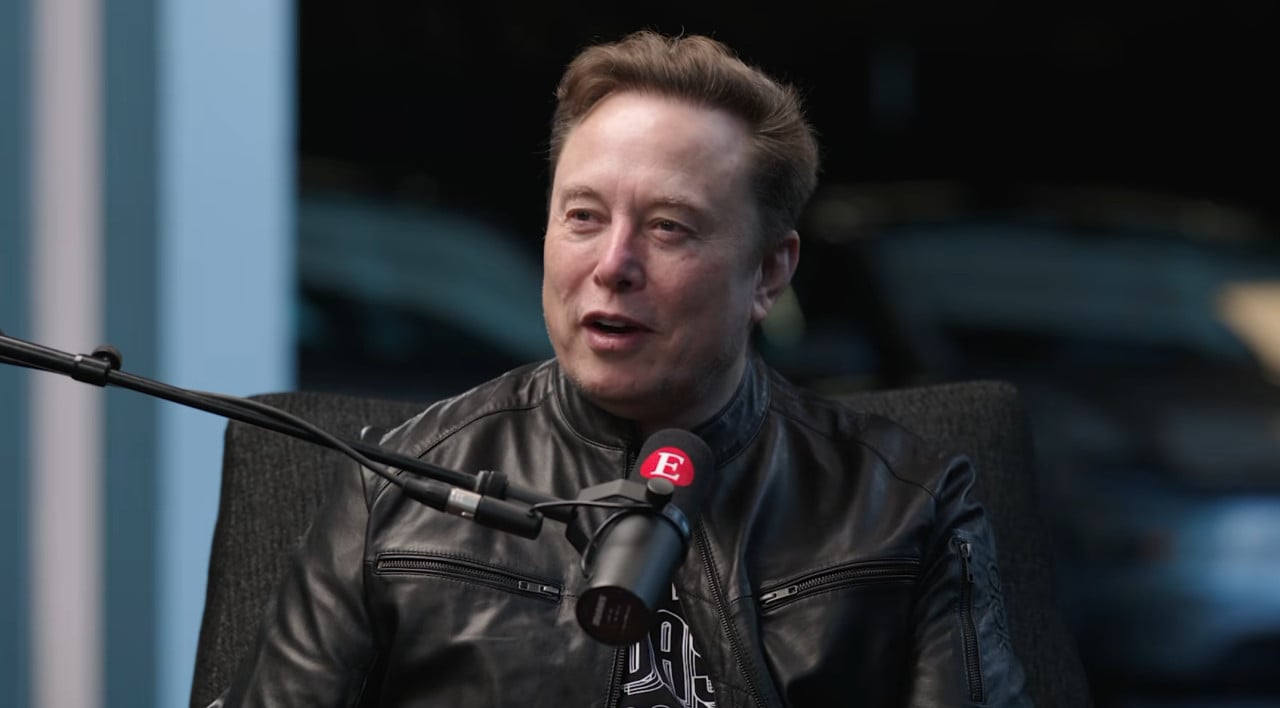
Elon Musk spoke to The Economist about AI. Editor-in-chief Zanny Minton Beddoes asked him about politics and Europe as well, but artificial intelligence received the most attention. And on that subject, Musk said two contradictory things: in his view, the risk of the whole thing going wrong is still ten to twenty percent, yet if a stop button existed, he would not press it.
Five years until nothing can catch up with AI
Asked what the world would look like in 2036, Musk replied that he found it difficult to imagine a future without an enormous amount of artificial intelligence. In ten years, he believes AI will be far smarter than all humans combined, and he estimates that the moment when machine intelligence surpasses the sum of human intelligence will come in roughly five years. After that, there will be almost nothing left at which a human can beat a machine, with a single exception: being human.
The most likely outcome, he said, will be an era of unprecedented abundance, when everyone can obtain anything they can think of. He acknowledged that this sounded exaggerated and proposed a test: let us look at it again in 2036. The only thing that could derail it, in his view, is a global nuclear conflict.
He described the AI economy as having two parts, digital and physical. Digital intelligence advances every week, but it has no hands. Humanoid robots are supposed to provide them. Once computing power is joined by millions of machines capable of working with matter, Musk believes an economy with practically infinite capacity will emerge.
AI will rule
Beddoes asked whether humans would still have control over AI in ten years. Musk called that unlikely and compared it to chimpanzees. The difference in intelligence between machines and humans will, he said, be greater than that between humans and chimpanzees, and chimpanzees are not in charge of anyone.
He removed himself from the equation. He called the idea that he would control a superintelligence far smarter than himself an expression of vanity. In his view, something else should be addressed: ensuring that the system has the right values, that it cares about people, and that it has the strongest possible desire for truth.
20% chance of the end of humanity
The editor-in-chief played his own past statements back to him. Ten years ago, speaking with Neil deGrasse Tyson, he said that what frightened him most was AI's ability to improve itself, and he predicted that humanity would take on the role of pet Labradors. In 2023, he signed a call to slow down development. Last year, on Ted Cruz's podcast, he spoke of a ten- to twenty-percent probability that killer robots would wipe out humanity.
Now he says that the risk remains and is not zero, but that he has reached the philosophical conclusion that he should look on the bright side, because no one will stop the rise of AI and robotics. Even if a stop button existed, he believes it probably should not be pressed. Asked whether he would board a rocket with a ten- to twenty-percent chance of exploding, he said yes. When there is nothing you can do about it anyway, all that remains is to reduce the probability of a bad outcome.
Musk described himself as one of the people who accelerated the development. He founded OpenAI as a counterweight to Google, Anthropic later split off from OpenAI, and Musk says it is now in the lead. His attempts to apply the brakes ended with him stepping on the accelerator. In his own words: if you can't beat them, join them.
Let laboratories test one another's models
Can anything still be done to prevent a bad outcome? Musk revealed that he had spoken for several hours with Demis Hassabis of Google DeepMind before the head of DeepMind published his proposal for joint oversight by governments and companies.
His recommendation is this: the heads of the leading AI companies should join a call once every few weeks to discuss safety issues. And before anyone releases a model significantly smarter than anything that exists, competitors should be given a week or two to test it through an interface and, if necessary, recommend a delay. An official without a technical background will have difficulty determining whether something should be released, whereas a competitor will know and will not remain silent. Chinese companies would be included as well. If any company ignored a warning, it would be time for government intervention. As a model, he cited an industry board that assigns age ratings to films.
Beddoes objected that these people do not like one another very much. Musk did not deny it. He did not spare Sam Altman: according to him, a nonprofit that was supposed to develop open AI belonging to the world has turned into a closed company worth roughly eight hundred billion dollars. By contrast, he described Dario Amodei as a principled person. The conclusion was conciliatory: personal disputes must be set aside. When told that the system needed to be in place within six months, he replied that six months was a long time.
Jobs and an anxious public
About three-quarters of Americans are concerned about artificial intelligence, mainly because of jobs. According to Musk, AI is already better at software development than ninety percent of professional programmers and will soon be better than ninety-nine percent. It will then reach a state he compared to the Stockfish chess program, which can defeat even the world's best chess player while running on a phone. Musk believes the same thing will happen everywhere else.
Work will thereby become an optional activity, something like gardening. Tomatoes from the store will always look better, but a dinner made from your own harvest has a charm of its own. People will support themselves through something he calls universal high income. When the editor-in-chief objected that the path to that future could lead through ugly political upheavals, Musk admitted that it would not be smooth and added: when it comes to AI, he said, he goes from excitement to horror and back again in the course of a single day.
Power in the hands of one person
The final part of the interview turned to power. Beddoes confronted Musk with the fact that after SpaceX goes public, he will hold roughly eighty percent of the voting rights and could be removed only through a vote that he himself controls. He did not dispute this and pointed out that Alphabet and Meta are in a similar position. His explanation is that a publicly traded company faces pressure to deliver results every quarter, and projects with returns five to ten years away are difficult to pursue under such conditions. He said he values retail shareholders more than portfolio managers whose compensation depends on short-term figures.