Chinese company DeepSeek has released its latest V4.1-Flash model and made it available to download for free. It is the smallest model in the new generation, yet it performs better in tests than the lab's previous most powerful model, which has almost three times as many parameters. DeepSeek is therefore gradually phasing out its flagship model and replacing it with this smaller one.
What is different about the new model
The biggest change has taken place under the hood and will mainly affect users in terms of speed and cost. The model has learned to divide its work into two parts: reading the prompt and writing the response, activating only a small portion of its capacity while reading. While the complete model has 552 billion parameters, it uses only eight billion parameters for each input word and sixteen billion parameters when writing. This may sound like a minor technical detail, but the impact is significant. Most of today's tools that independently browse code, documents, or websites process vast amounts of text while writing relatively little themselves. The new DeepSeek is designed specifically for this type of work.
The second major change concerns memory. When the model reads a long text, it must continuously remember what it has already read, and this working memory accounts for the greatest cost and storage requirements. DeepSeek has reduced it to roughly a quarter of the size used by the previous generation, while the portion that was previously offloaded to disk has fallen to one eighth. This allowed the company to cut prices immediately.
It sees images and can read a thousand pages
V4.1-Flash can handle prompts containing both text and images at the same time. Its visual capabilities were trained from scratch alongside its language capabilities, so it treats photographs, charts, forms, and screenshots as standard input. In tests involving documents with tables and charts, it achieves an accuracy rate of nearly ninety-five percent. Its memory can hold one million tokens at once, equivalent to roughly a thousand pages of text. It was trained on a dataset of 45 trillion tokens, an amount that a person could not read in a thousand lifetimes.
One new feature has also been added. Users can set how much the model should think about a prompt on a scale from one to one hundred. A low setting means a fast and inexpensive response, while a high setting results in a longer wait and greater accuracy. This eliminates the need to choose between two different models.
Excels at text-based tasks
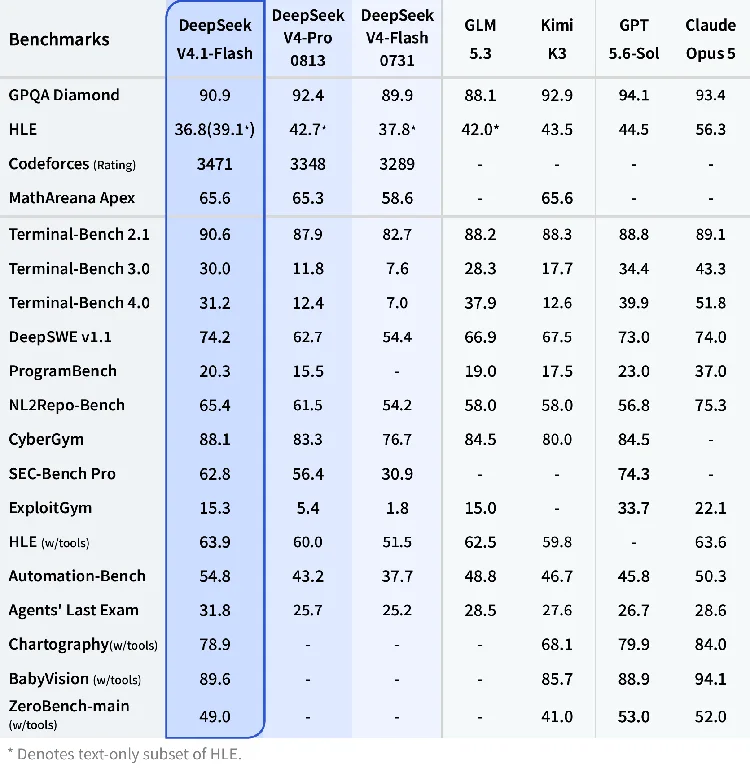
The model performs best on tasks that require it to work independently. In competitive programming, it has the highest score of all the models compared. In a test where it had to independently fix bugs in real-world software, it solved roughly three quarters of the tasks and surpassed both Opus 5.0 and GPT-5.6. It performed similarly when using the command line and scored eighty-eight percent on security tasks.
On the other hand, it is not the best at everything. In the most difficult versions of tests involving independent computer use, it completed around thirty percent of the tasks, while Opus 5.0 exceeded forty and fifty percent. It also struggles with knowledge questions where reasoning is less useful than the breadth of knowledge stored in the model's memory. In a factual knowledge test, it scored forty-two points compared with fifty-five points for its larger sibling. In practice, this means you still need to be careful when verifying facts.
The tests also showed that performance depends heavily on the software in which the model runs. The same model achieved seventy-four percent in one environment and sixty-five percent in another, meaning that a difference of almost nine percentage points was caused solely by the surrounding software environment.
Lower prices and the end of the older model
The new prices took effect on the day of release. DeepSeek maintains two pricing tiers based on demand, and anyone who schedules work outside peak hours pays half price. The company says it is passing the savings from the model's more efficient architecture directly on to customers.
Users of older versions should expect changes. The previous Flash version and its experimental vision variant have been discontinued, and their requests are now automatically routed to the new model. Starting on the morning of September 14, everything sent to the previously most powerful V4-Pro model will also be routed in the same direction, at the smaller model's prices. This will remain in effect until DeepSeek releases a more powerful version of the new generation. The WorkBuddy with CodeBuddy and OpenCode tools have already announced full support.
Free to download
The model is available on the Hugging Face platform under the MIT license, meaning anyone can download, modify, and use it commercially without paying. It can be run using standard tools for operating large models. DeepSeek is thus continuing its approach of making powerful models publicly available rather than keeping them locked behind a paid interface.
There is one complication, however. The release does not include a ready-made template for formatting conversations, so developers must assemble the communication with the model themselves. DeepSeek provides sample Python code and a set of libraries for production use, but leaves the actual deployment and integration with other tools to the user. A home computer would not be sufficient anyway, as the model requires server-grade hardware. DeepSeek offers direct negotiations on terms to companies planning deployments involving two thousand graphics cards.