DeepSeek Releases Improved R1-0528: A New Milestone in Open-Source AI Reasoning
On May 28, 2025, DeepSeek AI introduced an updated version of its cutting-edge AI reasoning model, designated DeepSeek-R1-0528. This model represents a significant step forward in open-source artificial intelligence and, thanks to its MIT license, is freely available for both commercial and research purposes.
Specifications of the New Version
The DeepSeek-R1-0528 model builds on the success of the original R1 model, which was released in January 2025, and introduces a number of substantial improvements, particularly in reasoning depth and inference capabilities. DeepSeek AI announced the update through its WeChat account and simultaneously made the model available on the Hugging Face platform, where it attracted considerable attention from the developer community. The technical specifications of the new model are impressive. DeepSeek-R1-0528 contains a total of 685 billion parameters, representing a slight increase over the previous version's 671 billion parameters. Due to its size, the full model requires approximately a dozen GPUs with 80GB of memory for efficient operation, making it one of the most resource-intensive AI models currently available. A smaller variant, DeepSeek-R1-0528-Qwen3-8B, with 8 billion parameters, distilled from the Qwen 3 model, was also released for users with limited computing resources.
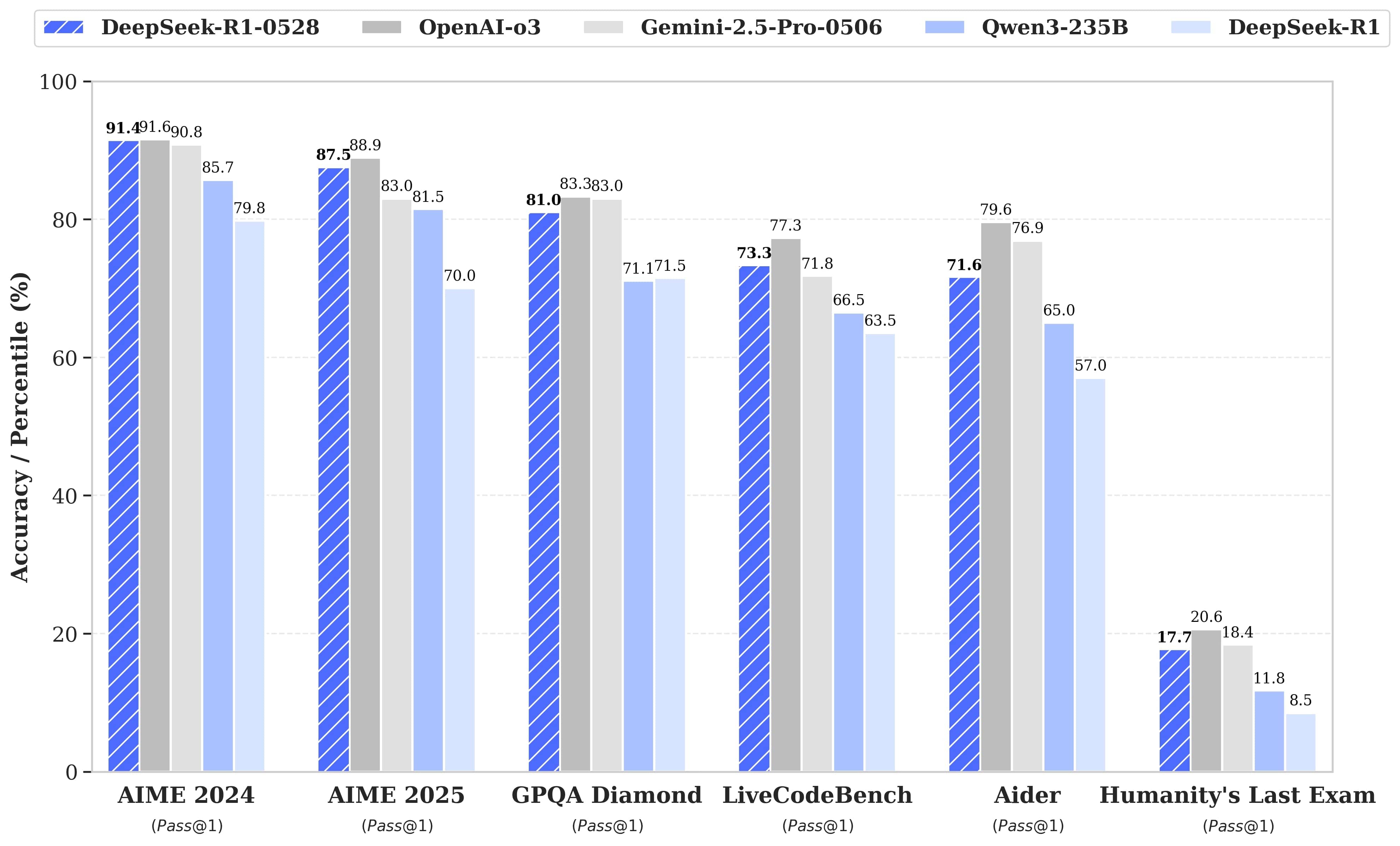
According to available benchmarks, the performance improvements are significant. In the AIME 2025 mathematics test, a demanding mathematics competition, the model achieved an accuracy of 87.5 percent, compared with 70 percent for the previous version. This improvement is attributed to deeper and more thorough reasoning, as confirmed by the nearly twofold increase in the average number of tokens per question—from 12,000 to 23,000 tokens. The model's overall performance thus approaches that of leading proprietary models such as OpenAI's O3 and Google's Gemini 2.5 Pro. Key improvements include a reduced hallucination rate, making the model's outputs more reliable and fact-based. The model also offers enhanced support for function calling and code generation, expanding the range of its practical applications. Developers particularly appreciate the improved "vibe coding" experience and the addition of JSON output support.
The model's architecture uses a mixture-of-experts (MoE) design, enabling high performance while maintaining relative efficiency. Although the total number of parameters reaches hundreds of billions, only 37 billion parameters are active during inference, optimizing processing speed while preserving output quality.
Distribution under the MIT license represents a significant advantage over many competing models. This permissive license allows unrestricted commercial use, making DeepSeek-R1-0528 an attractive option for businesses and research institutions alike. The model is available for download on the Hugging Face platform, where complete documentation and configuration files are also provided.
The model's practical applications focus primarily on solving complex mathematical problems, advanced programming and code generation, general logic, and multi-step reasoning. The model demonstrates strong capabilities in applications requiring reliable and deep inference, making it well suited for deployment in demanding specialized fields. Comparisons with competing models show that DeepSeek-R1-0528 holds a strong position in the market. Benchmark results place the model just behind the leading proprietary models and significantly ahead of many established open-source alternatives.
The developer community has already begun actively experimenting with the new model and providing feedback on its capabilities. DeepSeek AI promises continued support for the community and open-science initiatives. A detailed technical blog post with further information about the model's architecture and performance is also expected to be published soon.