

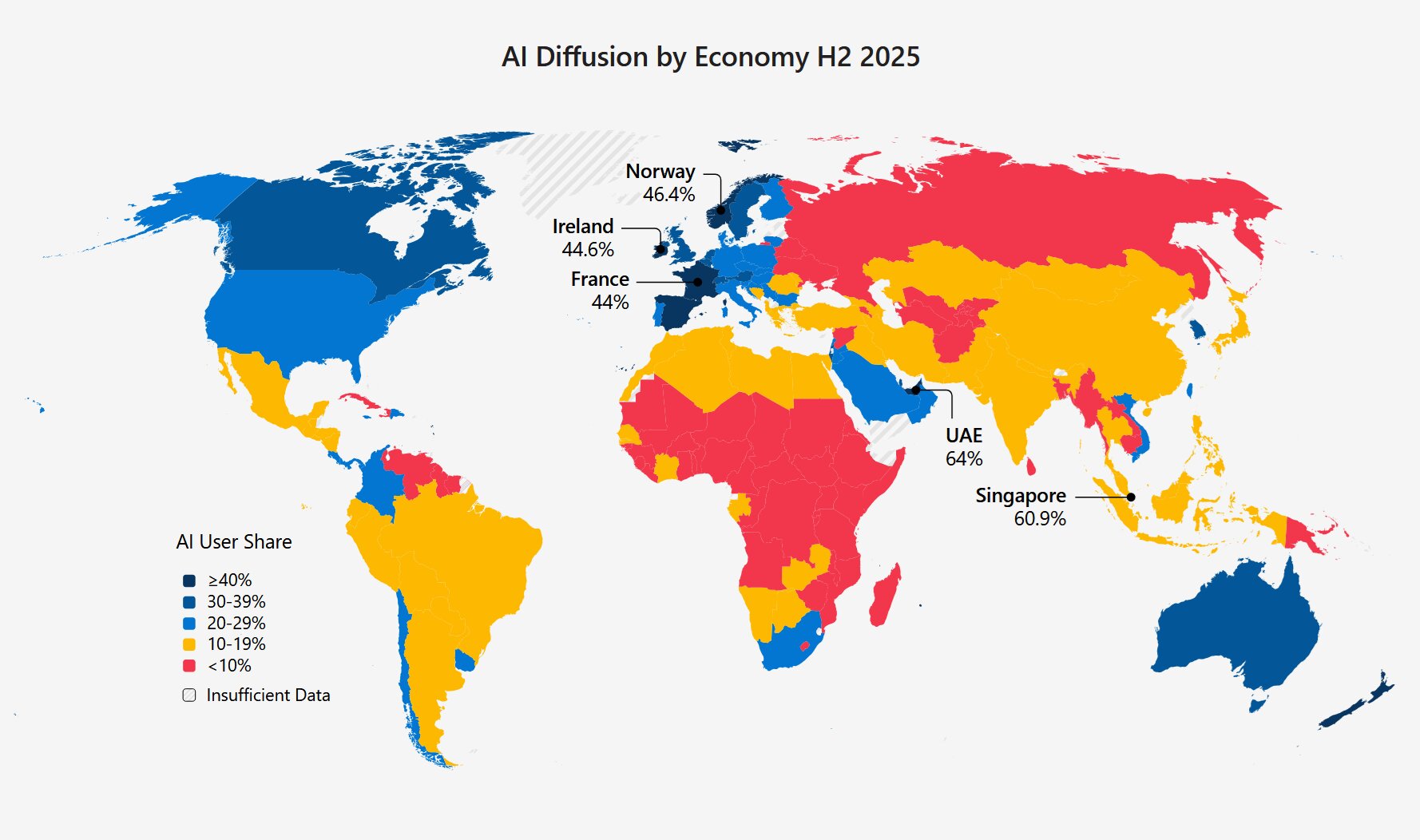
In January 2026, the Microsoft AI Economy Institute published a report titled "Global AI Adoption in 2025 — A Widening Digital Divide." This document charts how artificial intelligence spread around the world in the second half of 2025. It focuses on generative AI tools, such as chatbots and image-generation systems. The data shows that approximately one in six people on the planet uses these tools, which is astonishing progress for a technology that only recently became mainstream. The report is based on aggregated and anonymized Microsoft data adjusted for operating system market share, internet penetration, and population size in individual countries. This ensures that the figures reflect the actual situation around the world.
How was the research conducted?
AI adoption is measured based on the proportion of working-age people who used a generative AI product during the period under review. The data comes from Microsoft telemetry, meaning usage is monitored without identifying individuals. The figures are then adjusted to account for differences in the device market, internet availability, and population size across countries. The report acknowledges that no metric is perfect and plans to expand it in the future to include additional indicators, such as the impact on scientific progress or productivity.
The research divides the world into the Global North (advanced economies) and the Global South (developing countries). It tracks changes from the first half of 2025 (H1) to the second half (H2), with data through the end of the year. For example, global adoption was 15.1% in H1 and rose to 16.3% in H2. The gap between the North and South widened from 9.8% to 10.6%.
Key findings
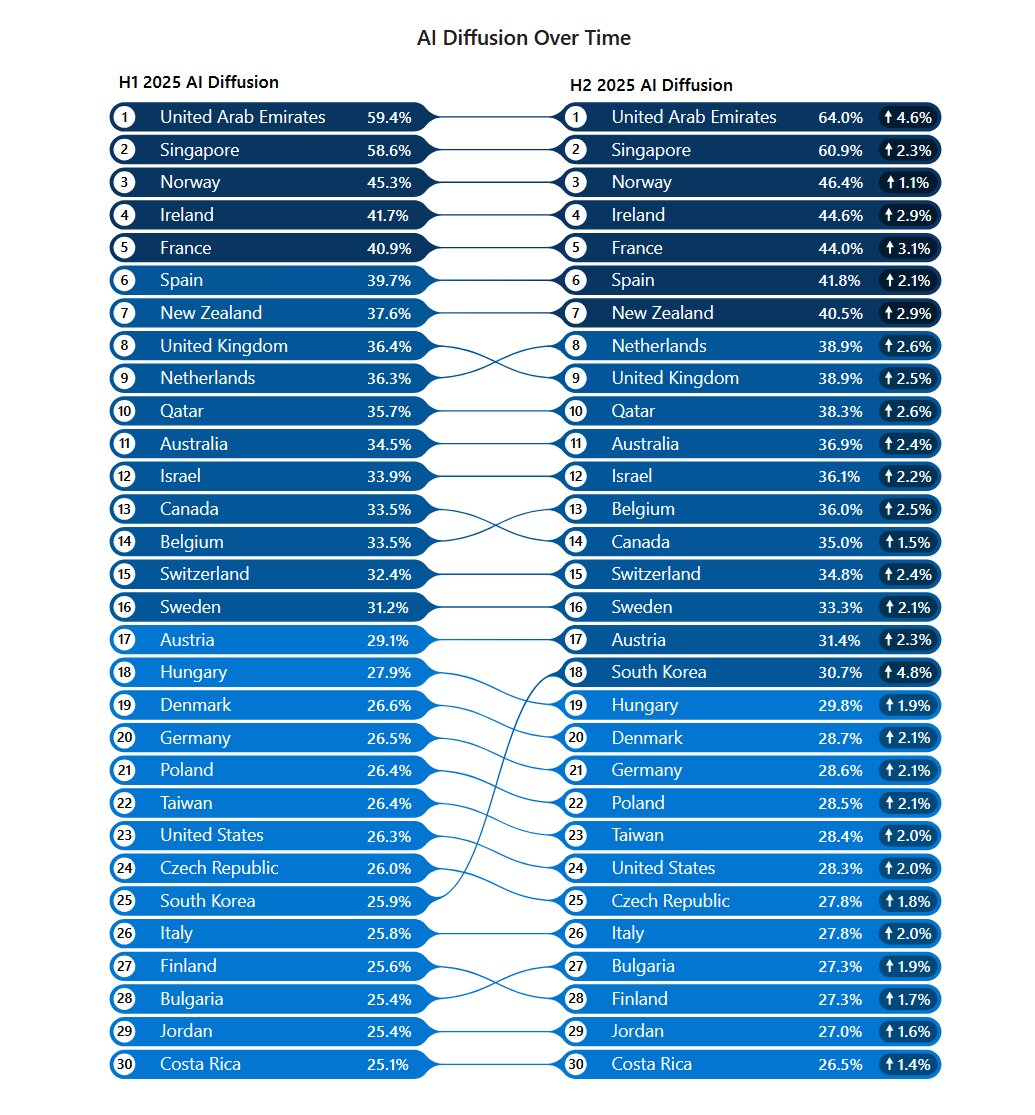
The United Arab Emirates has the highest adoption rate, at 64.0% of its working-age population, an increase of 4.6% compared with H1. Singapore is second at 60.9%, followed by Norway (46.4%), Ireland (44.6%), and France (44.0%). These countries have invested in digital infrastructure, AI education, and government use.
A major surprise is South Korea, which jumped from 25th to 18th place with 30.7% adoption, an increase of 4.8%. This was due to government policies such as the establishment of the National AI Strategy Committee in September 2025 and the AI Basic Act. Improvements to models such as GPT-4o and GPT-5 in Korean also helped, with scores on the Korean SAT benchmark rising from 16 to 100. The viral trend of generating Ghibli-style images in April 2025 attracted millions of new users.
The growing influence of open-source AI
The report highlights the rise of DeepSeek, an open-source platform under the MIT license with a free chatbot. This model has gained traction in China, Russia, Iran, Cuba, Belarus, and especially Africa, where it is 2 to 4 times more popular thanks to partnerships with Huawei. This reflects the competition between the US and China to spread their models.
By contrast, the US fell to 24th place with 28.3%, despite leading in innovation. Adoption is growing globally, but unevenly—the ten countries with the largest increases are all advanced economies. The report concludes with a list of hundreds of countries, ranging from the UAE to Cambodia at 5.1%.


