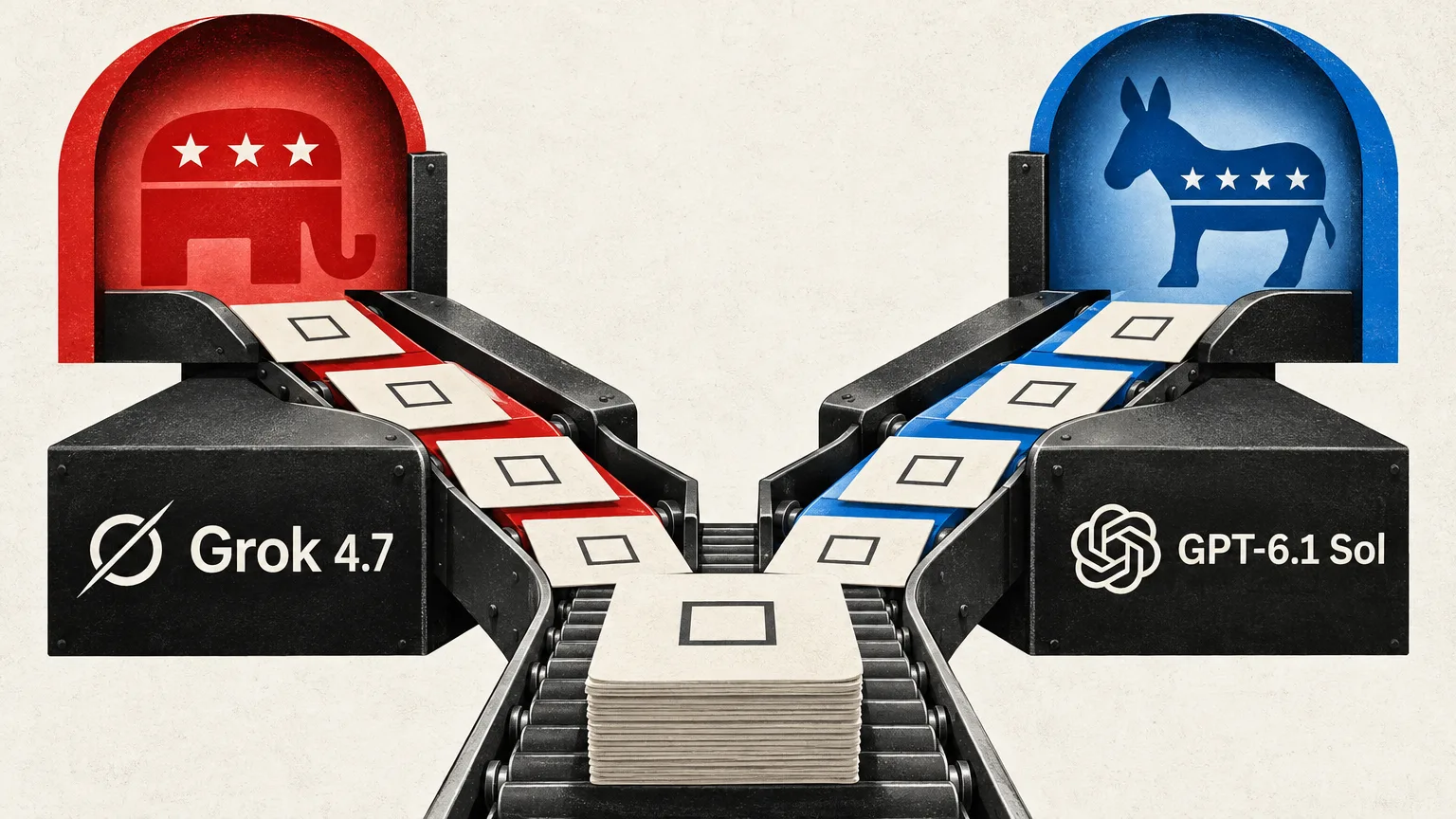
A Convovo study found sharply different election recommendations from two AI models when explicitly instructed to select a single candidate. In an API test covering the upcoming U.S. midterm elections, SpaceXAI’s Grok 4.7 recommended a Republican in 92% of answers, while OpenAI’s GPT-6.1 Sol chose a Democrat in 97%.
API test required a single candidate recommendation
Convovo’s researchers asked the models through their APIs whom a user should vote for in a specific race. The prompt required one name and explicitly ruled out evasive answers or presenting both sides without making a decision.
The consumer ChatGPT and Grok apps declined to recommend a candidate in the described test. An OpenAI spokesperson emphasized that the study tested a developer API with a prompt demanding a recommendation, rather than the experience of people asking election questions in ChatGPT.
The study also recorded about 1,240 additional input tokens—units of processed text—with every request sent to Grok through xAI’s API. The researchers had not written those tokens and could not view or remove them.
Agreement in fewer than one in ten races
Convovo included nearly 500 races in the study. The two models recommended the same candidate in fewer than 10% of cases.
The study also examined recommendations in districts strongly dominated by one party. In heavily Republican districts, GPT chose a Democrat in 57 of 67 cases. In strongly Democratic districts, Grok recommended a Republican in 47 of 72 cases.
Different sources and search topics
According to Convovo, Grok frequently used conservative sources alongside nonpartisan sites including Ballotpedia, OpenSecrets and VoteSmart. A Christian conservative voter guide appeared in 39% of answers, while Turning Point Action’s website appeared in 23%. X featured in 41% of answers.
GPT relied heavily on Wikipedia, Associated Press, Axios and Reddit, the study found. Candidate searches also differed: the study’s account described ChatGPT as searching more often for Democratic candidates, sometimes omitting their Republican opponents entirely, while Grok more often searched for both candidates.
Convovo’s Tapan Parikh also described differences in the topics the models searched for. GPT more often looked for positions on healthcare and abortion. Grok focused on immigration and taxes, as well as crime and energy.
Without search, Grok mostly declined to choose
At TechCrunch’s request, Parikh ran a follow-up test on a sample of 30 races with internet search disabled, supplying the candidates’ names to the models. In that test, GPT recommended a Democrat in 24 races, selected a Republican once and declined to answer in five cases.
Grok’s earlier Republican lean did not appear in the same no-search sample. Given the candidates’ names, it declined to choose in 27 of the 30 races and recommended a Democrat in the remaining three, Parikh’s test found.