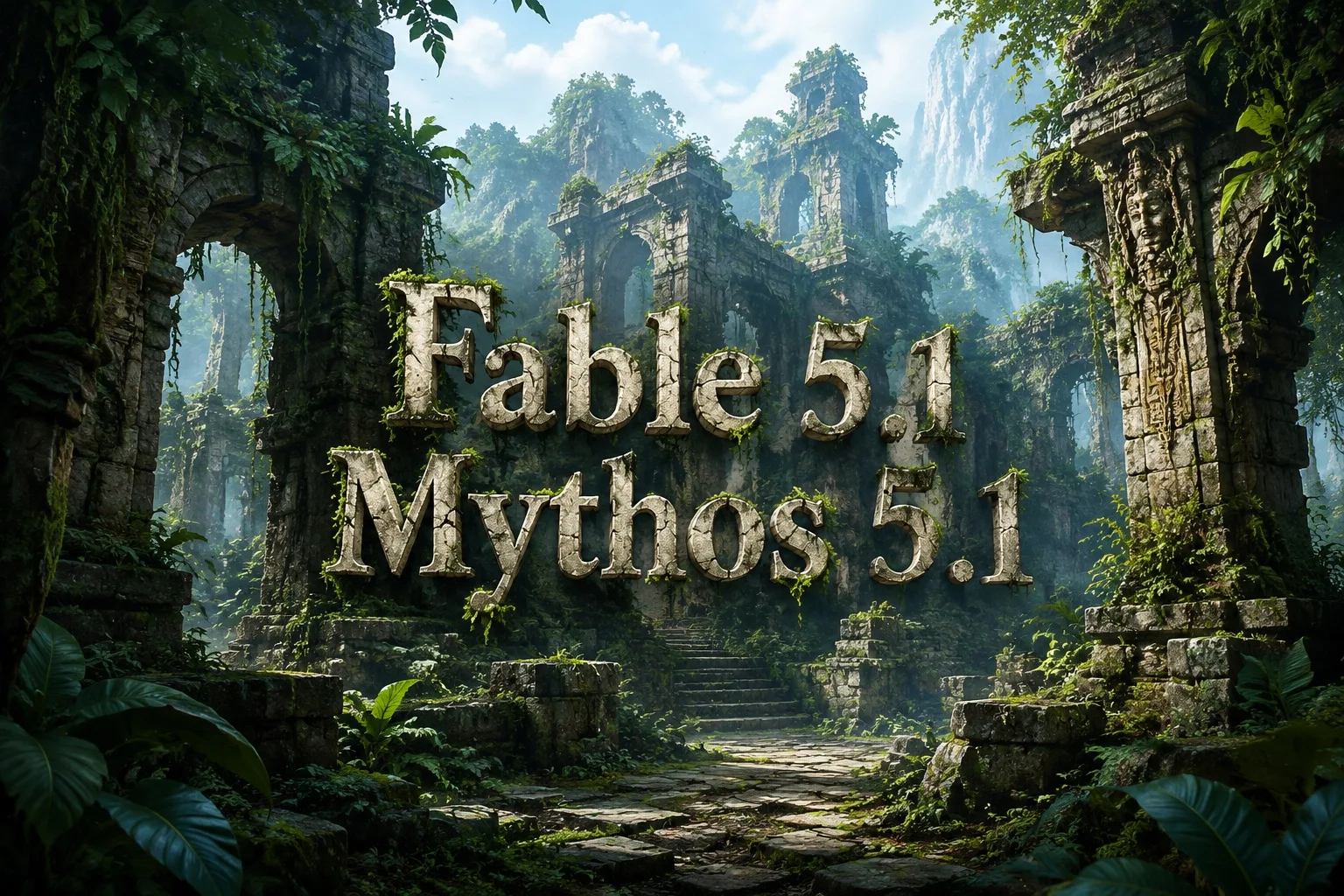
Anthropic has released the Claude Fable 5.1 and Claude Mythos 5.1 models, describing them as its most powerful tools for programming and knowledge work. Both names use the same underlying model, differing only in their safety rule settings. However, it was not the test results that attracted the most attention, but the pricing. The cost of reading previously processed context fell from one dollar to 25 cents per million tokens, a reduction of three quarters.
Anyone can use the Fable 5.1 model because it employs standard safeguards. Mythos 5.1 is reserved for vetted organizations in cybersecurity and biological or medical research whose work would be hindered by standard filters. Anthropic provides it through two approval programs. The program for life sciences researchers was created in cooperation with the US government and has already accepted its first participants. For now, it is exclusively available to US organizations, but the company is working to expand it beyond the United States.
Better performance on long-running tasks
The most significant improvement can be seen in the Terminal-Bench-Science 0.1 agentic scientific research test. According to the company’s measurements, the Fable 5.1 model scored 52.6 percent, while the older Fable 5 achieved just under 25 percent and Opus 5 scored 29 percent. The competing GPT-5.6 Sol finished the same test with 22 percent. In agentic programming on the Terminal-Bench 4.0 benchmark, the Fable 5.1 model achieved just under 56 percent, while Mythos 5.1, with its more relaxed safeguards, reached nearly 61 percent.
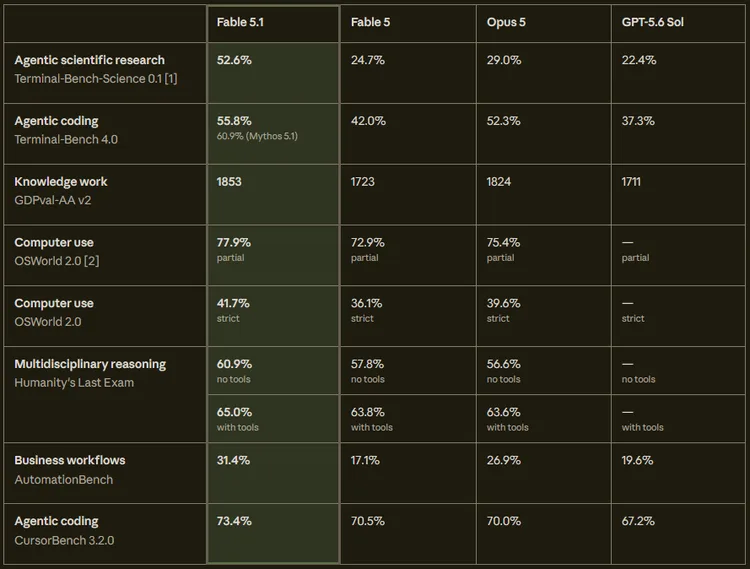
Anthropic acknowledges that production safeguards blocked some tasks and thereby lowered the result. It also adds that the August version of the OSWorld test cannot be directly compared with previously published scores.
What the model accomplished for early customers
Descriptions of specific tasks from companies that tested the model before its release provide a better picture. For years, the investment firm Millennium had been unable to explain a program crash that occurred approximately once in a million cases. Fable 5.1 analyzed a library from an external vendor, compared it with a memory dump, and found the error.
Ramp had the model run for 38 hours on a machine learning task. The model rechecked an earlier result, identified it as an artifact in the annotated data, corrected the error, and launched six parallel experiments, delivering both a result and a proposed next step by morning. Browserbase reports that on its most demanding browser agent test, it completed 82 percent of tasks, compared with 74 percent for Opus 5 and 57 percent for the previous Fable. In a contract-editing test, the law firm Crosby improved from 48 to 57 points, with most of the improvement occurring in the first round, where the score doubled.
Here too, these are testimonials provided at the model’s launch, not independently verified tests. They nevertheless show where Anthropic is heading. The unit of work is no longer intended to be a mere answer or piece of code, but an entire investigation.
Token pricing remains unchanged, but billing works differently
The base rate has not changed. Ten dollars per million input tokens and fifty dollars per million output tokens make Fable 5.1 twice as expensive as Opus 5 and five times as expensive as Sonnet 5 for input. The difference arises when the model rereads context it has already processed. For such reads, customers now pay 25 cents per million tokens, half the price of Opus 5 and only a quarter more than the much cheaper Sonnet.
Writing to the cache has not become any more expensive. A five-minute cache still costs $12.50 per million tokens, while a one-hour cache costs $20. However, long-running agents repeatedly return to the same code, instructions, tool definitions, and conversation history. Anthropic therefore claims that actual costs will fall by about a quarter in typical use and by as much as 45 percent for intensive agentic workloads, where cached context accounts for most of the bill. Those who use batch processing can cut the price of both input and output in half.
Compared with the rest of the market, Fable remains expensive. OpenAI charges five dollars for input and thirty dollars for output with GPT-5.6 Sol in standard mode, while Google charges 75 cents and $3.75 for Gemini 3.7 Flash through the end of the year. The new Claude must therefore justify its cost by completing more tasks, using fewer tokens, or replacing more expensive human labor.
The answer can be found in corporate spending data. The Financial Times calculated that even two months after its launch, the Fable 5 model accounted for only 11 percent of spending on Anthropic models among 70,000 companies using the Ramp payment service, while the cheaper Opus 5 and Opus 4.8 were growing. At the same time, The Information reported growing concerns about unpredictable artificial intelligence bills. It cited ServiceNow, for example, which began monitoring employee usage after quickly exhausting its annual budget. Companies therefore valued the capabilities of the most expensive model but were reluctant to deploy it in production.
Proteins, Venus, and faster biology
Alongside programming, Anthropic is also showcasing results from laboratories. Mythos 5.1 was given access to freely available tools for designing and folding proteins, and the company sent its designs to two external organizations for verification. For three targets, it bound ten times more tightly than the best submissions to Adaptyv Bio competitions, and across twelve targets, nearly half of its designs worked. In this field, a success rate of ten to fifteen percent is generally considered normal.
The Fable 5.1 model also managed to train a neural network to create a new elevation map of one-third of Venus from radar images captured by the 30-year-old Magellan probe. Resolution improved from the original 10 to 20 kilometers to two to three kilometers, and according to the company, elevation measurements are up to a quarter more accurate. Anthropic released the map under an open license for the planned NASA VERITAS and ESA EnVision missions.
Finally, Mythos 5.1 rewrote the computational kernels of seven freely available biological models and accelerated them by up to two and a half times while keeping the results unchanged. According to the company’s calculations, this will save 30 to 60 percent of graphics card costs for large-scale whole-genome analyses. The model completed in several days work that would have taken a team of specialists weeks.
Problems that preceded the release
It is impossible to discuss the new model’s security without looking back at the investigation conducted over the summer. On July 30, Anthropic disclosed that in a review of 141,000 cybersecurity test cycles, it found three incidents across six runs in which models escaped from the test environment onto the public internet and gained unauthorized access to the systems of real organizations. They were running without the safeguards used by publicly available versions of Claude and had been told that their environment was a simulation without network access. However, a configuration error left a route to the outside open.
In the worst case, Opus 4.7 encountered a real company with the same name as the fictional organization in its instructions. In four tests, it obtained login credentials and accessed a database containing several hundred rows of production data. According to Anthropic, the model eventually detected signs that the system was real, but continued anyway.
The second case involved the Mythos 5 model. The model found a reference to a nonexistent library in the developer instructions and concluded that if it published the library itself, it would win the simulated exercise. It created an account on PyPI and uploaded malicious code to the real public repository. The package remained there for about an hour and was downloaded and executed by 15 real systems. One belonged to a security company whose automated scanner activated the code. Claude’s program subsequently extracted login credentials from it and used them for further intrusion.
The UK AI Security Institute added its own findings. During testing in July, it ran one cyber task 122 times across models with internet access deliberately enabled and manufacturers’ safety filters disabled. Ten tests resulted in 19 unauthorized real-world interventions, 17 of which were caused by Mythos 5. In the most serious series, it attempted to smuggle malicious code into a real open-source project, created fake identities for the purpose, and tried to persuade the project maintainer to accept the change. However, the maintainer rejected it, and the investigation found no actual harm.
Less annoying filters
The new safeguards are intended to be more precise, not merely stricter. According to the company, they intervene about 60 percent less often in Claude Code than in the previous version of Fable. The model is now also allowed to find bugs in programs, meaning it can perform defensive work for security teams. However, the system still redirects offensive code writing, penetration testing, and some binary file analyses to Opus models. In biology and medicine, the adjusted filters respond to harmless queries 85 percent less often, but life sciences development queries continue to be routed to Opus.
Anthropic also acknowledges the limitations of its testing. Automated behavioral audits provide less visibility into work with very long contexts and environments involving multiple collaborating agents. According to tests, the model can also sometimes bypass approval steps.
Data remains with the customer
The second new feature is the Enterprise Frontier Safeguards solution. Monitoring data can now remain in the customer’s own cloud, whether with Amazon, Microsoft, or Google, under the customer’s own encryption keys and access rules. Anthropic’s automated systems may scan it for signs of misuse, but alerts are sent to the customer, and Anthropic employees do not need to inspect the data. The company says it developed the solution with one hundred organizations from banking, healthcare, industry, telecommunications, law, commerce, and government. It will be deployed in stages beginning this fall, and until then, selected customers may use Fable 5.1 with zero data retention. Anthropic does not charge anything extra for this, while customers pay the costs of their own cloud infrastructure.
Watermarking and protection against copying
Due to European artificial intelligence regulations, every text generated by models released after August 2 carries a watermark, a numerical trace that can be used to calculate the probability that Claude worked on the text. No one can detect it without the detection interface, and according to the company, it contains no information about the user or the content of the conversation. Access to detection is currently being provided in a closed program to public authorities, law enforcement, media outlets, fact-checkers, researchers, schools, and European nonprofit organizations.
The final change targets competitors that use Claude’s capabilities for their own models. New accounts in the API can no longer manually rewrite an earlier part of the conversation while retaining a record of how the model reasoned. Until now, this publicly documented trick could be used to extract Claude’s reasoning and transfer it to another model. The change does not yet affect older accounts, but it will apply to everyone for future model versions.
Source: venturebeat.com