


Researchers from the National University of Defense Technology in China are collaborating with Midea Group to develop the HumanoidExo system. This wearable suit captures human movements in real time and transfers them directly to robots. This allows robots to learn complex tasks faster and more accurately, without the need to collect vast amounts of data from videos or simulations. The system addresses the balance problem that often affects humanoid robots trained using traditional methods.
How the HumanoidExo System Works
The wearable suit in the HumanoidExo system tracks seven joints in the human arms and maps them to the robot’s movements. It uses inertial sensors on the wrists and a LiDAR scanner (laser rangefinder) on the back to monitor changes in body position and height. This data is processed by a two-part artificial intelligence system called HumanoidExo-VLA. The first part, the Vision-Language-Action model, understands what task the person is performing. The second part, a reinforcement learning-based controller, ensures that the robot maintains balance and stability during movement.
The researchers emphasize that collecting real-world data is difficult and expensive. HumanoidExo simplifies this by directly recording the movements of the person wearing the suit. For example, the robot learned to walk to a table even though such movements were not explicitly included in the training data. The system achieved a 100 percent success rate when manipulating objects without losing balance.
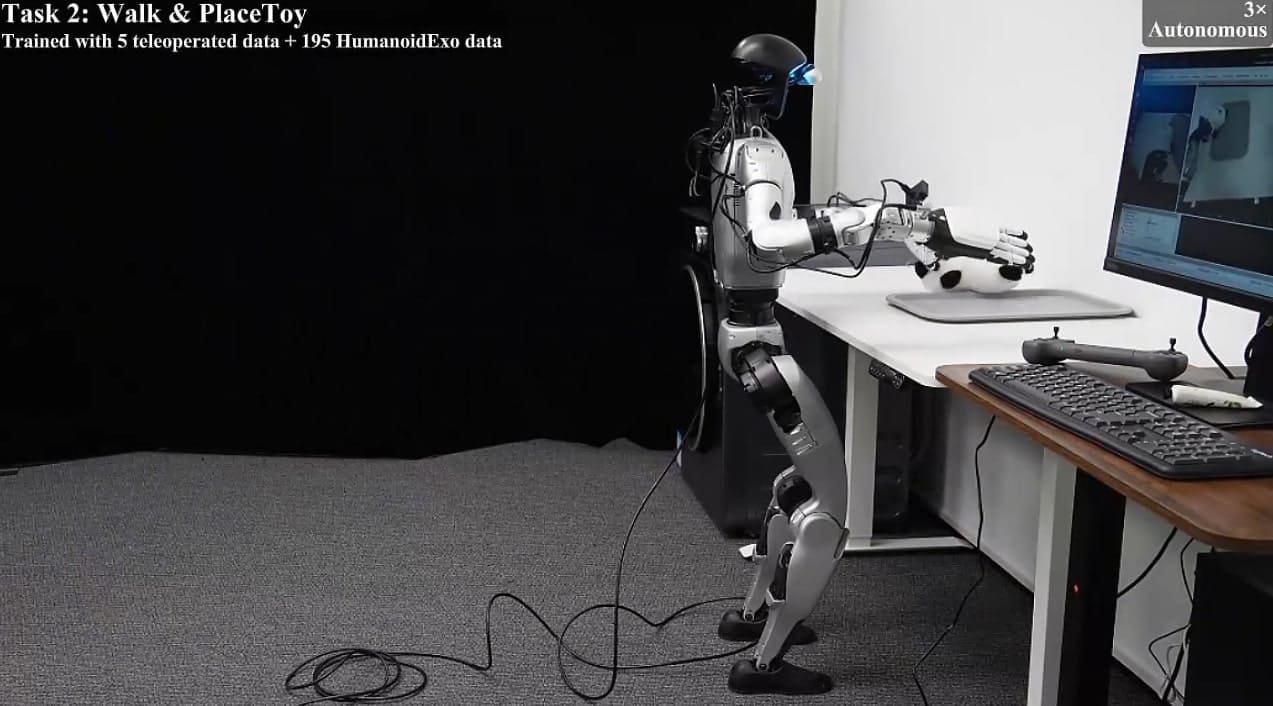
Experiments with the Unitree G1 Robot
In the tests, the researchers used the Unitree G1 robot. They trained it using five teleoperated sessions and 195 recordings from the exoskeleton. This combination of data increased the robot’s success rate in an object transfer task from just 5 percent to nearly 80 percent. This is close to the performance that would require 200 human demonstrations.
In one test, the researchers physically pulled the robot away from the work surface. The Unitree G1 was able to return to its position and complete the task. The robot performed complex actions, such as picking up and placing objects, with high accuracy. These results come from a research paper published last week.
Development in China and Globally
China is developing exoskeletons not only for robots but also for military and civilian purposes. The military uses powered and passive exoskeletons for logistics, high-altitude operations, and lifting heavy loads. These systems increase soldiers’ endurance in challenging terrain. In the civilian sector, there are lightweight knee braces for industrial or recreational use, as well as full suits with advanced assistive modes.
China has opened the largest training center for humanoid robots, where approximately one hundred robots learn complex warehouse tasks using virtual reality and motion capture. They achieve a 95 percent success rate in sorting and packaging. The goal is to deploy one hundred million robots by 2045.
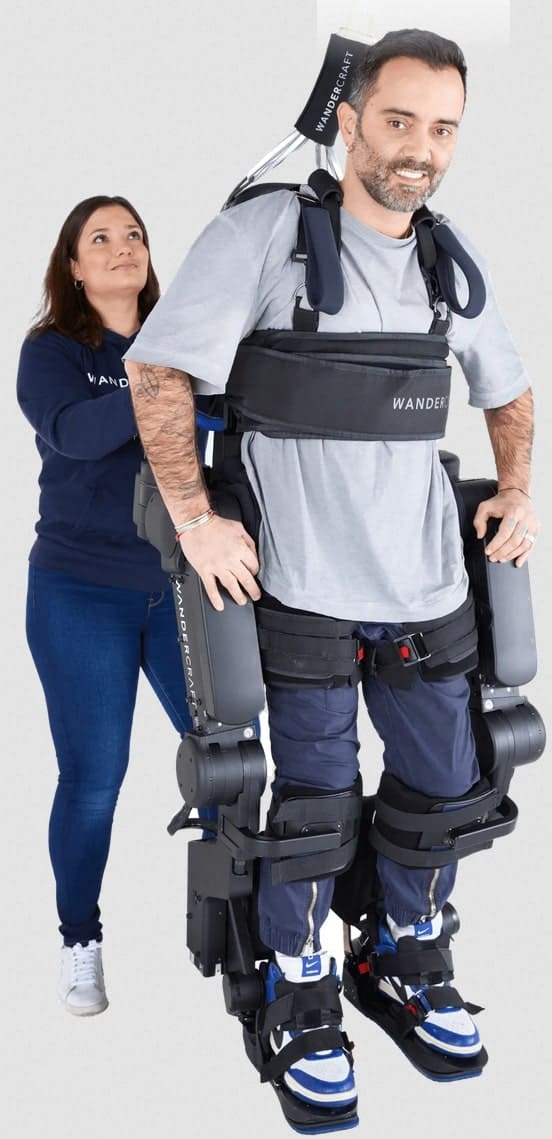
A global race in humanoid robotics is underway. Companies such as NVIDIA, Google DeepMind, and Figure are working on scaling up robot training. The French company Wandercraft, known for its Atalante X suit from the 2024 Olympics, has moved into humanoid robotics and unveiled the Calvin 40 model in June. CEO Matthieu Masselin noted that humanoid robots are appearing everywhere, from the US to China, including projects by Tesla and Figure AI. For Wandercraft, this is the same technology it has been developing for ten years.
Source: interestingengineering.com, unitree.com, wandercraft.eu


