

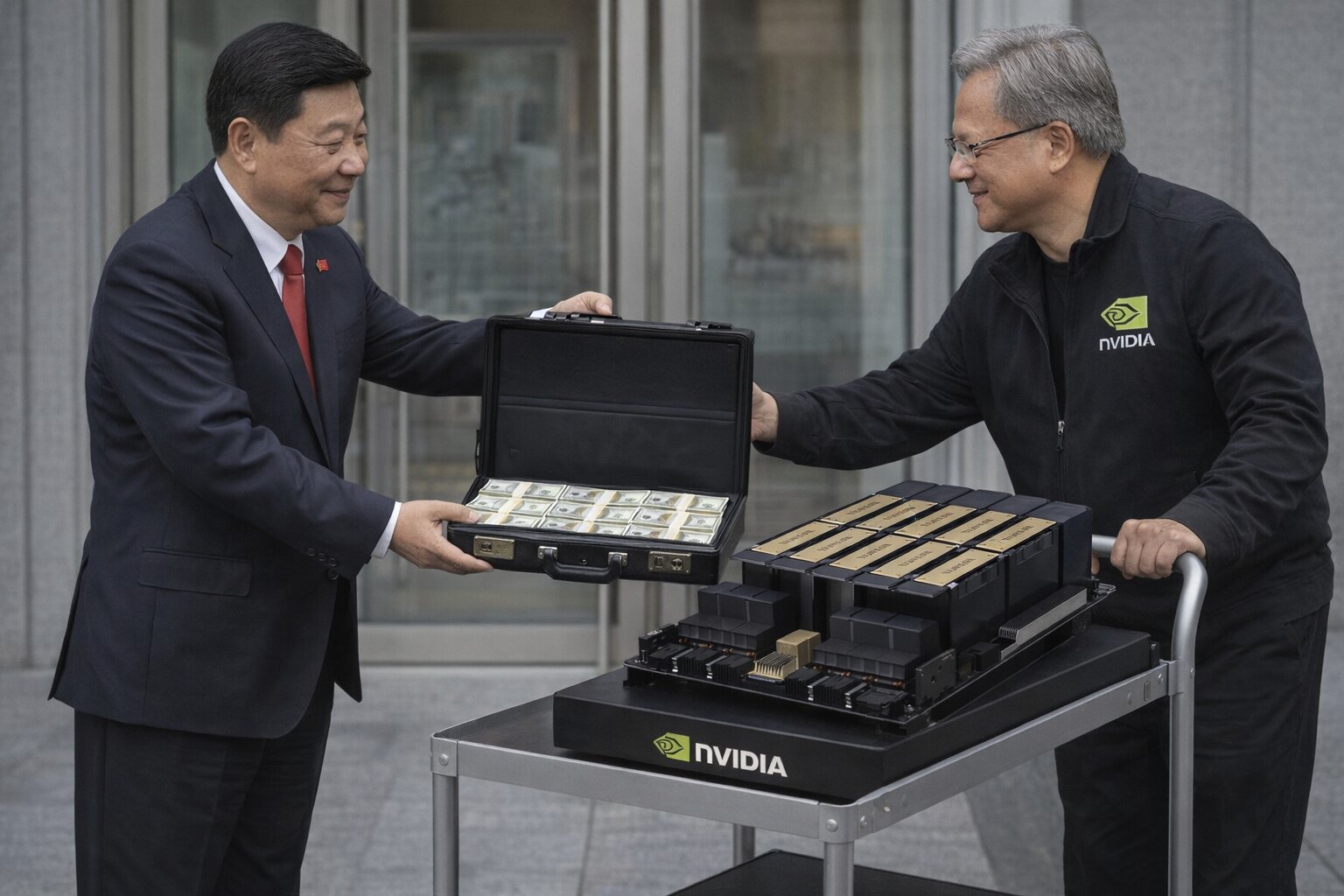
China has given three of its largest technology companies the green light to purchase Nvidia H200 chips for artificial intelligence. According to four sources familiar with the situation, ByteDance, Alibaba, and Tencent have received approval to purchase more than 400,000 H200 chips. Other companies are now lining up for the next round of approvals.
Regulatory approval came during Nvidia CEO Jensen Huang's visit to China this week, one of the sources said. Huang arrived in Shanghai last Friday for annual celebrations with Nvidia's Chinese employees and subsequently traveled to Beijing and other cities.
Approval conditions remain unclear
The Chinese government is granting approval only under certain conditions, which are still being negotiated. A source said the licenses are too restrictive, and customers have not yet converted the approvals into purchase orders. Chinese government officials previously told domestic technology companies at meetings that they should purchase the chips only when necessary. One proposal previously discussed by Chinese authorities would require each H200 purchase to be tied to a certain proportion of domestically produced chips.
Chinese technology companies have placed orders for more than 2 million H200 chips for 2026, while Nvidia currently has only 700,000 units in stock. Of this inventory, approximately 100,000 units are GH200 Grace Hopper superchips, which combine Nvidia's Grace processor with the Hopper GPU architecture, while the remainder consists of standalone H200 chips.
Nvidia approached manufacturer TSMC (Taiwan Semiconductor Manufacturing Co) to increase production. Another source said Nvidia asked TSMC to begin manufacturing additional chips, with production expected to start in the second quarter of 2026.
Price and performance of H200 chips
Nvidia has decided which H200 variants it will offer to Chinese customers and priced them at approximately $27,000 (roughly CZK 620,000) per chip. An eight-chip module is expected to cost around 1.5 million yuan (about CZK 5.1 million), slightly more than the previously unavailable H20 module, which sold for approximately 1.2 million yuan.
The H200, Nvidia's second most powerful AI chip, delivers approximately six times the performance of the H20 chip. Chinese internet companies consider the price attractive because it represents an approximately 15% discount compared with gray-market alternatives, which currently sell for more than 1.75 million yuan.
Geopolitical context vs. domestic chips
The approval comes after the United States formally allowed Nvidia to sell the H200 to China in early January. President Donald Trump's administration authorized H200 exports subject to a 25% fee, reversing the Biden administration's ban on exporting advanced AI chips to China. The first batch of H200 chips is expected to arrive before the Lunar New Year holiday in mid-February. It remains uncertain how many other companies will receive approval in subsequent batches or what criteria Beijing uses to determine eligibility. The H200 approval suggests that Beijing is prioritizing the needs of major Chinese internet companies, which are spending billions of dollars to build the data centers required to develop AI services and compete with U.S. rivals, including OpenAI.
While Chinese companies such as Huawei now have products that rival the performance of Nvidia's H20 chip, they still lag significantly behind the H200. Chinese chipmakers do not yet have any equivalents to the H200. However, Beijing has discussed requiring companies to purchase a certain quota of domestic chips as a condition for receiving approval to import foreign semiconductors. This measure is intended to support the development of the domestic AI semiconductor industry.
Sources: reuters.com and wsj.com


