

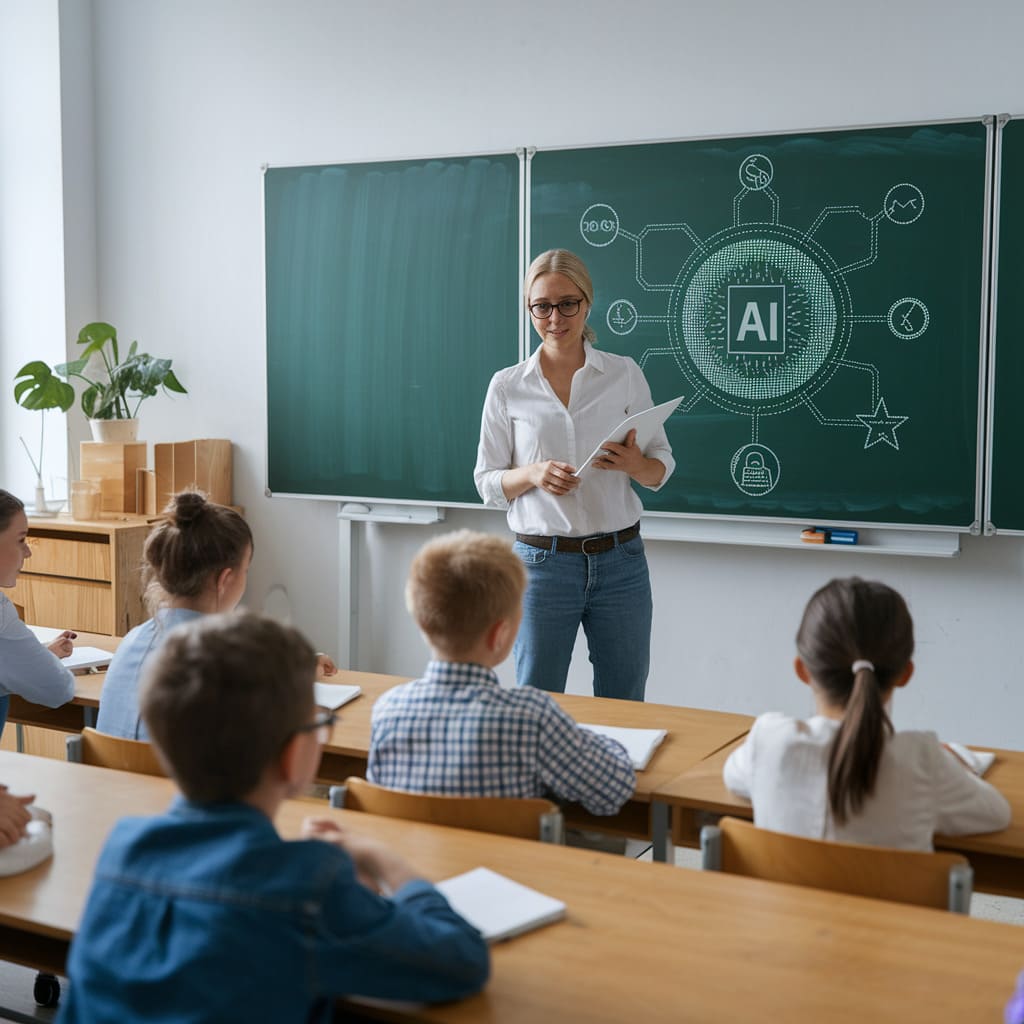
Artificial Intelligence in Czech Education: The Present and the Future
In recent years, artificial intelligence (AI) has become an integral part of our lives, and the Czech education system is gradually responding to this technological change. But how is the Czech Republic really doing in implementing AI in education? What are the current trends, and what should the meaningful integration of these technologies into our schools look like?
The Current State of AI in Czech Schools
According to recent research reported by Seznam Zprávy, Czech pupils use artificial intelligence most often in Czech language classes. Interestingly, most teachers ignore this technology in their teaching, even though it could bring significant benefits. The paradoxical situation was revealed by an article on Novinky - while teachers often express disapproval of students using AI, they themselves use this technology. This creates a certain contradiction: teachers do not want students to use tools such as ChatGPT for their assignments, yet they themselves use AI to make lesson preparation or administrative work easier. The AIdětěm.cz initiative is trying to change this situation and supports the meaningful use of artificial intelligence in education. It focuses on helping children learn to work with AI critically and use it as a supportive tool for their learning, rather than as a means of bypassing their own thinking.
What the Implementation of AI in Czech Education Should Look Like
To fully harness the potential of artificial intelligence in education, several obstacles need to be overcome. First and foremost, teachers should receive systematic training in AI. As the sources indicate, many educators currently tend to ignore AI because they lack sufficient knowledge and confidence to use it. The Czech education system should:
- Create a unified framework for the use of AI in education.
- Invest in training educators in new technologies.
- Update curricula to reflect technological changes.
- Support students' critical thinking when working with AI.
- Develop schools' digital infrastructure.
It is also important to change the way students are assessed. If students can easily create essays using ChatGPT, we need to reconsider what types of assignments we give and how we assess students' knowledge.
Inspiration from Abroad
While the Czech Republic is still grappling with the implementation of AI, some foreign education systems have already progressed further. For example, Scandinavian countries are integrating AI into teaching systematically and teaching students how to use these tools effectively and ethically. Finland, for instance, has adapted its educational programs to include teaching about AI and its use as part of ordinary digital literacy. Singapore, meanwhile, is investing in the development of personalized AI-based educational systems that adapt to the needs of individual students. The United Kingdom and the USA offer teachers specialized courses focused on integrating AI into teaching, an approach that could also serve as inspiration for the Czech environment.
Applications Designed for Learning
There are already many educational applications on the market that use artificial intelligence and can significantly help students with their studies. One of the most popular is Photomath, an application that simplifies the way students learn mathematics. Photomath allows users to scan a mathematical problem or equation with a smartphone camera and displays its solution within moments. What is particularly valuable for the learning process, however, is that the application does not provide only the final result, but also offers a detailed step-by-step explanation of the entire process. Students can thus understand the principle behind the solution and learn how to solve similar problems independently. The application handles a wide range of mathematical problems, from basic arithmetic operations to more complex algebra, trigonometry, or calculus.
Such applications represent a double-edged sword for the Czech education system – on the one hand, they can serve as excellent study aids for home preparation; on the other hand, there is a risk that students will use them only to obtain answers without actually understanding the subject matter. The key is therefore to teach pupils to use these tools meaningfully, as a supplement to traditional teaching rather than as a replacement for it. Teachers should be familiar with these applications and actively integrate them into their teaching methods.
Conclusion
Artificial intelligence represents both a challenge and an opportunity for the Czech education system. The current situation, in which students use AI primarily in Czech language classes while teachers often ignore the technology or have an ambivalent attitude toward it, is not sustainable in the long term. Successful integration of AI into education requires a systematic approach that includes teacher training, curriculum updates, and the creation of ethical frameworks for using these technologies. We can draw inspiration from abroad, where some countries have already made progress in implementing AI in their education systems. Initiatives such as AIdětěm.cz show that there is interest in the meaningful use of AI in education in the Czech Republic. It is now up to the responsible institutions to turn this interest into concrete steps that will help the Czech education system keep pace with technological development and prepare students for a future in which artificial intelligence will play an increasingly important role.


