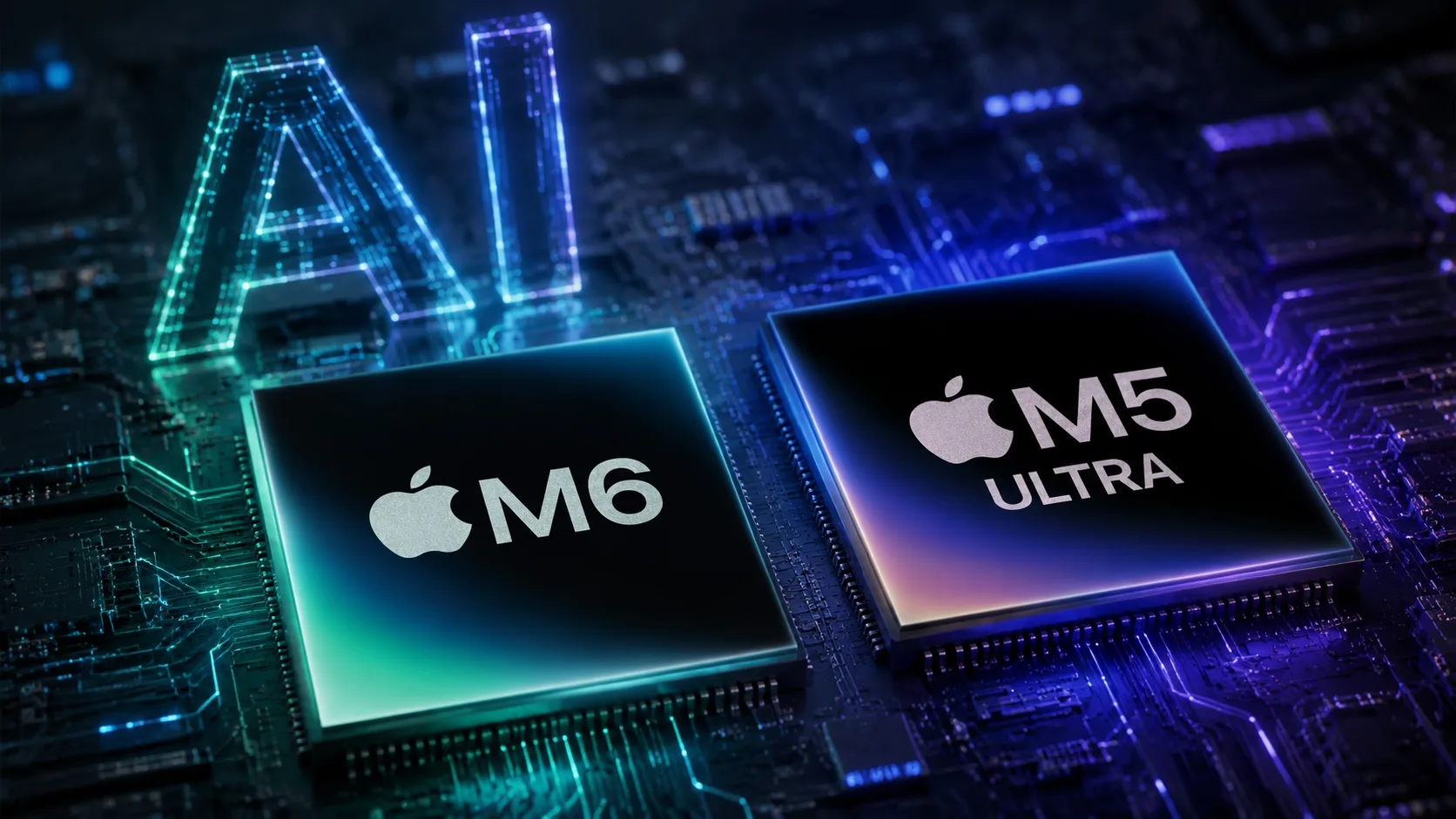
On August 25, Apple unveiled a new Mac mini and a new generation of Mac Studio. The small desktop is now available with either an M6 or M5 Pro chip. Preorders started on the day of the announcement, and the computers will go on sale on September 22. The entire announcement revolves around one thing: artificial intelligence running directly on the computer rather than on remote servers. Apple promises that the M6 version will deliver up to four times faster AI performance, twice as fast graphics and storage, and a 40 percent faster processor compared with the previous model featuring the M4 chip.
New M6 chip
The M6 is Apple's first-ever chip manufactured using a two-nanometer process. This allowed more transistors to fit into a smaller silicon area, which the company has translated into higher performance and better energy efficiency.
The processor section received two new compute units. The twelve-core CPU consists of two super cores, four performance cores, and six efficiency cores. The super cores handle tasks running on a single thread. The performance cores join them for more demanding computations, while the efficiency cores handle routine background processes. Apple claims up to 1.2 times faster multi-threaded performance than the M5 chip and roughly 2.4 times the performance of the M1. In practice, this means faster photo editing, code compilation, file indexing, and operations performed by agents that plan and execute steps on their own.
The GPU also has twelve cores, each with an integrated so-called Neural Accelerator. This increases peak AI graphics performance by roughly 30 percent compared with the M5 and by more than eight times compared with the M1. This will be particularly noticeable when processing prompts while interacting with a language model directly on the computer. The hardware also includes an updated shader architecture, Dynamic Caching, hardware-accelerated ray tracing, and 50 percent higher geometry throughput.
The new feature Apple highlighted most is the dual Neural Engine. Two sixteen-core units offer up to twice the peak performance of the previous generation. System libraries can use both units simultaneously, allowing applications to run models faster.
Mac mini with M6 and what it can do
The base configuration offers 16 GB of unified memory, expandable to 32 GB, with bandwidth of up to 170 GB per second. Memory is precisely what determines how large a model the computer can accommodate and how quickly it can respond.
Apple also provided benchmark results. In LM Studio, the new Mac mini is said to process prompts for a language model up to 13.5 times faster than the M1 model and up to 4.8 times faster than the M4 version. Spreadsheet calculations in Microsoft Excel are said to be 2.3 times faster than on the M1 and 1.5 times faster than on the M4. Gaming with ray tracing in Cyberpunk 2077 will then deliver up to twice the frame rate of the M4. This is the first time Neural Accelerators have been added to the Mac mini's GPU. That explains why Apple describes it as a major leap rather than a minor improvement.
Mac mini with M5 Pro
The M5 Pro is not based on a newer architecture like the M6, but on a higher-tier chip with more cores and substantially more memory. The M5 Pro offers up to an eighteen-core processor and twenty-core GPU with an improved shader core and third-generation ray tracing, making it a configuration suitable for 3D design, visual effects, and game development. Here too, every GPU core has Neural Accelerators. This enables the computer to handle photo and video upscaling or larger diffusion models.
The key difference lies in memory. The M5 Pro supports up to 64 GB of unified memory with bandwidth of 307 GB per second, opening the door to larger local models, complex 3D scenes, ProRes RAW editing, and work with extensive datasets. In LM Studio, prompt processing is said to be up to 8.5 times faster than on the Mac mini with M2 Pro and four times faster than on the M4 Pro version. Ray-traced rendering in Blender is up to 4.5 times faster than on the M2 Pro, while image processing in Affinity is 2.1 times faster. Apple emphasizes this model's quiet operation and low power consumption because it sees it as a machine designed for continuous operation, running AI agents or creative workloads.
The difference between the two models, therefore, is not that one is clearly better. The M6 offers faster individual cores and a more advanced manufacturing process. The M5 Pro has more cores and, above all, can handle larger models thanks to its higher memory capacity and bandwidth.
Connectivity and the ability to link multiple Macs together
Both models feature Wi-Fi 7, Bluetooth 6, and 2.5Gb Ethernet, with a 10-gigabit option available. On the front, there are two USB-C ports and a headphone jack. On the back, the M6 version has three Thunderbolt 4 ports, while the M5 Pro version has three Thunderbolt 5 ports, complemented by HDMI and Ethernet ports.
One feature of the faster interface is particularly interesting. Thunderbolt 5 makes it possible to link several Mac mini computers together and run large AI models entirely without using the cloud. Support for genlock over USB-C has also been added, enabling precise synchronization between a display and camera, including the iPhone 17 Pro.
macOS 27 and the new Siri
The computers are sold with the upcoming operating system. macOS 27 Golden Gate introduces Siri AI, a significantly more capable and personal assistant. It can find relevant context in your messages, emails, and photos, answer questions, and perform actions across applications. Siri is integrated into Spotlight and the system's context menus. Using a keyboard shortcut, you can ask it about whatever is currently on your screen. Apple Intelligence also adds browsing organization in Safari, advanced editing in Photos, and the ability to create automations in Shortcuts simply by describing the desired result.
Mac Studio and the M5 Ultra chip
Alongside the Mac mini, Apple also introduced a new Mac Studio. The M5 Ultra chip is created by combining two M5 Max systems using UltraFusion technology. For the first time in the M series, four silicon dies operate as a single processor. Bandwidth between them exceeds 4.4 TB per second. The result is an up to thirty-six-core processor, eighty-core GPU, and up to 512 GB of unified memory with bandwidth of 1.2 TB per second, which is 50 percent more than the M3 Ultra chip. This allows enormous datasets and language models with hundreds of billions of parameters to fit into local memory.
Why Apple wants AI on devices
Apple itself summarized the developer side. Tools and libraries such as Core AI, Core ML, Metal, and Xcode access the hardware of both chips directly and automatically distribute workloads among the processor, GPU, and Neural Engine. Developers can run and fine-tune large models locally and combine them with their own systems or Apple Foundation Models.
This is precisely why desktop devices have become strategically important to Apple. According to CNBC, they allow the company to maintain its position in a world where AI applications are being created while also giving it an opportunity to showcase the capabilities of its own processors. Developers building their own agents using software such as OpenClaw often run them on a dedicated Mac mini instead of in the cloud. Mac Studio, meanwhile, has become popular among researchers experimenting with training and deploying local models. In its announcement, Apple emphasized that it has built neural units designed to run models into its chips for both the iPhone and Mac. Its memory architecture also eliminates some limitations.
Johny Srouji, Apple's head of hardware technologies, said that the Mac mini has always been the most versatile Mac, whether used at home, in a studio, or as an always-on machine. With a more powerful GPU, accelerators in its cores, and higher memory bandwidth, it is now reaching a new level of artificial intelligence performance.
However, all of this comes at a price. The Mac mini with M6 starts at $899, or $799 for education. The M5 Pro version starts at $1,699, or $1,599 for education. The base model has therefore become $100 more expensive than the previous version. According to CNBC, this is already the second price increase, as Apple attributed the earlier increase from $599 to rising memory prices. The new Mac Studio starts at $2,499 with the M5 Max chip and $5,499 with the M5 Ultra. The previous Ultra version cost $5,299. Preorders are already open in thirty countries, including Czechia and Germany.