

For most of the history of artificial intelligence, there was a human behind every line of code. They programmed, debugged, and made decisions. Anthropic has published new data that changes the established way of doing things. More than 80% of the code the company deployed to production in May was written not by a human, but by Claude. And that pace is accelerating.
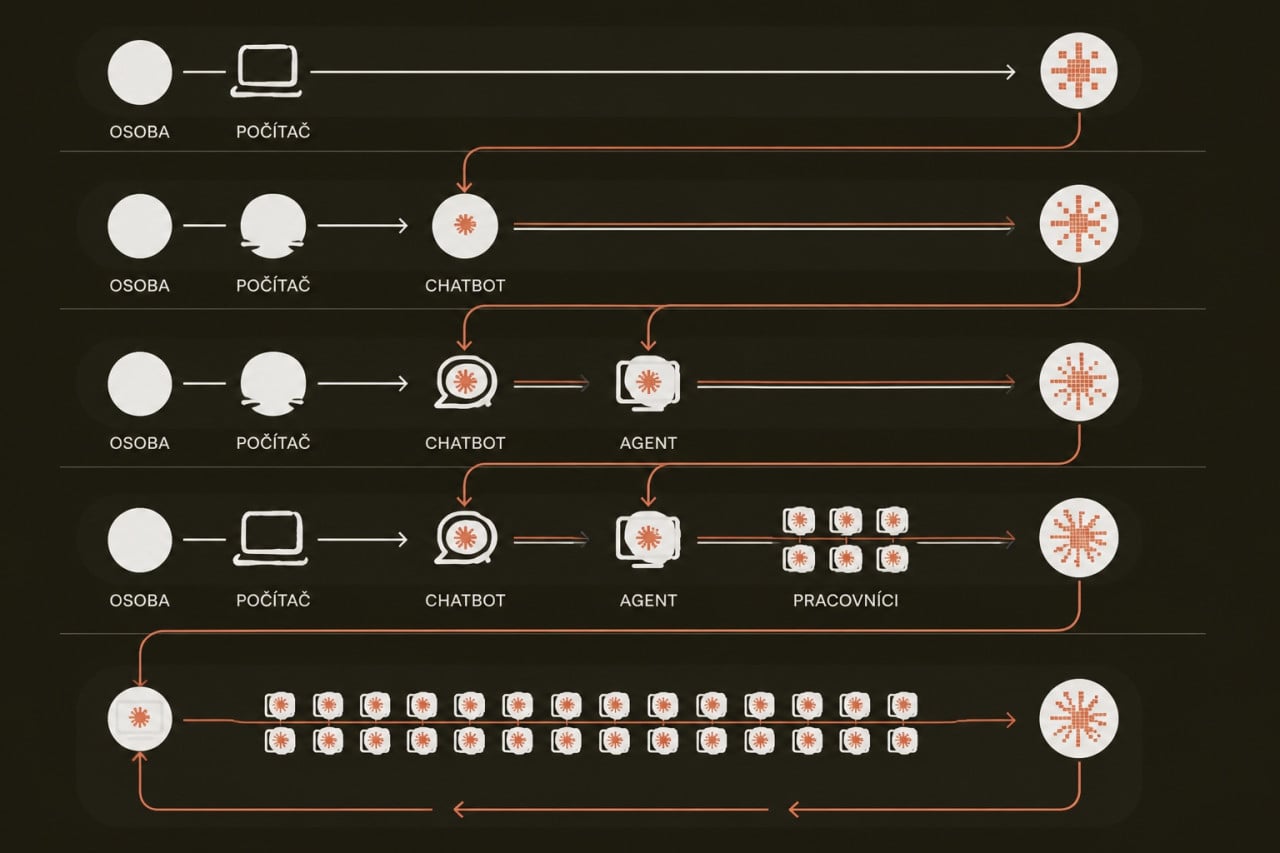
To understand how quickly things have changed, we only need to look back a few years. From 2021 to 2023, work at Anthropic looked much like it did at any other technology company. Engineers wrote code manually on their laptops. Then came chatbots, which began helping with small tasks. A developer would have a short snippet of code generated and copy it into the editor.
The next stage of evolution was agents. At first, they could independently write and edit entire files. Today, Claude runs code on its own, debugs live environments, and manages hours-long work tasks through specialized subagents. Without having to ask about every step. The average engineer at Anthropic now deploys eight times more code to production per quarter than in the years 2021 to 2024. Not because they work longer or smarter, but because Claude does a large part of the work. The engineer merely sets the direction and then reviews the results.
Public benchmarks show how rapidly the models' capabilities are growing. The duration of tasks that AI can reliably complete on its own is doubling approximately every four months. Previously, it doubled every seven months. In March 2024, Claude Opus 3 could handle software tasks that would take an experienced person about four minutes. A year later, Claude Sonnet 3.7 was working on tasks lasting an hour and a half. And this year, Claude Opus 4.6 can reliably solve assignments that would take a person a full 12 hours.
Claude's Capabilities
According to the company's data, the share of code written by Claude was still in the low single-digit percentages at the beginning of 2025. After Claude Code launched in February 2025, the numbers began to rise sharply. Today, it is over 80%. It is not just about quantity. What matters is the kinds of tasks for which Claude is used. For the most open-ended and complex problems, where even the engineer does not know in advance what the solution should look like, Claude's success rate reached 76% in May. Six months earlier, it was fifty percentage points lower.
One engineer encountered an incident: a routine update began crashing tens of thousands of training jobs. He gave Claude access to the cluster and a rough description of the problem. Within two hours, Claude isolated the single defect causing the entire issue, confirmed the fix, and closed the incident. The same work would have taken a person two to three days.
Another case: in April 2026, Claude independently deployed more than 800 fixes that reduced the frequency of a certain class of API errors by a factor of one thousand. The estimated amount of human work required for the same task? Four years. That is because such fixes are slow and tedious, and the human brain struggles to keep track of a huge amount of unfamiliar and unknown context all at once.
In April, Anthropic published the first demonstration of how its agents can handle open-ended scientific research from beginning to end. Claude-powered agents were given a problem in AI safety: can a weaker model reliably supervise a stronger one? The agents proposed hypotheses, tested them, shared results with agents running in parallel, and repeatedly refined them. In 800 hours and at a computing cost of approximately 400,000 Czech korunas, they achieved 97% of the possible improvement over the baseline. Two human researchers achieved 23% in one week.
A human entered this process only at the beginning: they selected the problem and established how the results would be evaluated. The agents designed every experiment themselves. And in optimization tests of training code, Claude Mythos Preview achieved a 52-fold speedup over the baseline code. An experienced human researcher would need four to eight hours to achieve a fourfold speedup.
Are Humans Slowing Progress?
This brings us to the most important question Anthropic is asking. The company's co-founder warned that if models continue to improve as quickly as they have so far, technological capacity will cease to be the limiting factor in AI development. Humans themselves will become that factor. "The evidence suggests that the human role is narrowing at every step of the development cycle," Anthropic wrote in its research paper. Code creation is largely automated. So is running experiments. What remains for people? Deciding what is worth solving. And checking whether AI is really doing what it is supposed to do.
The latter is becoming increasingly difficult. Anthropic implemented an automated Claude-based code review system that examines every proposed change to production code before it is deployed. A retrospective analysis showed that this system would have caught approximately one-third of the bugs that caused outages on claude.ai in the past. And they were written by some of the best engineers in the world.
Anthropic remains cautious about one thing. The point at which an AI system could fully autonomously design, build, and train its own successor has not yet arrived. And the company says it will not necessarily arrive in the future either. Nevertheless, it warns that it could come before governments, authorities, and society are prepared to respond at all. "It could happen before most institutions have time to react," Anthropic's paper states.
If that were to happen, the methods we currently use to secure AI systems, monitor them, and shape their behavior would become absolutely critical. Anthropic therefore proposes that governments and leading AI companies coordinate a potential temporary slowdown in the development of the most advanced models if development exceeds the pace at which society can safely handle it. At the same time, however, it warns that a unilateral slowdown by one company would simply create space for less cautious competitors.
What Is Happening Inside
Behind the numbers and charts, there is also a human side to this progress that Anthropic discusses. Internal employee communications reveal how quickly the structure of work itself is changing. "Work, and indeed life itself, operated on an economy of small favors between people. 'Can you help me run this script?' Each such request created a small debt, a little mutual awareness. Claude has swallowed this up. It is faster and creates no debt, but every such moment is a missed opportunity for human collaboration," one employee wrote.
Another admitted that he had not written a single line of code himself in about five months. He describes days when everything works perfectly and he suddenly feels that nothing he does actually matters. And then there are days when everything breaks down and he does not understand why, because he does not know exactly what Claude has been doing all along. This may be the greatest challenge that is rarely discussed.


