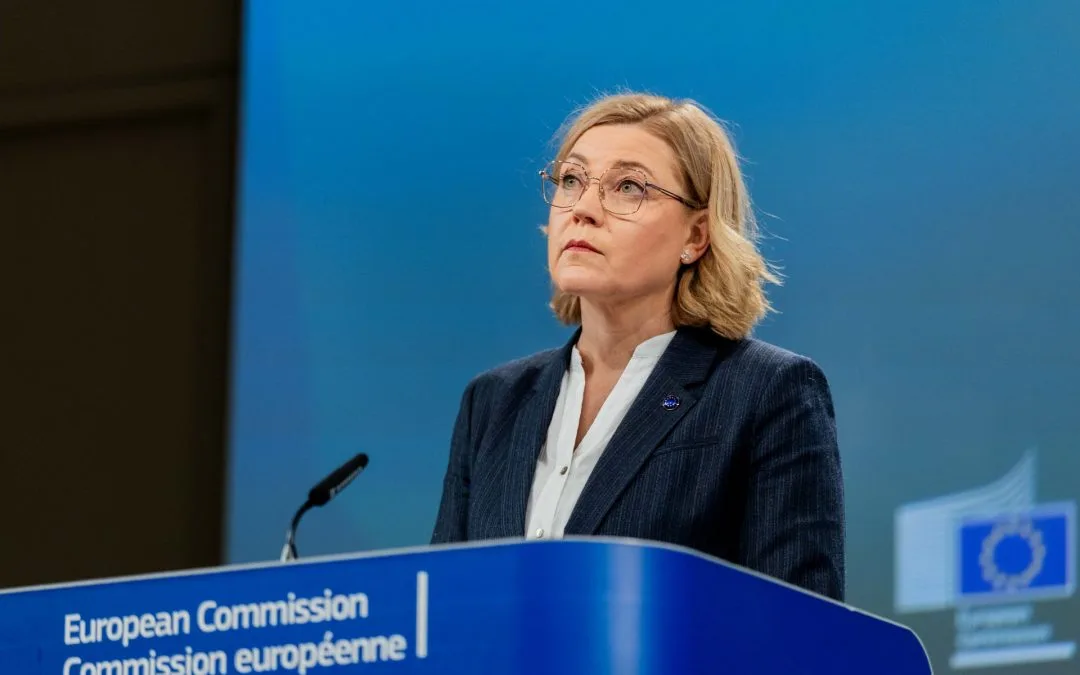
Henna Virkkunen arrived at the G20 innovation ministers' meeting in North Carolina in an environment that was not favorable to her. The White House framed the meeting as a demonstration of an approach completely opposite to the one promoted by Brussels. The Trump administration used the summit to clearly delineate the differences between the American and European approaches to artificial intelligence rules. The European Commissioner responded by arguing that the United States would ultimately adopt similar safeguards anyway, only reaching them by a different route.
Different approaches and the same outcome
On the sidelines of the meeting, Virkkunen said that the differences were not that great. According to her, Europe sets rules in advance, while America addresses them as it goes through litigation, with both sides targeting the same companies and practices. She repeated the same idea to Axios. According to her, both powers are addressing identical safety concerns, but in the US, safeguards are emerging from state laws and litigation rather than from a single comprehensive regulation such as the European AI Act.
These remarks came immediately after two days of meetings during which representatives of technology companies addressed the ministers. Speakers included Nvidia's Jensen Huang and Elon Musk, who reiterated the familiar criticism that Europe is constraining technology with too many rules. Responding to a question from Michael Kratsios, head of the White House Office of Science and Technology Policy, Musk said that new technologies should be legal by default, not prohibited. In his view, European restrictions are extreme and slow down progress.
The Commissioner rejected this argument, saying that she does not view innovation and rules as opposites. She referred to a recent Eurobarometer survey in which eighty percent of European respondents described carefully designed rules for artificial intelligence as essential for safety.
Michael Kratsios, the summit's host, presented the so-called Carolina Principles on September 1 and urged G20 governments not to establish new artificial intelligence agencies or adopt new blanket rules. According to him, politicians should not view every emerging technology as a problem. Henna Virkkunen countered that America already has its own rules, but lacks a federal framework. According to her, hundreds of different regulations exist at the level of individual US states. This is precisely the fragmentation Europe sought to avoid through the AI Act, so that uniform legislation would apply across the entire EU market.
Events of the past seven days
There was no need to wait long for practical examples of both approaches, as the past few days brought major steps on both sides of the Atlantic. The European Commission classified ChatGPT under the Digital Services Act rules as a very large online search engine, while the Reddit and Roblox platforms were placed in the category of large platforms. All three services were given four months to comply with the regulations. The very next day, the first official requests for information were also sent to more than thirty artificial intelligence providers under the AI Act. Commission spokesperson Thomas Regnier clarified that these questionnaires focus primarily on safety and copyright compliance.
In America, a comparable measure was achieved through the courtroom. Meta reached an agreement with plaintiffs from fifty-one states and territories under which it will block teenagers' access to social media overnight and limit their time on Instagram and Facebook to two hours a day. The agreement will cost the company more than twelve billion dollars over ten years. European law already automatically requires precisely such settings from these platforms. Virkkunen added that some of the provisions in the US court settlement already apply in Europe thanks to the Digital Services Act. It requires platforms to allow users to report illegal content or choose the algorithm used to recommend posts. According to her, Brussels is addressing exactly the same concerns about the addictive nature of social media that have led Meta, YouTube, and TikTok to face thousands of lawsuits in the US.
Officials and model evaluations
The unit within the European AI Office that evaluates the most powerful models consists of just thirty-six people. These officials send questionnaires to more than thirty companies, while on the other side of the Atlantic there are fifty-one plaintiffs and a multibillion-dollar settlement. Both paths may lead to rules, but with different dynamics and at different speeds. Moreover, Brussels itself has eased its approach. In May, EU officials agreed to scale back the AI Act and postponed obligations for the highest-risk areas of use until December 2027. This may be one reason why the technology chief now speaks of only small differences between the two approaches. At the same time, she emphasizes that Europe must simplify its rules and make them more accessible and faster for businesses.
The similarity between the two systems is also evident in areas where legislation is still being developed. Virkkunen explained that the European Union is working on options for testing models before their public release and for ensuring access for trusted partners. This issue is also being discussed at the G7 level.
Washington has its own equivalent of these mechanisms. The Trump administration has prepared a voluntary process for evaluating selected advanced models before they are placed on the market, which may give officials access to the technology for up to thirty days. However, the White House does not want to disclose this process. OpenAI CEO Sam Altman confirmed that the administration had already evaluated its Astra model. He emphasized that it was a voluntary step, which the company nevertheless agreed to undergo.
Children, addictive design, and disputes over data centers
For now, the European Union is proceeding according to its own plan. In July, the European Commission published preliminary findings concerning the addictive design of Meta's services, and earlier in the summer it focused on how the company verifies the minimum user age of thirteen. The Commission has reached similar conclusions regarding TikTok and launched an investigation into Snapchat in the spring. Henna Virkkunen said that Europe is prepared to introduce even stricter rules, but social media platforms themselves can already do much more.
Regarding artificial intelligence itself, the Commissioner noted that the enforcement powers associated with the AI Act took effect in August. Moreover, most of the largest developers had already been cooperating voluntarily with the Commission before that date. According to her, companies understand that if they want to operate in the European market, they must comply with local regulations.
At the end of the interview, the discussion turned to an issue Europe will face just as America does. Asked whether public opposition to the construction of data centers was also growing in the European Union, the Commissioner replied that this debate was already very active in some member states. Careful planning was intended to prevent precisely such conflicts. She also described an imbalance within the Union, where investors seek locations with abundant cheap and clean energy. According to her, it is not right for these centers to be located in only a few selected countries, because they are a key part of digital infrastructure and should be distributed across the entire territory.
Sources: thenextweb.com, france24.com and news.bpdata.com