

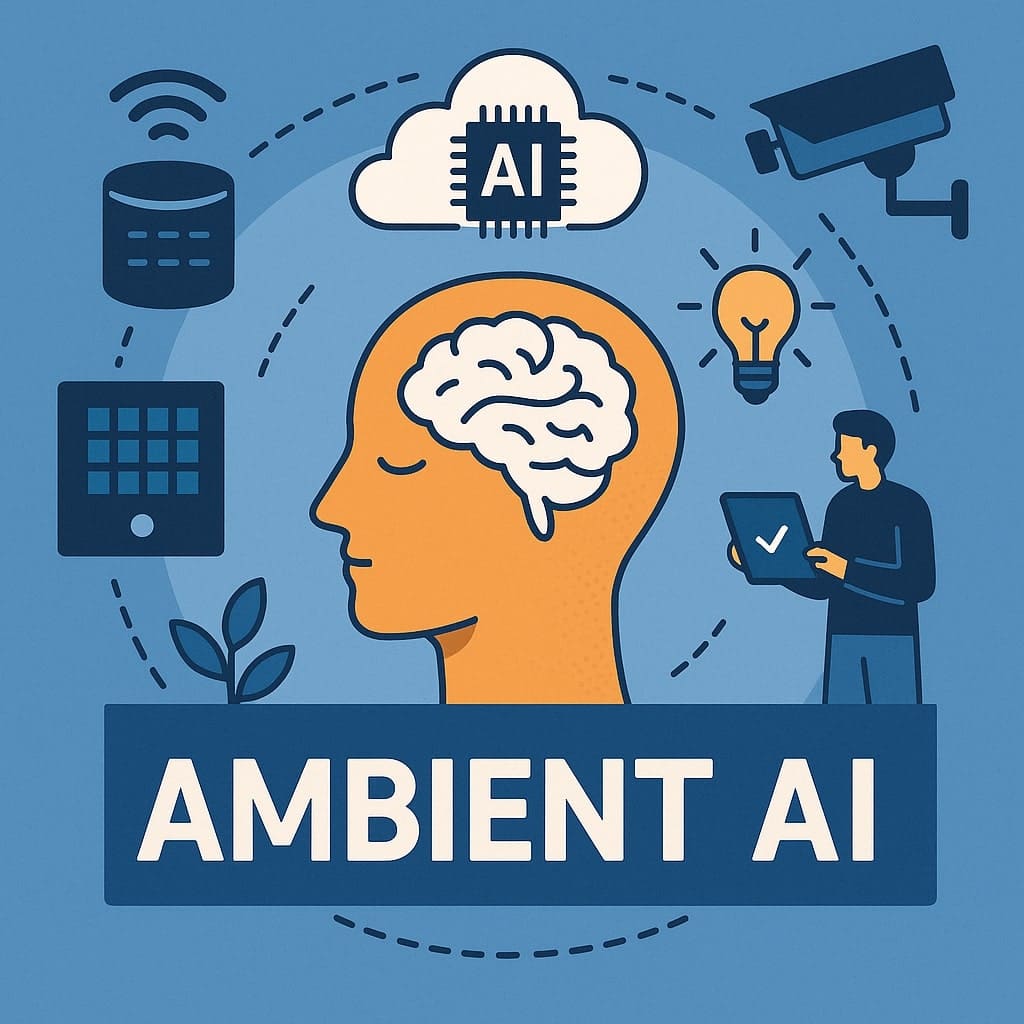
What exactly is Ambient AI?
Nowadays, we are surrounded by various technologies that demand our attention. Notifications, alerts, constant switching between applications – all of this distracts us from work and reduces our productivity. But what if there were a way to harness the power of artificial intelligence without having to devote our attention to it? That is exactly what Ambient AI is about. Ambient AI (ambient artificial intelligence) is a type of AI that works unobtrusively in the background without requiring our active interaction. Simply put, it is artificial intelligence that you do not even realize you are using. It quietly operates in the background and makes everyday tasks easier without demanding your attention.
Imagine having an assistant who anticipates your needs, gathers important information and prepares everything necessary – all without a single instruction from you. That is exactly how Ambient AI works. Instead of distracting you with new interfaces or complex procedures, it integrates into the tools you already use and improves them in a way that is almost invisible. For example:
- It automatically analyzes customer feedback and extracts key insights from it.
- It intelligently prioritizes tasks in your list according to their importance.
- It generates suggestions for solving problems based on previous experience.
- It anticipates what information you will need and prepares it in advance.
Why Ambient AI is becoming important in product management
For product managers, Ambient AI represents a true breakthrough. Traditional AI tools often require explicit instructions: you have to formulate a query, wait for a response and then process the results. This process, although useful, adds further layers of complexity to work that is already complicated enough. Ambient AI, on the other hand:
- Saves time and mental capacity – You do not have to learn new procedures or think about how to formulate queries. AI works automatically.
- Reduces cognitive load – At a time when product managers face information overload, Ambient AI filters out the noise and highlights what matters.
- Enables you to focus on strategic work – Instead of dealing with routine tasks, you can devote yourself to creative thinking and strategic planning.
- Strengthens the ability to make informed decisions – Without the need for manual searching, you have quick access to relevant data and insights.
Practical examples of using Ambient AI in a product team
- Intelligent customer feedback analysis
The traditional way of processing customer feedback is time-consuming. You have to go through all the comments, identify patterns and prioritize problems. Ambient AI automates this process – it continuously analyzes feedback, identifies key topics, sentiment and trends without requiring your intervention. When you then open the dashboard, you see a summary that is already prepared: “Over the past week, 34% of users expressed frustration with the login process, which is an increase of 12% compared to the previous period." - Contextual feature suggestions
When working on a product roadmap, Ambient AI can analyze product usage data, market research and customer requests in the background. When you start planning a new feature, the AI already has relevant information prepared: “Similar features have been successfully implemented by competitors X and Y. Our users in the Enterprise segment requested this feature 37 times over the past three months. Implementation could increase retention by approximately al." - Automatic task prioritization
Instead of manually determining the priority of each task, Ambient AI can continuously reassess your task list based on deadlines, strategic goals, dependencies and available resources. When you open your product backlog, the most important items are already at the top – without a single click on your part.
How to start using Ambient AI in your team
Implementing Ambient AI is not a one-time project, but rather a gradual process. Here is how to get started:
- Identify the areas with the greatest potential
Start by analyzing where your team spends the most time on routine tasks. Typical areas include: Customer feedback analysis, Backlog organization and prioritization, Market and competitor research, Reporting and information sharing. - Choose tools with integrated Ambient AI
Many modern product tools already incorporate elements of Ambient AI. Look for platforms that offer: Automatic data analysis, Intelligent recommendations, Predictive features, Seamless integration with your existing ecosystem. For example, tools such as ProdPad are beginning to implement features that automatically analyze and categorize customer feedback, suggest connections between different requests and provide contextually relevant information. - Set clear expectations with your team
It is important that all team members understand how Ambient AI works and what value it provides. Explain that: AI does not replace their judgment, but supports it, AI outputs should always be critically evaluated, The goal is to increase productivity and the quality of decision-making, not merely to automate processes. - Gradually expand its use
Start with one or two areas and gradually expand your use of Ambient AI as your team becomes familiar with its capabilities. Regularly evaluate the benefits and adjust your approach as needed.
Risks of Ambient AI
When implementing any form of AI, it is important to consider the ethical implications. With Ambient AI, this applies doubly because it operates unobtrusively in the background:
- Transparency – Even if AI works in the background, users should know that it is present and how it affects their work.
- Privacy and data – Ambient AI often requires access to large amounts of data. Ensure that privacy rights are respected and data is processed responsibly.
- Control and accountability – You should have the ability to turn AI off or adjust its behavior. Ultimate responsibility for decisions remains with people.
- Dependence – Excessive dependence on AI can weaken critical thinking. Foster a culture in which AI is viewed as a tool, not as a replacement for human judgment.
The future of Ambient AI in product management
We are only at the beginning of the Ambient AI era. In the future, we can expect:
- Deeper integration across tools – AI will connect information between the various platforms you use.
- More advanced predictive capabilities – AI will not only analyze current data, but also predict future trends and needs more accurately.
- More personalized assistance – AI will learn from your unique working style and adapt its operation to your preferences.
- Augmented reality and Ambient AI – Imagine AR glasses that discreetly display relevant data and suggestions during a meeting with a client.
Ambient AI as a competitive advantage
In today’s rapidly changing environment, the ability to respond quickly and make informed decisions is crucial to success. Ambient AI offers product managers the opportunity to work smarter, not harder. Unlike other technological trends, Ambient AI does not require a complete overhaul of your processes or extensive training. Instead, it integrates unobtrusively into your existing work, gradually increases your efficiency and enables you to focus on what truly matters – creating great products that solve real problems. Product teams that can effectively harness the potential of Ambient AI will gain a significant competitive advantage – not because they have access to better technology, but because they will be able to devote more of their time and mental capacity to strategic thinking and creative problem-solving. And perhaps the best thing about it all is that as Ambient AI gradually becomes part of your working life, you will not even notice that it is there – you will simply enjoy the fruits of its work while focusing on what you do best.


