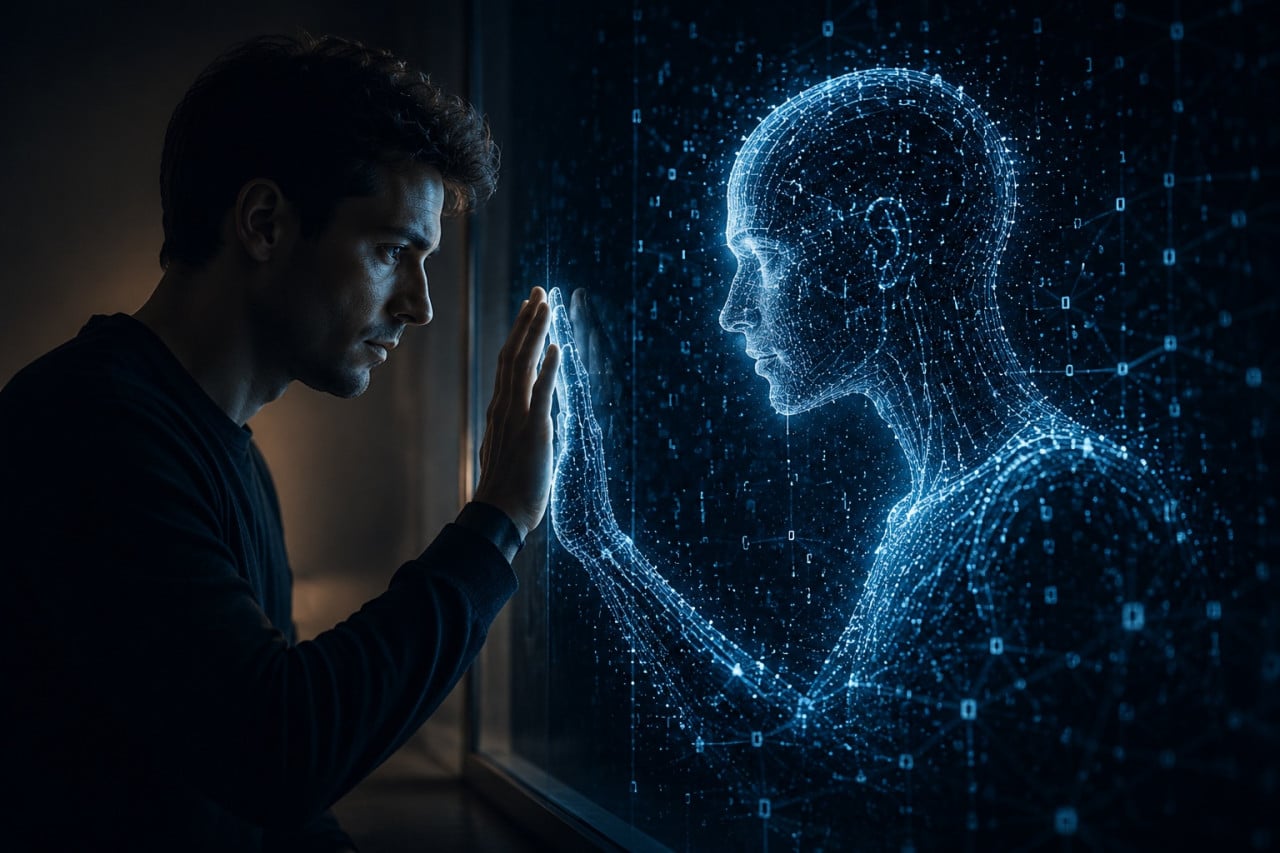
The debate about artificial intelligence consciousness has been going on for years. Some say that consciousness is merely a matter of sufficient computational complexity. Others dismiss the entire idea as fantasy. Alexander Lerchner, a senior research scientist at the Google DeepMind laboratory, has presented an argument that neither camp can easily ignore. And with a million views on the X platform, it has also attracted the attention of a wider audience.
The central idea of his paper is surprisingly simple, even though the author argues his case very thoroughly, both philosophically and physically. Large language models do not simulate consciousness because they are not powerful enough. They do not simulate it because the structural nature of computation makes it impossible.
One particular sentence from the paper is important: "Expecting an algorithmic description to bring about the quality it represents is like expecting the mathematical formula for gravity to physically exert a force." In other words, an algorithm describing an emotion is still only a description. Just as a map of Manhattan is not Manhattan.
The key distinction that few people recognize
Lerchner builds his entire argument on the distinction between two concepts: simulation and constitution. Consciousness arises directly in the human brain. The physical process itself is the experience. When you feel pain, it is not the output of a computation; it is the physical event itself within the tissue of the nervous system.
AI simulates consciousness. It produces outputs that imitate consciousness without ever generating the thing itself. A chatbot can write "I feel sad" just as naturally as "the result is 42." Neither of these responses comes from experience. Both are the result of the same mechanism: predicting the next token.
To support his argument physically, Lerchner introduces the concept of a mapmaker, a creator of maps. This is an active, experiencing agent without whom computation, in the literal sense, does not exist at all. The physical world is continuous. Voltage across a transistor changes continuously, temperature rises and falls, and chemical concentrations fluctuate. For computation to emerge from this, someone must divide this continuous flow of physical reality into a finite set of symbols and assign meaning to them. Lerchner calls this alphabetization.
And here is the catch. This alphabetization cannot be performed by the machine itself. It is always performed by someone outside it: a human engineer who designs the hardware, floating-point number formats, and chip architecture. Without this external agent, there are no symbols in a computer. There are only electrons moving according to the laws of electrodynamics.
The problem will not be solved even by embodied robots
Proponents of conscious AI have a ready response: AI simply does not have a body. All we need to do is give AI a body, senses, and means of movement, let it physically interact with the world, and the symbol will naturally become "grounded" in reality.
Lerchner calls this argument the transduction fallacy and rejects it. Sensors do convert physical forces into voltage, but this is precisely where externally performed alphabetization once again comes into play. An analog-to-digital converter, calibrated by a human engineer, converts continuous voltage into an integer. The machine still operates only on symbols, not on physical reality itself.
Lerchner offers an analogy: connecting a computer to cameras and robotic arms is like connecting a weather model to live atmospheric sensors. The model receives real data, but it does not become the atmosphere. It simulates it.
Too many executives want to believe otherwise
From the outset, Lerchner's work has run up against one uncomfortable context: it conflicts with public statements made by AI company leaders. Demis Hassabis, the head of DeepMind itself, repeatedly speaks of the arrival of artificial general intelligence as an event comparable to the Industrial Revolution, only ten times faster. Anthropic CEO Dario Amodei has admitted that he is "open to the idea" that today's models might be conscious.
Lerchner disagrees and provides a physical rationale for his position. According to him, consciousness is not a software artifact that could arise accidentally or deliberately by scaling computational power. It is not a property of architecture. It is a property of physical constitution. At the same time, Lerchner emphasizes that his argument is not biologically exclusive. He does not claim that only carbon-based life can possess consciousness. If an artificial system ever acquired consciousness, it would be solely because of its specific physical constitution, not because of its syntactic architecture.
The debate about AI consciousness is not merely an academic exercise. If large language models were conscious, or even just "possibly conscious," this would immediately raise questions about their rights, protection, and treatment. Researchers would have to consider whether training a model through feedback is actually a form of suffering.
Lerchner wants to approach this debate differently. Instead of waiting for a complete theory of consciousness, he proposes a rigorous ontology of computation. He shows that the question is not "are AIs conscious?" but "can computation as such cause consciousness at all?" And his answer is no. Philosophers contacted by 404 Media confirmed that Lerchner's argument is logically consistent. At the same time, they acknowledged that most of these arguments have been circulating in philosophy for "years and years." What is new is not the thesis itself, but who is presenting it, where they are presenting it from, and the physical framework supporting it.
So what are we building when we build AI?
Lerchner's answer is "increasingly accurate predictive maps." The more powerful the model, the more faithful the map. But a map, regardless of its fidelity, resolution, or physical embodiment, remains categorically different from the territory of lived experience.
Language models describe the world in a way that resembles human thought more closely than anything before them. That is precisely why it is so difficult to realize that there is no one behind the output experiencing anything. No pain. No wonder. No sense of existing. Just electricity moving according to the laws of physics, and a person at the other end who has assigned letters to that electricity.