

Another milestone reached: AI takes home gold from the International Mathematical Olympiad
Think only students can participate in the International Mathematical Olympiad? Think again! Google DeepMind and OpenAI decided to send their chatbots. And the result? A gold medal for both companies. Officially, however, only for one.
AI systems rival human intelligence
At this year's International Mathematical Olympiad (IMO) on the Sunshine Coast in Queensland, Australia, artificial intelligence systems surpassed the gold-medal threshold for the first time. This definitively confirmed that AI can rival human intelligence.
Google DeepMind, with its Gemini DeepThink AI model, and OpenAI decided to pit themselves against the most talented high school students. Both companies relied on AI models that process natural language and joined more than 600 of the best students from around the world.
Above-average results in mathematics
Both AI models solved 5 out of 6 mathematical problems, the result required to win a gold medal. Only about 11% of students normally achieve this score or better. For the world of artificial intelligence, this result is a tremendous success. Solving such complex problems does not merely mean understanding the problem correctly, but also choosing suitable methods and producing proofs several pages long. And all this within the official time limit of 4.5 hours!
From silver to gold
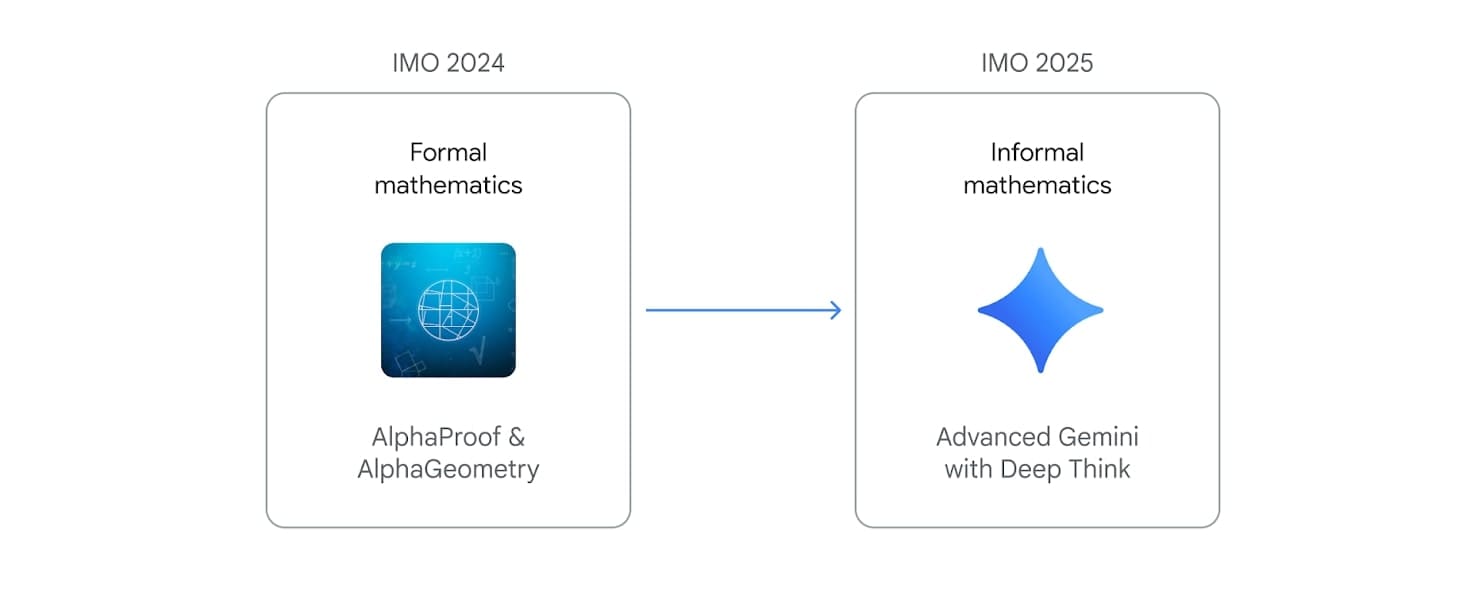
Last year, Google DeepMind chose to rely on the specially developed mathematical models AlphaProof and AlphaGeometry, which were not traditional chatbots and needed the problems to be converted into a special programming language before they could solve them. The results were admirable (4 out of 6 problems solved correctly), but they were only enough for a silver medal.
This year, Google and OpenAI therefore decided to place their trust in so-called “reasoning” models, which process problems similarly to humans—that is, using natural language—and employ completely different techniques from conventional AI models. And it turned out that reasoning models are indeed approaching human intelligence.
Google officially won gold, OpenAI only theoretically
Because the IMO is a venue where students in particular are meant to compete in mathematical skills, the organizers set a clear condition: no AI company could publish its results before the official ceremony.
There were several reasons for this decision. During this period, the organizers officially verify the results and subsequently announce the students' achievements. Publishing the AI's achievements in such a situation would mean overshadowing the students' results.
Google DeepMind cooperated with the IMO organizers, did not publish the results, and had everything properly confirmed and assessed by a certified panel. It thereby received an officially recognized gold medal. OpenAI, however, did not follow the rules and announced its result before the results had been finalized, meaning that it won its “gold” only in theory.
Although both artificial intelligence systems achieved the same score, only Google DeepMind and its Gemini DeepThink model officially won a gold medal.
Students are still ahead
The fact that artificial intelligence won a gold medal at the Mathematical Olympiad is certainly a breakthrough. It confirms that AI's capabilities continue to advance and that it can rival the best experts or scientists.
Google DeepMind representatives even believe that within a few months, artificial intelligence will be able to successfully solve calculations and problems that continue to hinder many research projects today.
However, students once again achieved the highest results this year, so AI still failed to defeat the brightest student minds. Given the rapid progress in artificial intelligence, however, everything could be different as early as next year.
Source: The Neuron, Reuters, New York Times, The Wall Street Journal


