

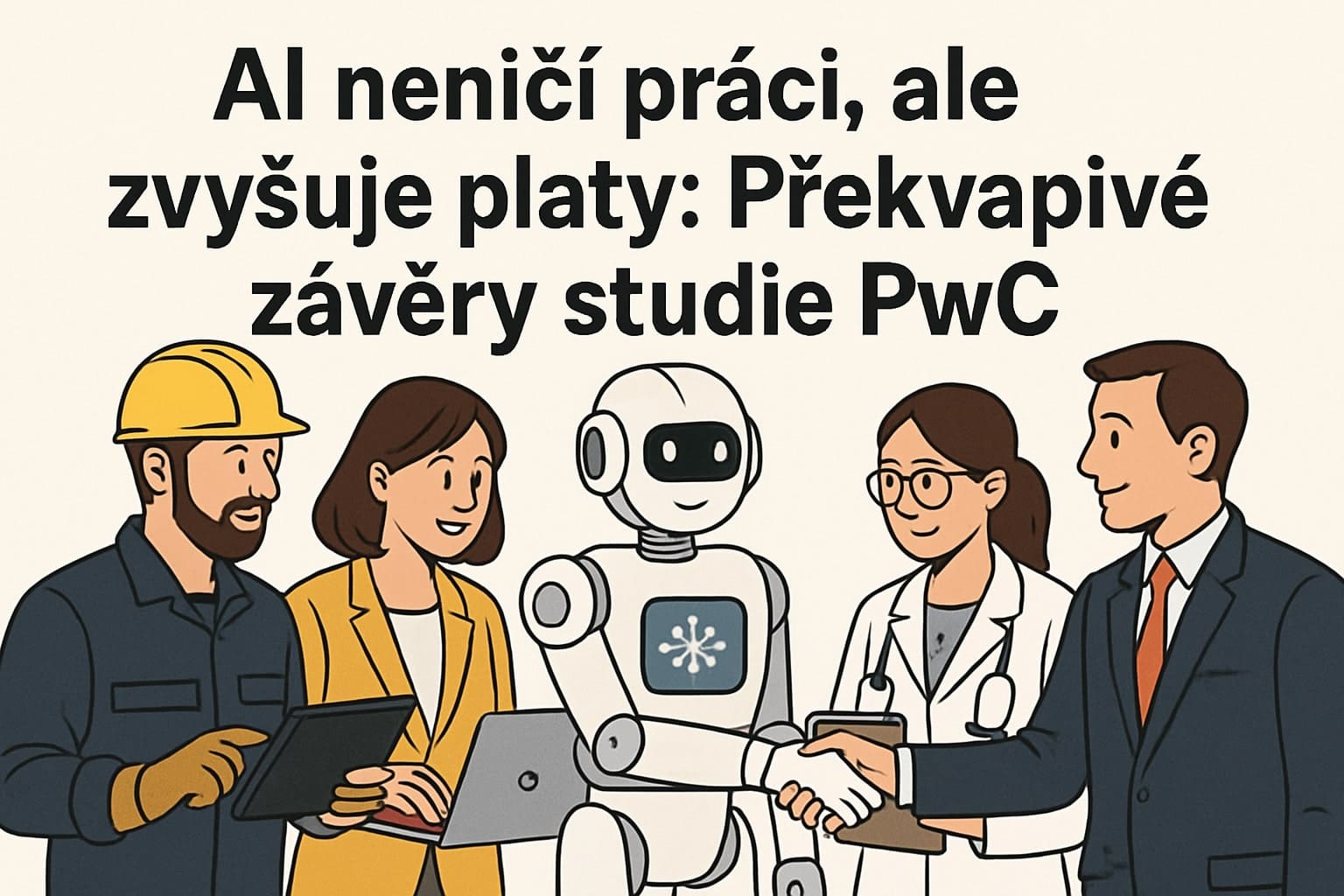
AI Is Not Destroying Jobs, but Raising Wages: Surprising Findings from a PwC Study
In June 2025, PwC published an extensive study titled "The Fearless Future: 2025 Global AI Jobs Barometer," which offers an unexpectedly positive perspective on the impact of artificial intelligence on the global labor market. This study represents one of the most comprehensive research projects in this field—it analyzed nearly one billion job postings across six continents to assess how artificial intelligence is actually affecting employment, wages, required skills, and productivity.
Study Methodology and Scope
The PwC study provides a detailed look at the global labor market in the early days of artificial intelligence. Researchers analyzed data from job postings across all continents, allowing them to gain unique insight into how employer requirements are changing and how quickly the skills needed for different roles are evolving. A key finding was that the skills employers seek for roles exposed to artificial intelligence, such as financial analysts, are changing 66% faster than for roles that are less affected by AI, such as physical therapists. This pace of change suggests that AI does not stop at automating routine tasks, but fundamentally transforms job responsibilities and required competencies.
Surprising Finding: AI Creates Jobs Rather Than Destroying Them
The study's most remarkable finding is that jobs exposed to artificial intelligence grew by nearly 40%, despite concerns about the automation of these roles. This result stands in dramatic contrast to common predictions that AI will lead to massive layoffs. Instead, artificial intelligence appears to be transforming existing roles and creating new opportunities. According to Laoise Mullane, workforce consulting director at PwC Ireland, AI "amplifies and democratizes expertise, enabling employees to multiply their impact and focus on higher-level responsibilities." The study documents specific examples of this transformation. Consider Amina, an information analyst whose role has fundamentally changed thanks to AI. While she previously spent a considerable amount of time on routine information searches, AI agents now handle basic research for her, allowing her to focus on more complex analysis and client work. Similarly, John, a customer support agent, no longer has to deal with simple queries—AI handles those—instead, he can focus on complex issues, effectively becoming a highly valuable problem solver.
Dramatic Wage Growth for Workers with AI Skills
One of the study's most surprising findings concerns wage growth. Workers proficient in AI skills, such as prompt engineering, can command a wage premium of up to 56% over colleagues without these capabilities. In Ireland, for example, workers specializing in AI saw an average wage premium of 56% over the past year, more than double the 25% premium recorded the previous year. These data show that demand for AI skills is growing rapidly and that the market readily rewards those who acquire them. Wages are also growing twice as fast in industries more exposed to artificial intelligence compared with less exposed sectors. This finding suggests that AI is not merely a tool for cutting costs, but rather a catalyst for creating greater value, which companies are willing to reward fairly.
Productivity Has Quadrupled
Since 2022, when ChatGPT awakened the world to the possibilities of generative AI, business productivity in industries rapidly adopting AI has nearly quadrupled. This dramatic increase is especially evident in sectors such as finance, software, and publishing. By contrast, industries less exposed to AI, such as mining and hospitality, experienced a decline in productivity growth over the same period. This polarization shows that the benefits of AI are not automatic—organizations must actively invest in its implementation and employee training. Industries best positioned to use AI recorded three times greater growth in revenue generated per employee. This finding confirms that AI genuinely increases the value of human work rather than replacing it, with far-reaching implications for human resources management strategies and technology investments.
Changing Education and Skill Requirements
The study reveals a fascinating trend in employer requirements—demand for formal degrees is declining faster for roles exposed to AI. What you can accomplish with artificial intelligence is becoming more important than what you studied years ago. This shift suggests a fundamental change in how competencies are assessed, with practical skills and the ability to collaborate effectively with AI technologies outweighing traditional qualifications. This development has enormous implications for education systems and professional development strategies. Organizations and individuals must rethink their approaches to learning and focus on continuous skill development rather than obtaining a degree as a one-time achievement.
The Gender Dimension of the AI Revolution
An interesting and important finding of the study is that, in all countries analyzed, more women than men hold roles exposed to artificial intelligence. This observation represents both an enormous opportunity and a critical need to ensure that women are equipped with the rapidly evolving skills needed to thrive in an AI-driven world of work. This issue requires careful policymaking and investment in education and reskilling to prevent new forms of inequality from emerging.
Future Challenges and Skeptical Voices
Although the results of the PwC study are largely optimistic, the researchers highlight several potential risks. Companies are using AI to replace entry-level roles, including those for programmers, which may limit traditional career paths for graduates. Moreover, job and wage growth cannot be expected to continue if the AI bubble bursts or another economic crisis occurs. They also warn that when money becomes tight, management's new AI-enabled ability to "do more with less" could mean that fewer doors open, and some could remain closed forever. This issue requires careful monitoring and potentially regulatory measures to protect workers.
The PwC study suggests that the focus is shifting strongly toward how we collaborate with AI, rather than whether we use it. This is particularly evident in areas such as software development, where modern AI programming now relies heavily on agents that directly manage code, tests, and tools, going far beyond basic prompting.
The results of this extensive study suggest that artificial intelligence functions more as a tool for growth than merely as a means of improving efficiency and cutting costs. Companies that use AI exclusively to reduce staff may be missing out on greater opportunities, such as new markets and revenue streams. The future of work will likely be characterized by collaboration between humans and machines, with technology enhancing human capabilities rather than replacing them.


