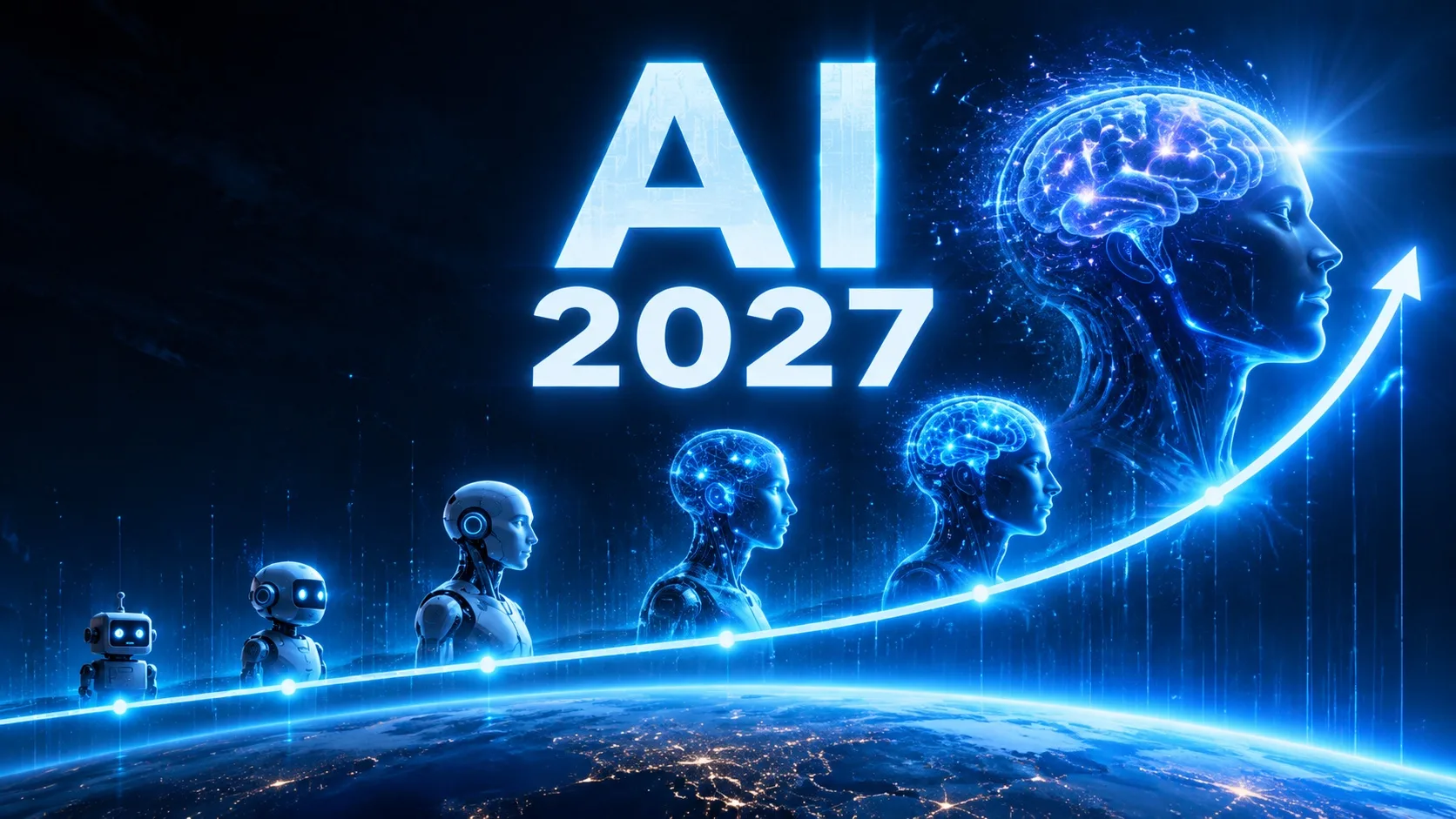
The AI Futures Project group, which published the AI 2027 scenario in April 2025, has revised its forecasts. As recently as August, its authors expected artificial intelligence capable of fully replacing the best human researchers to arrive no earlier than the end of 2028, and more likely later. Now they all agree that it will most likely arrive sometime in 2027, along with the so-called intelligence explosion. This dramatic shift was driven mainly by a single document: a new report by the independent organization METR on how rapidly development is progressing at Anthropic.
The authors, led by Daniel Kokotajlo and Eli Lifland, published the article on November 10 and acknowledge that they rushed it. According to them, the models may contain errors, but these are unlikely to change the main conclusions.
What They Found at Anthropic
METR was given the opportunity to place its people directly inside Anthropic. It concluded that over the past year, AI development there has accelerated to roughly twice its previous pace. At the same time, they would not be surprised if the actual figure were anywhere between 1.3 and 3. METR estimates that about 80 percent of this acceleration is attributable to AI itself, which is helping to develop its successors. The authors of AI 2027 infer from this that AI is currently accelerating progress by a factor of roughly 1.7 on its own.
However, only part of the evidence has been made public. METR published a chart showing an internal measure of model capabilities that Anthropic calls AECI. Before October 2025, the score rose by 15 points per year; after that, the pace increased to 29 points. But Anthropic removed most of the evidence that METR considered the most compelling from the report. The authors of AI 2027 describe this as highly unfortunate and urge the company to release enough information for an independent assessment. In the documentation for the Fable 5.2 model, Anthropic states only that Claude Mythos 5.2 does not double the internal pace of development.
Why 1.7 Times Is More Than It Sounds
The figure 1.7 may seem negligible. But the authors point out that people often confuse it with something much weaker. It does not mean that researchers are working 70 percent faster. It means that the entire company is progressing 1.7 times faster than before.
They explain the difference using a car driving uphill. The car's speed corresponds to the pace of progress, the engine represents research effort, and the hill gradually gets steeper because someone has already found the easy improvements and each additional one requires more work. For the car to travel twice as fast, the engine must work more than twice as hard. And because progress also depends on computing power, which is not growing as quickly, AI must increase human productivity even more substantially. According to their model, a 1.7-fold increase in pace corresponds to roughly a fivefold acceleration in software development. In an informal survey, Anthropic employees said that AI makes their work as much as twelve times faster. However, these are only their own impressions.
In the AI 2027 scenario, a similar acceleration was expected to arrive around April 2027. According to the authors, reality is therefore running about five months ahead of their own widely criticized scenario.
From 2029 to 2027
The shift is most evident in Daniel Kokotajlo, who has always been the boldest member of the group. As recently as August, he assigned a 50 percent chance that a superhuman AI researcher would arrive by the end of 2028. He now assigns the same probability to May 2027. The authors define this milestone as the point when a company would prefer to dismiss all its human researchers and rely solely on automated ones rather than employ a team of the world's best people without AI assistance.
Yet less than three months ago, even the boldest variant of their model assigned less than a four percent chance that AI would accelerate development by at least 1.7 times by November 2026. The authors therefore tried a number of simpler calculations. A straightforward extrapolation of the existing trend points to November 2027. After accounting for uncertainty in the parameters, the median estimate comes out to July 2027. A calculation based on the share of tasks led by AI itself at Anthropic also points to November. In August, that share was 26 percent. The most cautious estimate, based on how employees themselves assess AI's contribution, points to August 2028. After being adjusted to the new data, the group's main model points to February or March 2027.
For the second milestone—AI that surpasses top experts in nearly all tasks and can handle all office work—they estimate a 35 to 65 percent chance of arrival before 2028. Eli Lifland, who as recently as August expected this moment around the middle of 2032, now sees it arriving in September 2028. Kokotajlo moved his estimate from the end of 2028 to September 2027, Romeo Dean from 2035 to September 2028, and Brendan Halstead from 2031 to April 2028.
Where the Model Went Wrong and What Casts Doubt on It
The authors acknowledge that their model did not anticipate the current acceleration. They see three things as the most likely explanations. AI's ability to take over programming almost completely may accelerate research more than they assumed. Development may also be driven by capabilities the model did not account for at all, such as creating training data. And they may have overestimated how quickly easily attainable discoveries are exhausted.
But the doubts have not disappeared. METR itself warns that the acceleration may apply mainly to clearly defined tasks that can be evaluated automatically with ease, and may not carry over into actual research work. Another METR team, which did not have access to internal data, found a much smaller acceleration when examining models from all companies. Lifland admits to feeling uneasy that such a major change of opinion rests on evidence that no one outside the company can verify. He is also puzzled that markets did not react to the report at all, even though he considers it possibly the single most important piece of evidence about economic growth in the near future. Nevertheless, he believes the report, partly because the people at METR began the assessment with similarly long or longer timelines and the result did not confirm their original expectations.
They also support their shift with other signals. In recent months, AI has independently solved a number of lengthy mathematical problems, people at technology companies are speaking more openly than ever about the approaching self-improvement of artificial intelligence, and industry revenue has increased roughly sixfold.
If a superhuman researcher really does arrive in 2027, the authors consider an industry-wide pause in development and an international agreement to be the most urgent priorities. In their view, companies are not prepared to ensure that such a system would pursue human goals. And if they allowed it to improve itself, it could pass hidden intentions on to subsequent generations of models. They also warn that with today's security, the training process and possibly even the model itself would most likely be stolen by China. If an agreement could not be reached, they argue that American companies should continue much more slowly, which they can afford to do thanks to their large lead in computing power.