

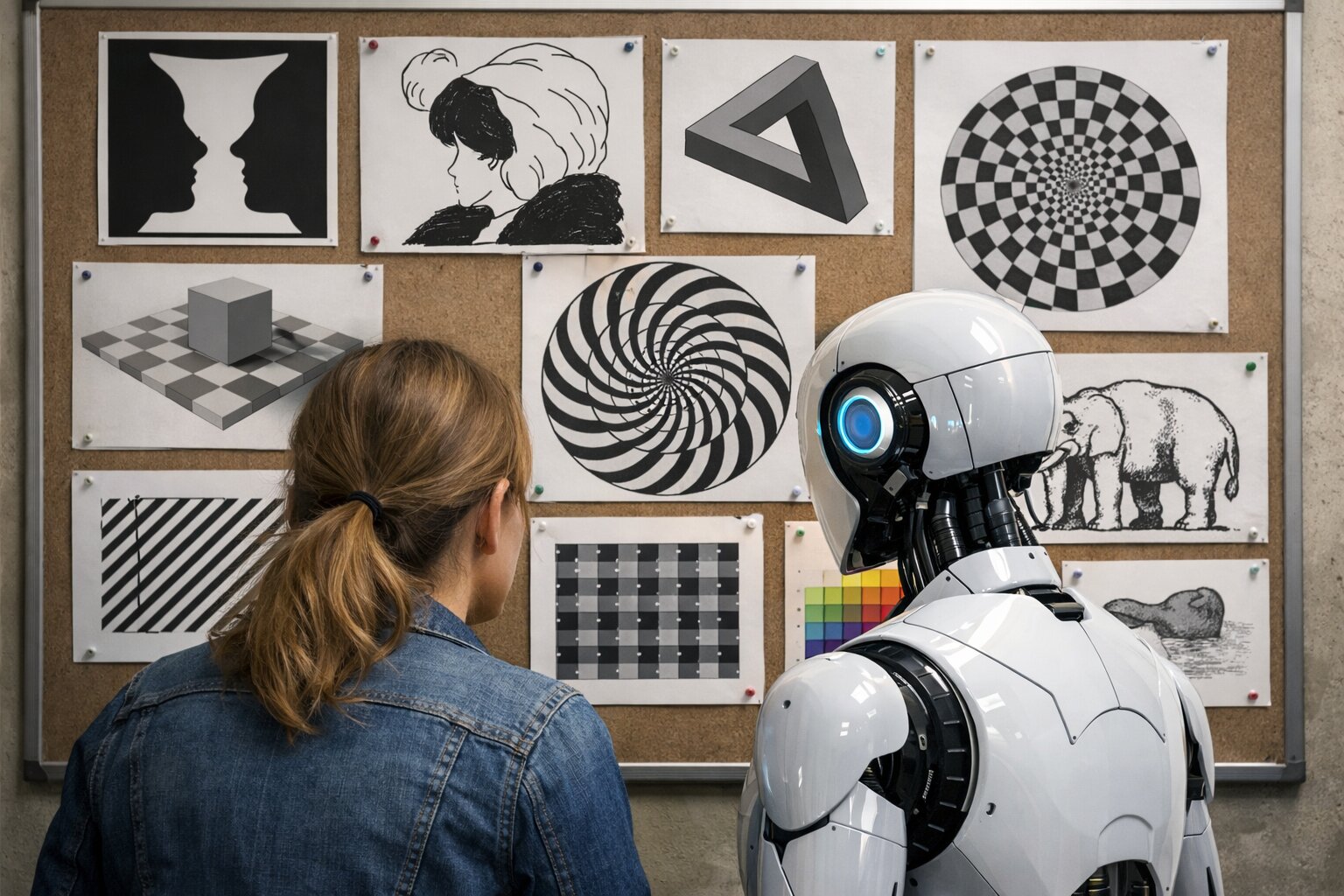
Optical illusions entertain and confuse us throughout our lives. For example, the Moon appears larger near the horizon than high in the sky, even though its size remains the same. These illusions are not merely errors in our vision but reveal the clever shortcuts our brain uses to quickly process the world around us. The brain cannot process every detail, so it selects only what matters.
Scientists have now discovered that some artificial intelligence (AI) systems fall into the same traps as we do. This helps us better understand how our own brain works. Systems based on deep neural networks (DNNs), which power many of today’s AI systems, including ChatGPT, can be fooled by similar illusions. Eiji Watanabe, an associate professor of neurophysiology at Japan’s National Institute for Basic Biology, says that using these networks makes it possible to simulate and investigate how the brain processes information and creates illusions, without the ethical issues associated with experiments on humans.
How is AI tested using illusions?
Eiji Watanabe and his team conducted an experiment with a deep neural network called PredNet. This network is based on the theory of predictive coding, which says that our visual system does not merely process what we see passively, but first predicts what it expects based on past experience and then adjusts for differences according to the actual input from the eyes. This allows us to see more quickly.
In the experiment, they trained PredNet on videos of natural landscapes recorded with head-mounted cameras that mimicked the human perspective. The network processed about a million frames to learn the rules of the visual world, including the properties of moving objects. It had never seen an optical illusion before. They then showed it variations of the rotating snakes illusion—a static image with colored circles that appears to rotate when we look at it—and a modified version that people perceive as motionless.
These experiments were designed to verify whether AI could mimic human perception and support the theory of predictive coding. The results were interesting: PredNet was fooled by the same images as humans, suggesting that the illusion contains elements that trigger a prediction of motion in a way similar to our brains. Watanabe believes that the network’s perception is similar to human perception.
Nevertheless, there were differences. When a person focuses on one circle in the illusion, it appears to stop, while the others continue spinning in their peripheral vision. PredNet, however, saw all the circles moving simultaneously because it has no attention mechanism and processes the entire image at once. No deep neural network can yet experience all the illusions that we perceive.
Quantum AI and shape illusions
Further research was conducted by Ivan Maksymov, a researcher at the Artificial Intelligence and Cyber Futures Institute at Charles Sturt University in Bathurst, Australia. He was inspired by studies that use concepts from quantum mechanics to explain the perception of the Necker cube—an illusion in which the cube appears to switch between two orientations—and the similar Rubin’s vase illusion, in which we see either a vase or two faces in profile.
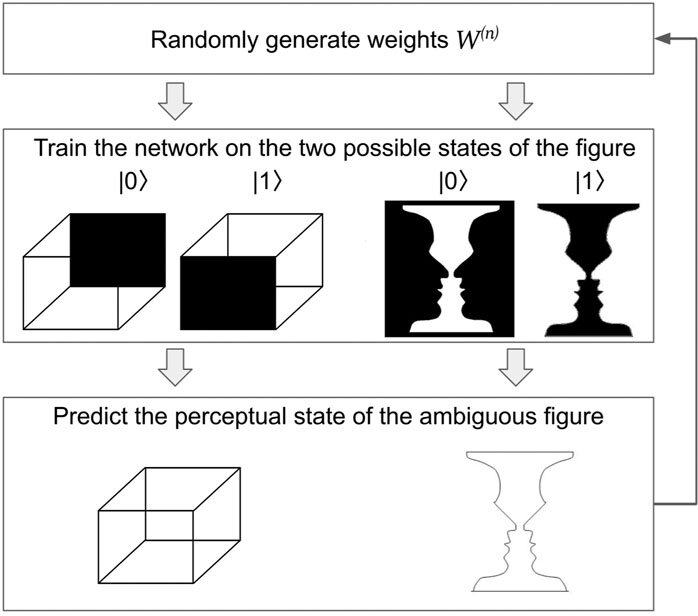
Maksymov created a model combining quantum physics with AI. He designed a deep neural network that processes information using a phenomenon called quantum tunneling and trained it to recognize these two illusions. When he fed one of the illusions into the system, the network generated one of the interpretations and then switched between them over time—much like humans do. The switching intervals were very close to those reported by people in tests.
This approach was used to better model human decision-making in illusions where the brain chooses one version or the other. Maksymov does not believe this means that our brain has quantum properties, but rather that quantum theory helps model aspects of thought, such as quantum cognition. Such a system could simulate changes in perception in space, where gravity affects how astronauts see illusions such as the Necker cube. On Earth, they see one perspective more often, but after three months on the International Space Station (ISS), they see both equally often because gravity helps estimate depth.
Significance of the research
Studies of people who do not perceive illusions, such as a man who became blind as a child and regained his sight in his 40s, have provided clues. He was not fooled by shape illusions such as the Kanizsa square, in which four circular fragments create an illusory square, but he did see motion illusions such as the barber pole, in which the stripes appear to rise even though the pole is merely rotating. This suggests that motion perception is more resilient to vision loss than shape perception, perhaps because we learn to process motion earlier in childhood.
Brain imaging studies using functional magnetic resonance imaging (fMRI) have revealed which parts of the brain are activated during illusions, but the subjectivity of perception, as in the viral image of a striped dress from 2015, where people saw either blue and black or white and gold, makes objective investigation difficult. AI offers a new way to study this without relying on descriptions from people.
These AI experiments help simulate human visual processes and test theories without risk. For astronauts, this is crucial to ensure that they can trust their eyes in the unfamiliar environment of space.
Additional source: bbc.co.uk


