

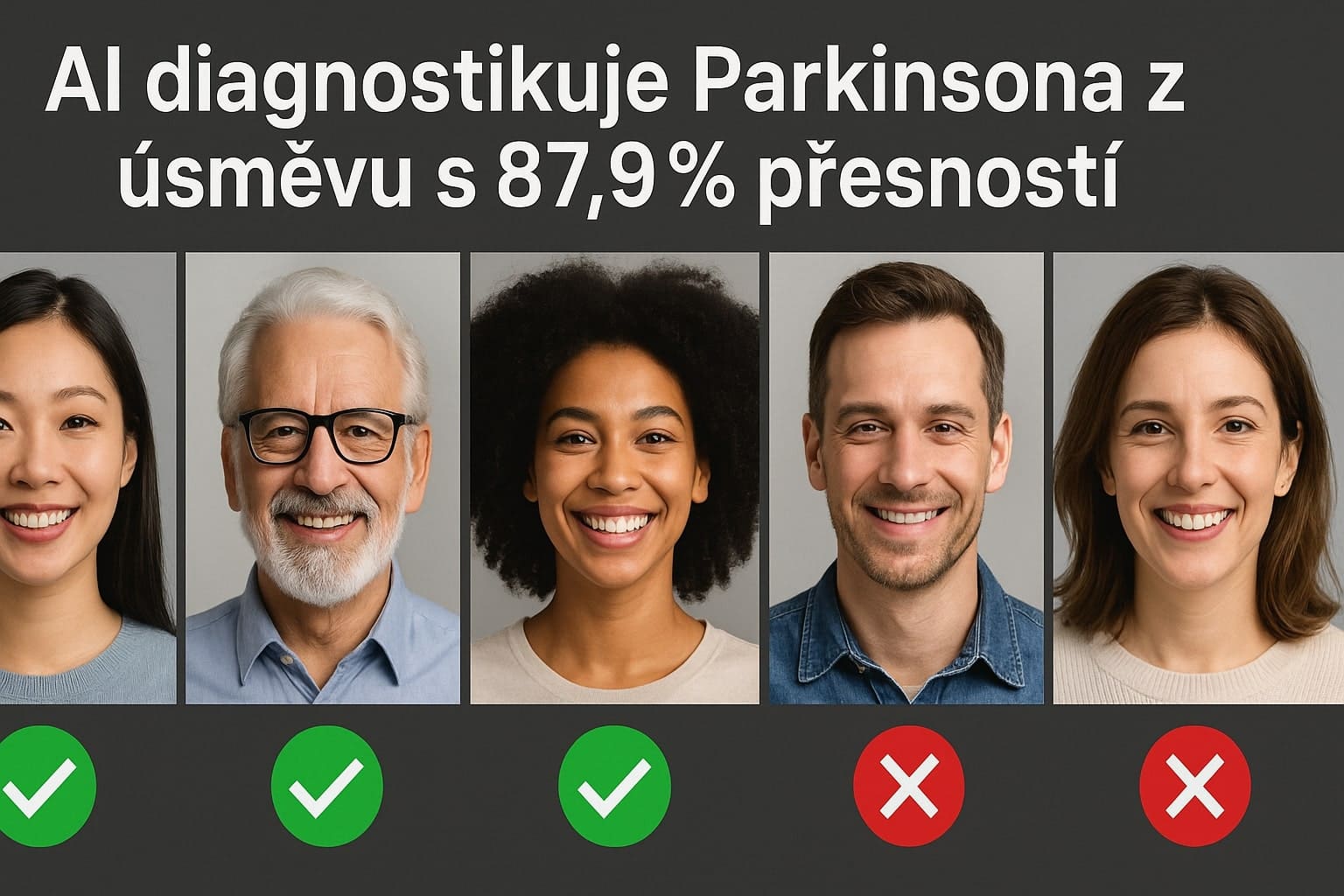
AI Can Diagnose Parkinson's Disease from a Smile with 87.9% Accuracy
A new era in Parkinson's disease diagnosis is beginning. Scientists have developed a revolutionary artificial intelligence system that can detect this neurodegenerative disease using only a short video of a patient smiling.
Groundbreaking Study with the Largest Dataset
A team led by Tariq Adnan published a study in the prestigious New England Journal of Medicine that changed how we view the possibilities for diagnosing Parkinson's disease. The researchers used the largest known video dataset of facial expressions, involving 1,452 participants, 391 of whom had Parkinson's disease.
The model achieved a surprising overall accuracy of 87.9% in detecting the disease based solely on smile analysis. Even more remarkably, the technology worked reliably across different populations in both North America and Bangladesh.
According to the Parkinson's Foundation, an estimated 90,000 new patients will be diagnosed with the disease this year, while the number of people affected is expected to reach 1.2 million by 2030. Early diagnosis of Parkinson's disease is a significant challenge due to limited access to clinical specialists and the need for in-person examinations.
AI tools for remote screening offer scalable and cost-effective solutions that can bridge these healthcare gaps. This is particularly important for rural and underfunded communities.
How the Technology Works
The new screening method works on a simple principle. Participants recorded themselves mimicking facial expressions, including smiling, using an online platform. The research teams then extracted facial landmarks and measured action units to quantify hypomimia—a common motor symptom of Parkinson's disease characterized by reduced facial muscle movement.
Machine learning models were developed using these features, enabling them to distinguish people with Parkinson's disease from healthy individuals. The study used a broad recruitment strategy, including participants from North America recruited through social media, emails, wellness centers, and research registries, together with a high-risk group from Bangladesh.
Performance Across Different Populations
The model trained solely on smile videos achieved 87.9% accuracy, 76.8% sensitivity, and 91.4% specificity in tenfold cross-validation. Validation using external test sets showed 80.3% accuracy in a U.S. clinical dataset and 85.3% accuracy in the Bangladeshi group.
While the negative predictive value remained above 92% in all settings, the positive predictive value fell to 35.7% among Bangladeshi participants, reflecting variations in population characteristics.
Further Research and Technological Advances
The latest research from 2024 has shown that AI-driven facial expression analysis is developing rapidly. Researchers at Cornell University are working on AI-equipped glasses that use acoustic sensing to reconstruct facial expressions in real time. This creates the possibility of continuously monitoring patients with Parkinson's disease.
Researchers at UC San Francisco developed a video-based system that uses ordinary smartphones to quantify facial features and track disease progression. Systematic reviews confirm that deep learning models, particularly convolutional neural networks, achieve up to 88–95% accuracy in identifying patients with Parkinson's disease.
The Future of AI Diagnostics
Lead study author Tariq Adnan emphasized: "Smile videos can effectively distinguish between individuals with and without Parkinson's disease, offering a potentially easy, accessible, and cost-effective screening method, particularly when access to clinical diagnosis is limited."
The video processing and machine learning code is publicly available on GitHub, allowing other researchers to continue this work. The research was funded by the National Institute of Neurological Disorders and Stroke at the National Institutes of Health.
Future steps include broader validation of the AI screening method in additional real-world populations and further refinement of the algorithm to maximize the accuracy of early detection. Regulatory and clinical translation pathways will determine whether and when this technology becomes available in the U.S. healthcare system.


