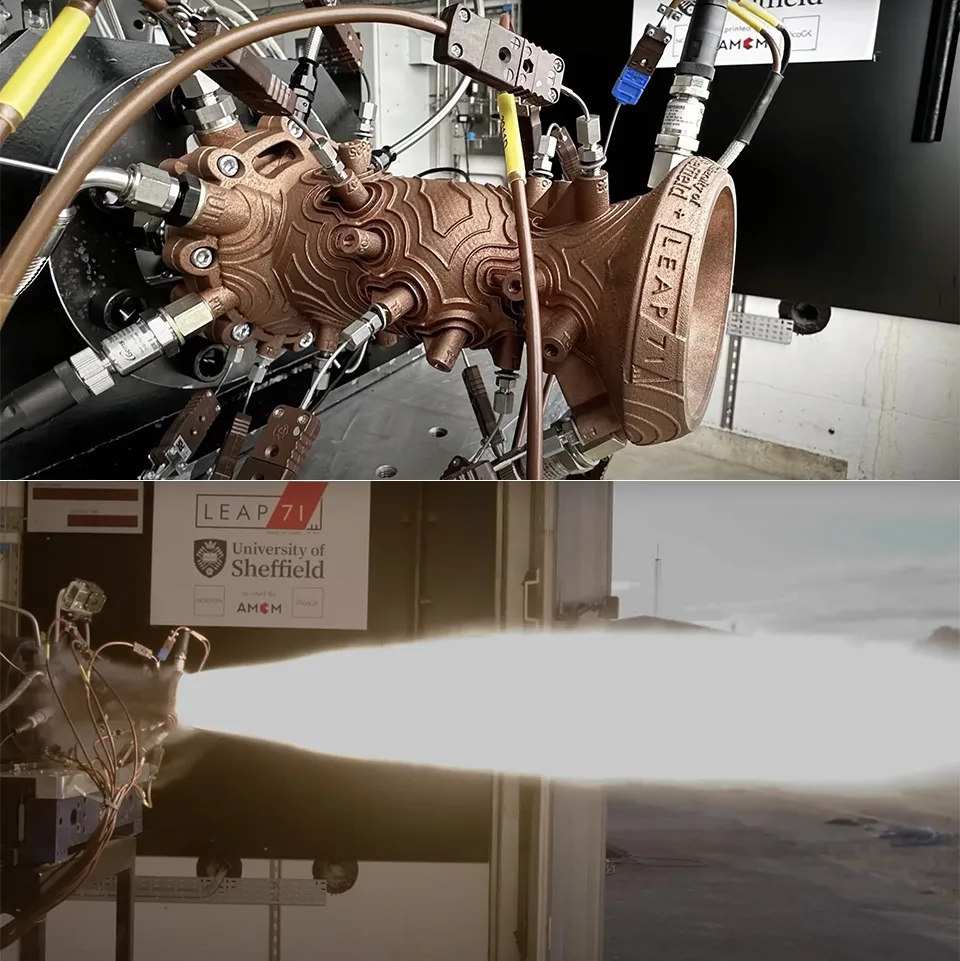
In 2024, a rocket engine whose shape had not been conceived by any human fired for the first time at a test facility in Westcott, England. It was designed by LEAP 71’s Noyron software, printed in copper, and successfully ignited on the first attempt. Less than two weeks passed from the final specification to the finished component. In the conventional engineering world, the same work would have taken months, or more likely years.
The project was launched by Dubai-based company LEAP 71 together with engineers from the University of Sheffield and inventor Sam Rogers. Sheffield contributed its expertise in advanced manufacturing, metal printing, and rocket propulsion. It also provided ongoing feedback on how the software worked. The university workshop then took delivery of the engine from printing company AMCM, finished it, and prepared it for testing, also in less than two weeks.
Why engine designs take years
Behind the entire idea is a pair who had met before. Aerospace engineer Josefine Lissner and software entrepreneur Lin Kayser founded LEAP 71 in 2023 after working together at Hyperganic. There, Lissner designed an experimental rocket demonstrator using algorithms written specifically for metal printing. This work produced an insight that took both founders further. Many engineering considerations, such as how to route cooling or where a material’s limits lie, can be encoded as reusable logic rather than a one-off drawing.
Kayser wonders why designing a heat exchanger takes months and designing a rocket engine takes years when a microchip, one of humanity’s most complex devices, can be created in just a few months. Both are based on physics, logic, and manufacturability. According to him, the problem lies in the way engineers work. CAD programs may look like modern computer-based tools, but in reality they serve only as improved sketchpads. The actual computation still takes place in the designer’s mind, and their hands then transfer it into the final shape very slowly. Kayser says that drafting software captures the shape but not the intent, so the reasoning behind it is not recorded.
So what does Noyron do?
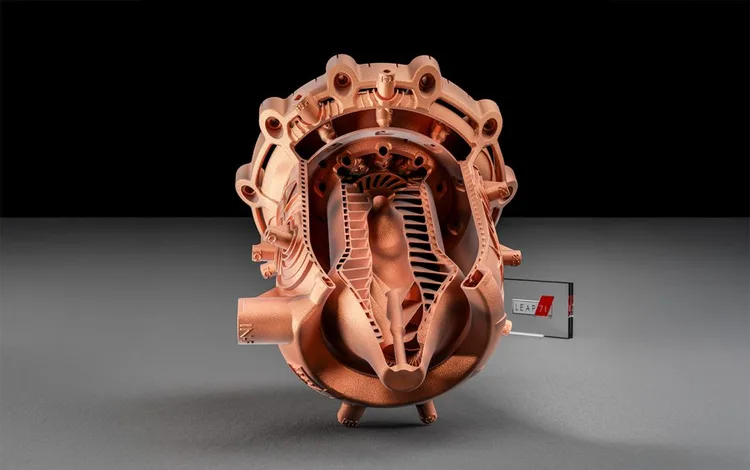
Noyron is not a chatbot that you simply tell what you want. It is a large computational model for engineering into which its creators have encoded expert knowledge, logic, physics including thermal models, manufacturing process rules, and related data as a single coherent whole. An engineer therefore does not draw one specific engine. Instead, they break the specification down into building blocks, describe how they interact, and encode the process an experienced expert would use to approach the design. The result is not a single component, but a system capable of creating an entire range of valid designs derived from the same knowledge base.
Noyron does not focus solely on the final shape. It attempts to predict the behavior of the finished product in advance, including mechanical motion and thermal conditions. The software outputs print-ready geometry, manufacturing process settings, files for further machining, and an overview of expected performance.
Feedback is also important. Data measured during an actual test or simulation is fed back into the system, allowing its estimates to be gradually aligned with reality. Every component it designs therefore improves the foundation for those that follow. The more things the company builds with it, the more accurate the software becomes.
Noyron generates geometry using PicoGK, a foundational geometry kernel that LEAP 71 released as open-source software so that other developers could use it as well.
Shapes no one could draw
This brings us to why this is about more than simply speeding up the work. Metal printing makes it possible to manufacture components that could never be milled from a solid block of material. These are highly interconnected shapes filled with internal channels that perform several tasks at once. But a person at a drawing board can take advantage of this freedom only to a limited extent. Drawing such a shape by hand would take forever, and calculating it is impossible for a designer.
This is precisely why Kayser argues that it makes no sense to talk about artificial intelligence in engineering without a computational approach. If the physics, logic, and reason behind every decision are not recorded anywhere, a neural network has nothing to learn from. Some experts have already described Noyron as the first artificial intelligence that actually builds machines.
How the tests turned out
The Sheffield engine burned liquid oxygen and kerosene, the same combination that powered the Saturn V rocket during the Apollo missions to the Moon. No one in the United Kingdom had used it for many years. At the time, Lissner said that the company could automatically create functional rocket engines and send them straight to practical testing. Less than two weeks passed from the final specification to the completed engine, whereas in traditional engineering this would have been months or years of work. According to her, each subsequent version can also be created within a few minutes.
Since then, testing has moved into full swing. In December 2025, the company fired two orbital methane-oxygen engines that Noyron had designed independently. Then, in March this year, it unveiled a printed aerospike engine with twenty tonnes of thrust together with partner company HBD. An aerospike is a propulsion system with a markedly different nozzle shape from conventional rockets. It had been considered promising for decades but technically difficult to implement.
Rockets are not the only field involved. Specialized versions for electromagnetic propulsion, machine motion, and heat exchanger design are also based on the Noyron model.
Who is buying the software?
This year, the company signed an agreement with European space company The Exploration Company. It licensed Noyron RP, the version focused on rocket engines, for five years with an option to extend. The two parties have been working together since 2023.
The Exploration Company is building the reusable Nyx cargo capsule and the powerful Typhoon engine. It will integrate the software into its own computational program, where it will generate the shapes of propulsion components. The company will then verify the results through its standard testing. CEO Hélène Huby explained that the company wants to explore a broader range of possible solutions and move more quickly between individual testing rounds.
Lissner added that most space companies still rely on time-consuming manual drafting of shapes, while Noyron offers a code-first approach. According to her, over the past two years the company has validated its software by firing engines with different configurations only weeks apart.