An experienced chemist can look at a proposed synthesis route and say within moments that it will not work. Not because they have calculated anything. They simply see it. This is exactly the kind of judgment that researchers at the Lausanne-based EPFL tried to teach machines. And by all accounts, they succeeded.
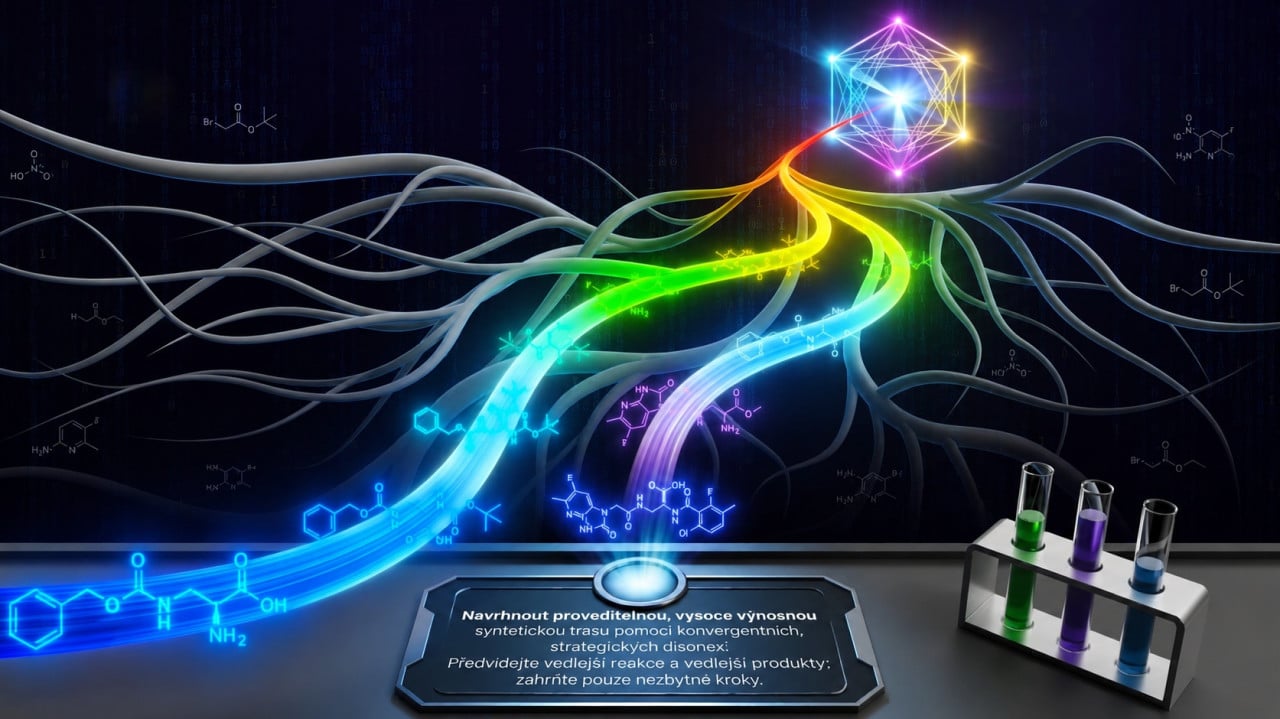
The result is a system called Synthegy, described in the prestigious scientific journal Matter. It is a tool that combines traditional computer algorithms for planning chemical synthesis with large language models. It allows chemists to enter instructions in plain Czech or English and receive ranked route proposals along with explanations of why each one makes sense.
Designing molecules is one of the most difficult tasks in chemistry. Every compound, whether a drug or an advanced material, requires a carefully planned series of reactions. Chemists usually work backward: they start with the target molecule and look for simpler starting materials and feasible reaction pathways. This approach is called retrosynthesis.
Today, computer tools can search vast chemical spaces and suggest hundreds of possible routes. The problem was that they could not evaluate them—ranking them according to what an experienced expert would actually choose. Although filters and fixed rules helped, every change in strategy required rewriting the code. Hours of work instead of minutes.
How Synthegy works
The system operates in two stages. First, traditional retrosynthesis software generates candidate routes, drawing on vast reaction databases and decades of research. The language model then comes into play. Each proposed route is converted into text. The model reads it and compares it with the instruction entered by the chemist at the outset. For example: avoid protecting groups or form the cyclohexane ring as early as possible. Synthegy evaluates and ranks each route and explains its decision.
Evaluating 60 proposed routes takes approximately 12 minutes and costs around 2 to 3 dollars in computing resources. This is a significant reduction from the hours the process previously took.
“When creating tools for chemists, the user interface matters a great deal. Earlier tools relied on cumbersome filters and rules,” says Andres M. Bran, the study’s first author. “With Synthegy, we are giving chemists the ability to simply talk, allowing them to move much faster and work with more complex synthetic ideas.”
The system also thinks at the electron level
Retrosynthesis is only half the story. Synthegy applies the same logic to reaction mechanisms—the detailed description of how a reaction proceeds step by step through the movement of electrons.
Mechanisms help chemists understand why a reaction works, not merely what it produces. Synthegy breaks reactions down into elementary electron movements, and the language model evaluates each step. The chemist can add context: temperature, a hypothesis about a specific pathway, or reaction conditions. The model takes this into account.
“Connecting synthesis planning and mechanisms is very exciting: we usually use mechanisms to discover new reactions that allow us to synthesize new molecules,” says Bran. “Our work bridges this space computationally through a unified natural-language interface.”
How Synthegy performed against experts
The EPFL team did not want to rely solely on internal tests. It conducted a double-blind study involving 36 chemists. They were given pairs of proposed routes for the same target molecule and asked to say which one better matched the given instruction.
The team then compared their choices with Synthegy’s. Of 368 valid assessments, the system agreed with the experts in 71.2% of cases. Not a perfect score, but high enough not to be due to chance. The study’s authors conclude that the model genuinely captures important reasoning rather than merely superficial textual features.
Before this research, no one had demonstrated that a language model could evaluate hundreds of multistep synthesis routes according to a specified strategy and agree with human experts in more than half of cases.
Synthegy also has its weaknesses
In addition to the limitations mentioned above, the system has clear weaknesses. Smaller language models perform at close to chance level. Synthegy works only with the largest and most expensive models. Sometimes the model confuses the direction of a reaction, leading to incorrect conclusions about feasibility. And the system can no longer meaningfully keep track of routes longer than 20 steps.
Moreover, the cited score of 71.2% comes from a specific subset of the problem. The evaluated pairs of routes contained 6 to 15 steps and were assessed against a single type of strategic instruction. No one has yet investigated how the system performs with shorter routes or differently worded instructions.
Why this is a different approach
Most discussions about artificial intelligence in chemistry revolve around generation: AI designs structures, AI predicts properties. Synthegy takes a direction in which language models do not generate chemistry, but evaluate it.
Traditional software does what it does best: it searches vast spaces of possibilities. The language model does what it does best: it reads, understands context, and compares it with an instruction. The result is a tool capable of capturing part of what is referred to in the laboratory as experience. For PhD students, this means access to a senior chemist’s intuition from a single prompt. For research laboratories, it shortens the journey from an idea to a validated synthetic strategy.