

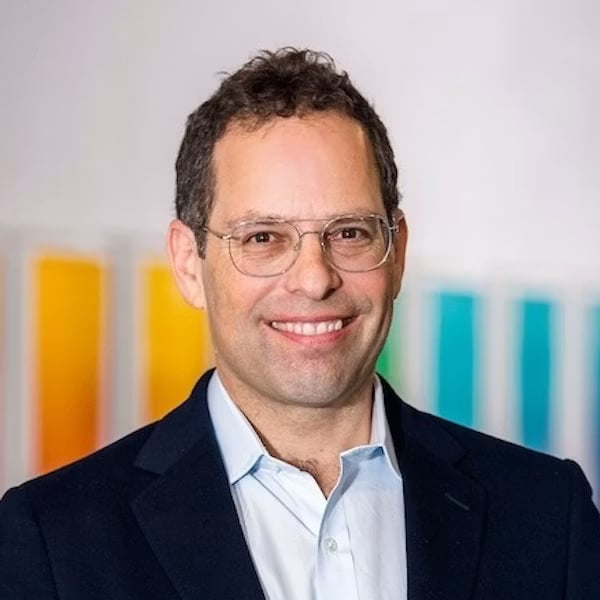
Neil Rimer co-founded the investment firm Index Ventures, one of the most successful venture capital firms of the past three decades. Since its founding, the firm has raised roughly fifteen billion dollars from external investors, and last year alone, sales of stakes in companies, including Figma’s IPO and Google’s acquisition of cybersecurity firm Wiz, brought it around nine billion dollars, according to media reports.
He stepped back from day-to-day investing in 2021 and spends most of his time in Athens, where his wife is from and where his children proudly carry Greek passports. He arrived for the interview in a wrinkled shirt and jeans, rather than the expensive sweater worn by most people in his industry.
Rimer and his statements about AI and money
At a new technology festival in Athens in late May, Rimer said he had a strong feeling that some form of redistribution of the wealth accumulating around artificial intelligence was coming. He added that it would happen, whether voluntarily or involuntarily, and that he personally hoped for the voluntary option. In his view, technology leaders have an opportunity to set the direction of this process.
If anyone else had said something like that, it would have sounded like ordinary populism. But coming from someone who has ranked among the investment world’s elite for decades, it carries entirely different weight.
Rimer does not believe that the wealth generated by AI will remain forever with those who are currently building the models and owning the infrastructure. On the contrary, he expects the money to spread to a broader range of companies, software developers, and businesses that actually deploy artificial intelligence in their operations. And that is despite the fact that AI startups currently consume a huge share of all investment in early-stage companies—more than two-fifths, according to available figures.
It is precisely this imbalance that worries him. The most valuable companies attract enormous amounts of capital, while questions are increasingly being raised about who will ultimately reap the returns when the models, chips, and cloud infrastructure are controlled by only a small group of companies.
An era when the wealthy are giving less
His comments came at an unusual moment for generosity. The Giving Pledge, an initiative launched by Warren Buffett and Bill Gates in 2010 through which billionaires commit to donating half of their wealth to charitable causes, is slowly losing its relevance. In the first five years, one hundred and thirteen families joined, followed by seventy-two, then forty-three, and in all of 2024, only four. Elon Musk, the richest person in the world, has declared that his companies are themselves philanthropy.
Rimer is also seeing this cooling in his own portfolio. Among other things, Index owns a stake in Anthropic. When Business Insider asked financial adviser Alex Caswell whether his newly wealthy clients, many of whom work at Anthropic, planned to give away a larger share of their wealth, the answer was clear. Although the company matches employee donations up to a quarter of the value of their stake, and some have taken advantage of this, most do not consider philanthropy at all when making their plans. Instead, they want to invest in startups themselves or launch their own company.
The scale of the entire phenomenon is hard to grasp. This year, after SpaceX went public, Musk briefly became the very first person whose wealth exceeded one trillion dollars, but after SpaceX’s shares fell, his wealth dropped back below that threshold. Forbes counted in its ranking this year alone forty-five new billionaires in AI, with a combined fortune of around $2.9 trillion, even though neither Anthropic nor OpenAI has gone public yet.
When money becomes this concentrated among a few people, history shows that it does not last. Either the surplus starts being shared voluntarily, or pressure from below will sooner or later force politicians to redistribute it for you. That is exactly why Rimer talks about two paths, an easy one and a hard one, and hopes that the rich will choose the easy one before someone else makes the decision.
The debate between governments and companies is also growing
The fact that voluntary giving is faltering opens the door to ideas about how redistribution could be imposed from above. One of them came from OpenAI, which reportedly considered giving the U.S. government a five-percent stake in the company. OpenAI CEO Sam Altman presents it as a way to share the profits from artificial intelligence with the public, but critics see it more as an attempt to buy political peace.
After all, Silicon Valley has never enthusiastically welcomed the government among its shareholders. Sequoia investor Roelof Botha joked last year that one of the most dangerous phrases in the world is when someone tells you they are from the government and are here to help. Rimer’s point is different. He would rather see people like him decide to give some of the money back themselves than have someone else take it from them.
None of this is new to Rimer; he has spent his entire life in technology. He is far more interested in something he calls the moral core of technology companies. His interest was sparked in 1984, when he was studying at Stanford and Apple offered the first Macintosh to students at a discount. Steve Jobs and Apple’s other founders were his heroes at the time because they were building something he considered genuinely beneficial to the world.
Today, something else concerns him. He hears his own children talk about some technology companies in the same tone that earlier generations used when speaking about arms manufacturers or cigarette companies.
Critics may argue that, as an investor in Anthropic and other technology companies, Rimer himself is among those profiting from the entire boom, meaning that some of the money whose redistribution he discusses also flows to him. But he would rather see people like him decide to give some of that money back voluntarily than have someone else do it for them one day.
Sources: mangodeveloper.com and techcrunch.com


