

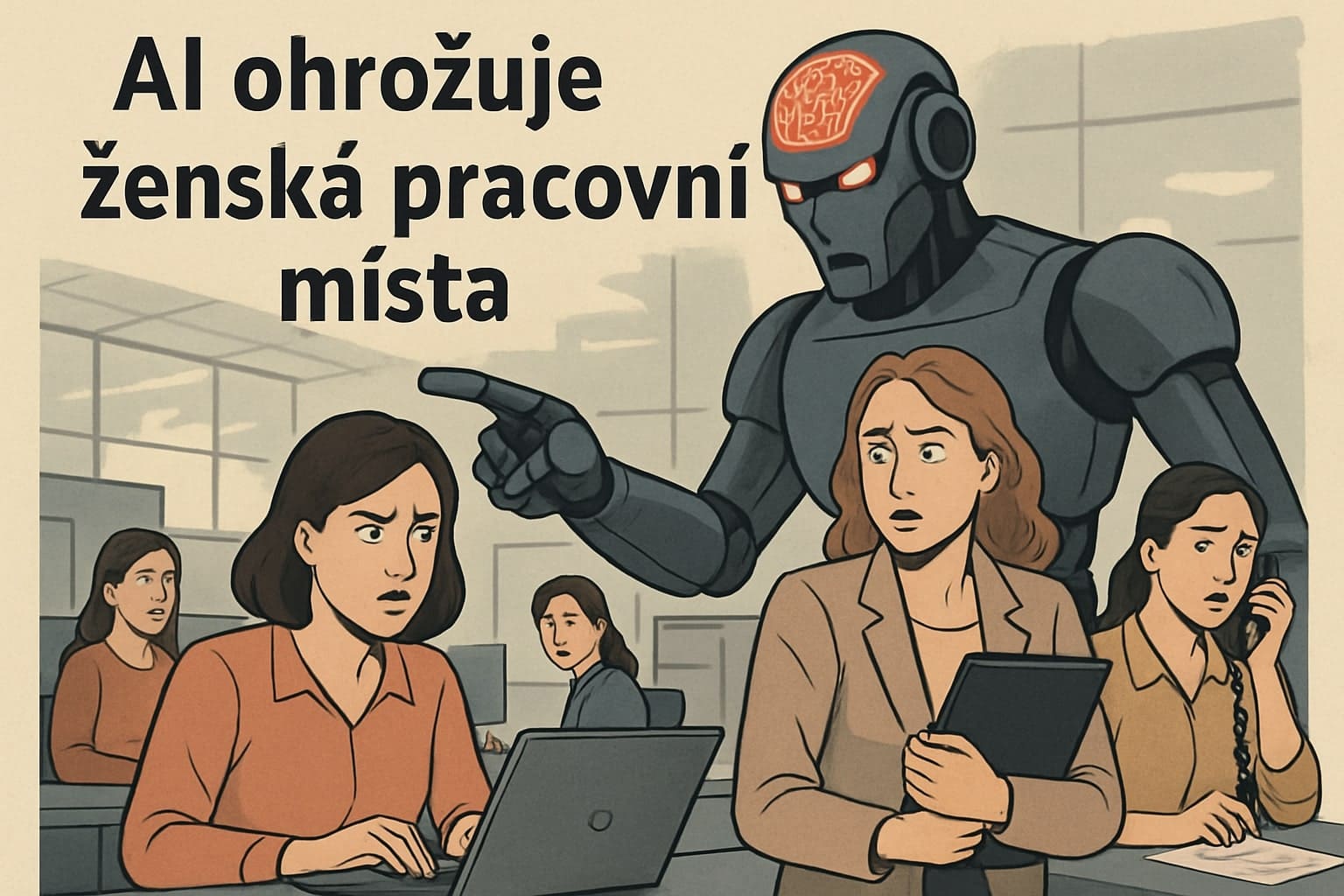
New Study: AI Automation Threatens Women Three Times More Than Men
Artificial intelligence is fundamentally changing the labor market, but its impact is not evenly distributed between genders. According to the latest analysis from 2025, women in wealthy countries face a significantly higher risk of being replaced by artificial intelligence than men—specifically, their risk is three times higher. This trend raises serious questions about the future of gender equality in the labor market and could reverse decades of progress in employment opportunities for women.
Study Findings
The report reveals alarming statistics concerning the impact of automation on women's employment. The likelihood that women in wealthy countries will face jobs with "high automation potential" has risen to 9.6%, up from 7.8% recorded just two years ago. By contrast, the risk for men remains at a significantly lower level of just 3.5%. This dramatic imbalance is not accidental but reflects structural differences in the types of jobs traditionally held by women versus men. A key factor behind this disparity is the fact that artificial intelligence is most aggressively replacing precisely the types of work in which women are overrepresented. These primarily include administrative positions, office jobs, and data-processing roles. These roles are particularly vulnerable to AI-driven automation because many tasks in these areas can be effectively transferred to algorithms and machine learning. Organizations are rapidly adopting AI technologies to reduce costs and increase productivity, leading to the elimination of these positions or their rapid transformation into gig-economy work.
Gender Equality Issues
The International Labour Organization (ILO) warns in its report that this trend is likely to widen the gender employment gap rather than narrow it. Although progress has been made toward equalizing the number of hours worked by men and women, pay disparities persist. As formal employment opportunities for women shrink due to automation, their work is increasingly relegated to unpaid domestic responsibilities. This phenomenon represents a potential step backward in efforts to achieve gender equality in the workplace. The problem is further complicated by the fact that AI systems themselves often exhibit gender and racial biases. These biases arise because algorithms rely on historical data that reflect existing inequalities in society. The combination of biased algorithms and the widespread deployment of AI technologies therefore risks further entrenching the exploitation and discrimination of already vulnerable groups. This systemic bias means that AI not only replaces women's work but may also reproduce and amplify existing injustices in decision-making processes related to hiring, performance evaluation, and career advancement.
Fewer Job Opportunities
However, the impact of AI on the labor market is not limited to traditional employees. Both highly skilled freelancers and conventional employees have experienced declining wages and fewer job opportunities as companies shift tasks previously performed by humans—including translation, art creation, and marketing analysis—to generative AI systems. This shift affects a broad range of professions and shows that automation is not limited to routine or manual work. The benefits of increased productivity resulting from AI adoption often accrue primarily to corporate owners rather than to workers themselves. This concentration of benefits on the side of capital is prompting labor unions to begin organizing resistance to the unchecked introduction of labor-replacing technologies. This development highlights the growing tension between technological progress and the protection of employees' jobs and incomes.
Measures to Restore Balance
Some analysts propose universal basic income or new social protection systems as ways to address the mass displacement caused by automation. However, such measures remain politically controversial and have not been tested on a large scale. The absence of concrete solutions means that workers, particularly women in the most at-risk sectors, face uncertainty about their economic future. The AI-driven transformation of the workplace is thus deepening existing gender inequalities in labor markets worldwide, especially for women employed in sectors most vulnerable to automation. Without targeted policy interventions or systemic changes addressing both technological bias and economic displacement, these trends threaten not only individual livelihoods but also broader efforts toward gender equality in the workforce. The situation requires immediate attention from policymakers, technology companies, and society as a whole to ensure that the benefits of AI are distributed fairly and do not deepen existing inequalities.


