

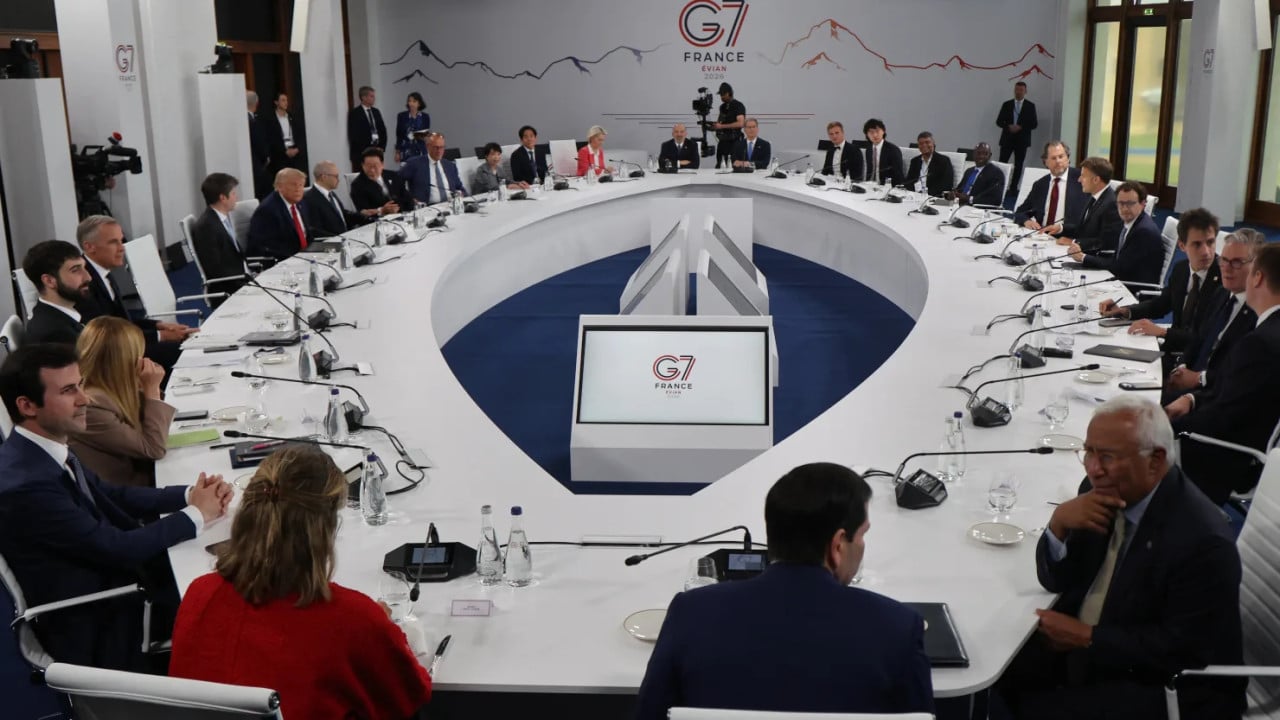
The heads of the largest artificial intelligence companies arrived at the G7 summit in Évian-les-Bains, France, with one shared message for world leaders: you must quickly find a way to govern AI. What Sam Altman of OpenAI, Demis Hassabis of Google DeepMind, and Dario Amodei of Anthropic could not agree on at all, however, was the answer to the question of what exactly that should mean.
Three days of talks in the French Alps culminated in a working lunch that lasted two and a half hours. Alongside presidents and prime ministers, the technology industry's leading figures sat at the table. And one very uncomfortable shadow hung over the entire meeting.
The dispute no one wanted to discuss openly
Less than a week before the summit, the Trump administration forced Anthropic to cut off access to its most advanced models, Fable 5 and Mythos 5. Washington imposed export restrictions on these models on national security grounds after receiving reports that the artificial intelligence safeguards could be circumvented. For technical reasons, the company opted to disable access to the models entirely in order to comply with the order.
For the other G7 countries, it was a shock. They suddenly found themselves without access to technology that Anthropic itself describes as exceptionally capable of finding and exploiting software vulnerabilities. And concerns flared up in Europe and Silicon Valley that the White House was willing to cut even allied countries off from the latest models.
Interestingly, according to people familiar with the talks, no one directly mentioned the incident over lunch. One industry representative called it “the elephant in the room.” Everyone knew about it, but no one wanted to discuss it.
We only have a few years, company leaders warned
Hassabis, Altman, and Amodei agreed on at least one thing. Governments have very little time to bring AI under control. Their specific timelines differed, however. Hassabis spoke of three to five years. Amodei was much more urgent, claiming that we are one to two years away from models that will be better than humans at absolutely everything. Altman summed it up by saying that in a year or two, we will have systems with astonishing power.
And now for the uncomfortable part. While all three emphasized the enormous benefits this would bring, they also spoke openly about the downsides. And they were not talking about jobs or inequality, which were mentioned only in passing. They were talking about security threats: cyberattacks, bioterrorism, nuclear matters, and warfare.
Amodei even warned that if the current trajectory continues, AI could become the main source of countries' economic and military power. That is not a particularly reassuring thought for leaders outside the United States, because all the leading companies in the field are based in America. DeepMind may be in London, but it is owned by Google.
Where opinions diverge
When it came to the question of how to govern the technology, Amodei called for the creation of a coalition of democratic countries led by the United States. It would oversee access to the technology and isolate common adversaries, among whom he named China. According to him, cooperation should include controlled access to the most advanced models as well as trade in chips and components, from which China would be excluded. Altman rejected this. Once safeguards are in place, he said, we must lean toward human freedom. We want every person in the world to benefit from the technology and figure out for themselves how to use it.
They also disagreed about the role the companies themselves should play. Hassabis proposed a body that would build trust, something like a technical standards organization supported by leading labs. It would be international in nature but led by the United States, and it could adapt its rules every quarter based on newly identified risks. Hassabis added that he was already working on something like this.
Altman, by contrast, warned that labs should not have too much power. “There is a threat more insidious than the technical risks of this technology,” he said. “It is the threat that the very real risks of AI will become a justification for concentrating power in the hands of a very small number of people.” And he sent leaders a clear message: do not delegate your responsibility to labs like mine.
Macron: If America can flip the switch, that is a problem
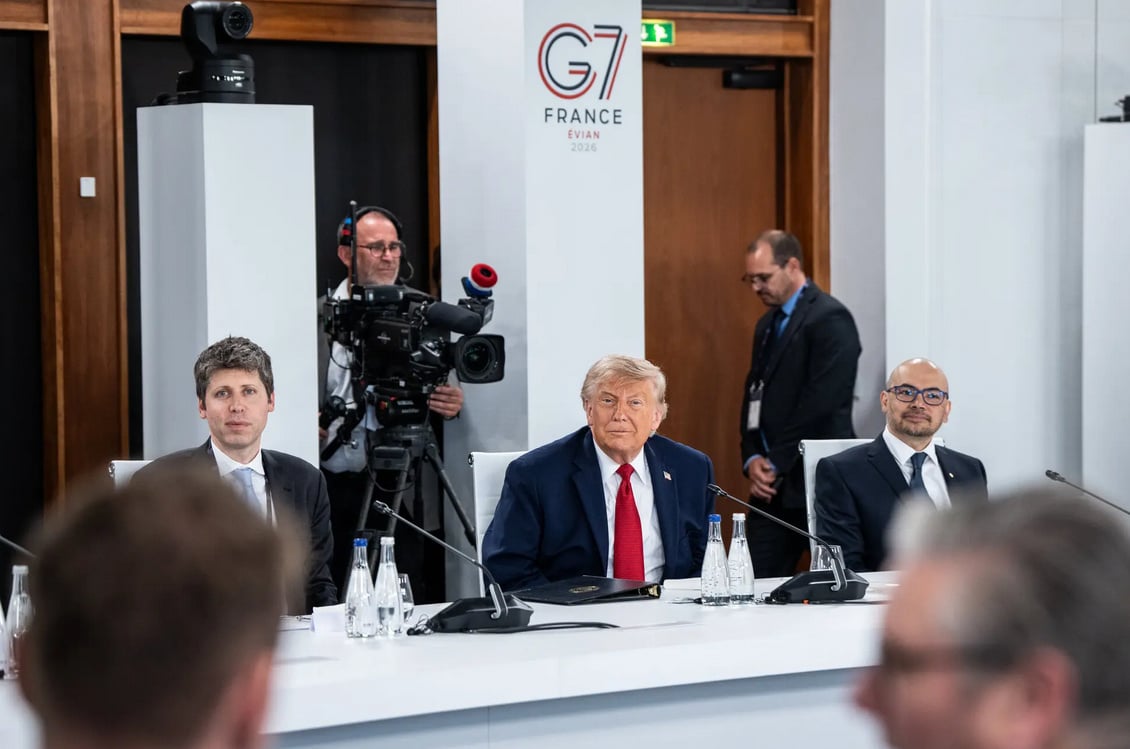
Americans were not the only guests. Around a dozen technology executives attended the lunch. Arthur Mensch represented the French company Mistral, while representatives from Canada's Cohere, Italy's Domyn, Britain's Synthesia, and Germany's Black Forest Labs were also present. In addition to President Trump, the United States was represented by Treasury Secretary Scott Bessent, Commerce Secretary Howard Lutnick, and Secretary of State Marco Rubio.
French President Emmanuel Macron said that the dispute surrounding Anthropic had “clarified what is at stake” for America and its allies. He warned that if Washington can “flip the switch overnight,” it will harm the trillion-dollar American companies leading the global AI race. Macron called for stricter rules and warned of the danger of democracies failing to help one another. He promised that a platform for cooperation among democracies would be created in the coming months to jointly establish uniform standards.
Indian Prime Minister Narendra Modi also voiced his concerns. According to people familiar with the discussion, he was troubled by Anthropic being cut off and emphasized that democratic countries must have access to the models so they can protect their critical infrastructure.
Mensch of Mistral then highlighted an issue that he said came up repeatedly, particularly among non-American participants: how countries can secure a technology supply chain that they control themselves. “When you have an intertwined supply chain, are you sure your partners cannot cut you off?” he asked.
Amodei: Resist the temptation to splinter
Amodei himself called on leaders to “resist the temptation to splinter” in their approaches to AI rules. This came as, according to leaked internal chats, his own employees complained that the White House was unfairly attacking them. “Are we being bullied based on bad feelings?” one Anthropic employee wrote. “At what point does it start to look like they simply don't want us to exist?” another asked in an internal conversation.
Amodei said he understood countries' efforts to prevent AI from falling into the wrong hands, but that democratic nations should stick together. And on this point, he was surprisingly supported by his longtime rival Altman. Altman emphasized that every country in the room should receive tools for cyber defense. Hassabis agreed as well.
Canadian Prime Minister Mark Carney agreed that the United States could lead such a coalition. And OpenAI's chief global affairs officer Chris Lehane said he sensed that even the non-American leaders in the room recognized that the US could play the leading role in setting standards.
Starmer and Meloni raised their own issues
British Prime Minister Keir Starmer avoided directly answering whether AI governance should be based on restricting the technology or providing broad access. Instead, he emphasized the need for public consent. He agreed that standards were urgent given the pace of development, adding: “If AI leaders are afraid, politicians are afraid too.” At the same time, he warned that both children and freedom of expression must be protected. “If we cannot do both, we will lose public consent,” he said.
Italian Prime Minister Giorgia Meloni raised an issue that Rome has championed since its G7 presidency in 2024. She focused on accountability for AI and the question of how to define truth in artificial intelligence. According to an Italian diplomat, the issue is that it is becoming increasingly difficult to distinguish what is true from what is fake. Meloni also discussed the issue of watermarking AI-generated content with Japanese Prime Minister Sanae Takaichi in Rome.
Europe was careful not to inflame the dispute surrounding Anthropic unnecessarily. Brussels proceeded cautiously, partly because there had been no official announcement from the US government about export restrictions, only a statement from Anthropic itself. “We are ready to engage and address these security risks together with our like-minded partners,” said European Commission spokesperson Thomas Regnier. One European diplomat summed it up as follows: “The issue is rebuilding trust; we need to recreate a circle of trust.”
Sources: cnbc.com, afr.com, politico.eu and news.sky.com


