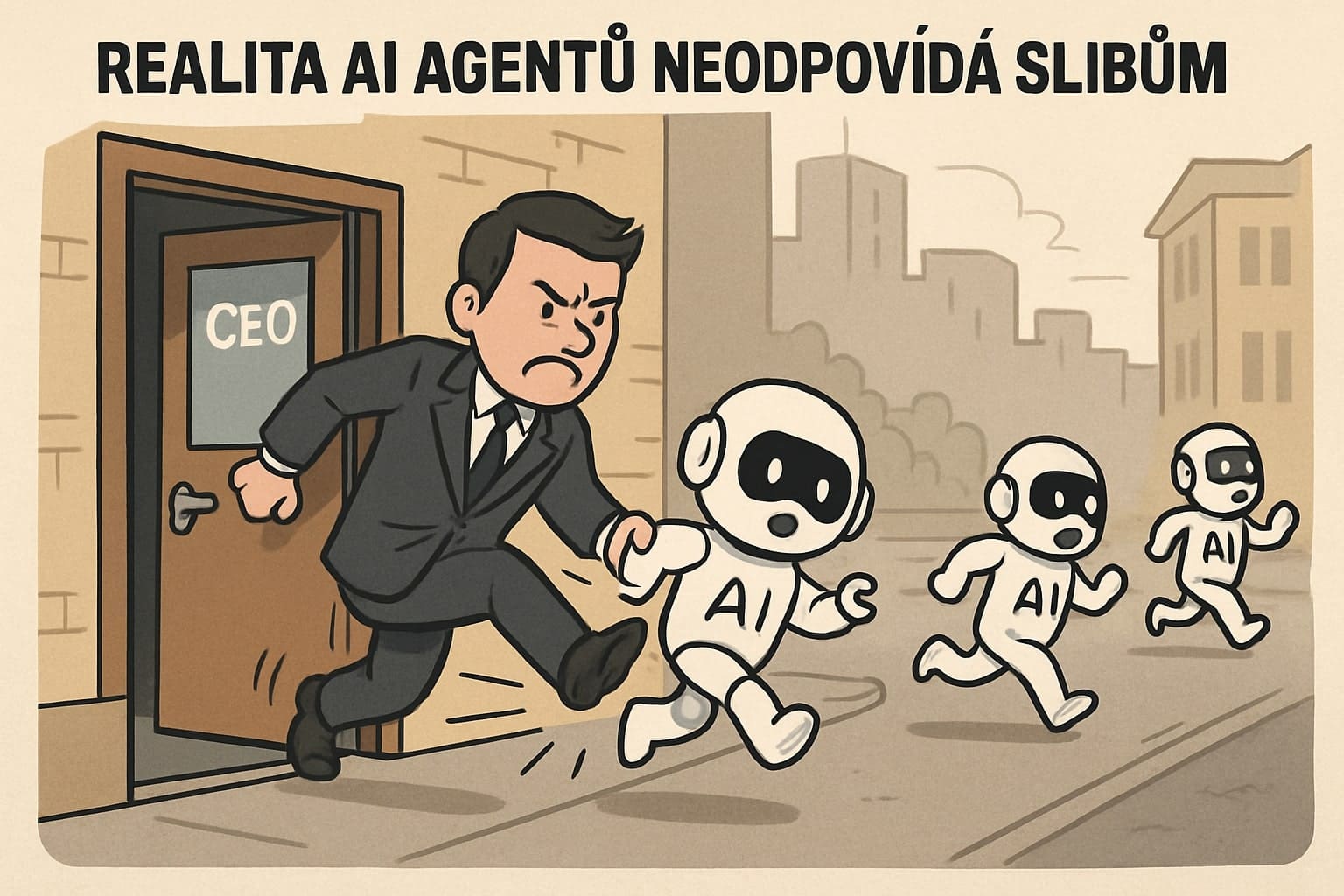
The Reality of AI Agents Falls Short of the Promises
According to tech billionaire and OpenAI CEO Sam Altman, 2025 was supposed to be the year when "AI agents will work." Despite the massive hype, however, so-called "AI agents"—software products intended to perform tasks autonomously at a human level—have so far failed to live up to expectations. As of April, even the best AI agent could complete only 24% of its assigned tasks. Yet that did not stop business executives from swarming to the software like flies to carrion and eliminating entire divisions of human workers to make room for their AI replacements.
Gradually, however, it is becoming clear that AI agents have not even paid off yet—while exposing their employers' embarrassing secret—and more and more executives are waking up to the chaotic reality of the AI hype. A recent study by consulting firm Gartner, for example, found that of 163 business executives, fully half said they would abandon their plans to "significantly reduce customer service staffing" by 2027.
A Return to the "Hybrid Approach"
This situation is forcing corporate PR specialists to rewrite speeches about AI "moving beyond automation" and instead lean on phrases such as "hybrid approach" and "transitional challenges" to describe the fact that they still need people to keep the workplace running. "The human touch remains irreplaceable in many interactions, and organizations must balance technology with human empathy and understanding," said Kathy Ross, senior director analyst for customer service and support at Gartner.
Employees have felt this way for some time. Another report by IT company GoTo and research firm Workplace Intelligence found that 62% of employees now say AI is "significantly overhyped." Similarly, only 45% of corporate IT executives said they had a formal AI policy in place, suggesting a scattered and rushed rollout of the technology. Of these IT leaders, 56% said that "security concerns" and "integration challenges" were the main barriers to AI adoption.
Companies' Embarrassing Return to Human Employees
The reports come as a number of companies have already made humiliating reversals in recent weeks. Financial startup Klarna, for example, reduced its workforce by 22% during 2024 ahead of the long-promised AI revolution. In May, however, the company reversed course on its AI strategy and announced a "hiring drive" to bring all those "human meat sacks" back to work.
According to technology critic Ed Zitron, the entire agentic charade can be explained by the fact that "it is not obvious what any of these AI products do, and when you finally understand them, they do not seem to do very much." "These 'agents' are branded to sound like intelligent life forms capable of making intelligent decisions," Zitron writes, "but they are really just bloated automation that requires enterprise customers to invest time in programming them."
Carnegie Mellon Revealed the Truth About AI Agents
Researchers at Carnegie Mellon University conducted an experiment in which they staffed a fictional software company called "TheAgentCompany" exclusively with AI agents. These agents, developed by leading companies such as Google, OpenAI, Anthropic, and Meta, were assigned roles typical of a real software company: financial analysts, software developers, project managers, HR staff, and others. The AI agents were tasked with activities such as navigating directory structures, exploring virtual office environments, and conducting employee evaluations using collected feedback.
The AI agents' performance was remarkably poor. The best model, Anthropic's Claude 3.5 Sonnet, was able to complete only 24% of its assigned tasks. Even these limited successes came at a considerable cost: the tasks required nearly 30 separate steps and more than $6 per task. The overall operation was described as "amusingly disorganized," highlighting the current limitations in task management and collaboration among AI agents.
The Future of AI Agents Remains Uncertain
The study demonstrates that despite rapid advances in AI, current agentic systems are not ready to autonomously manage complex real-world operations without substantial human oversight. This revelation offers reassurance that AI is unlikely to replace entire workforces in the near future, not because of a lack of ambition, but because the technology is not yet capable of reliably handling such responsibilities.
The experiment is part of an industry discussion about the future of AI agents—autonomous digital assistants capable of handling tasks across applications and platforms. While some analysts believe that widespread adoption of such agents could fundamentally change how the internet and many industries operate, current evidence from experiments such as Carnegie Mellon's suggests that these impacts remain speculative for now.
Staffing a company exclusively with AI agents, as tested by Carnegie Mellon University professors, resulted in significant inefficiencies and unfinished work, underscoring that AI agents currently lack the sophistication required for autonomous business operations.