Agnes and the Stone Dragon's Egg
ages 4–99 minutesgentle, magical, and adventurous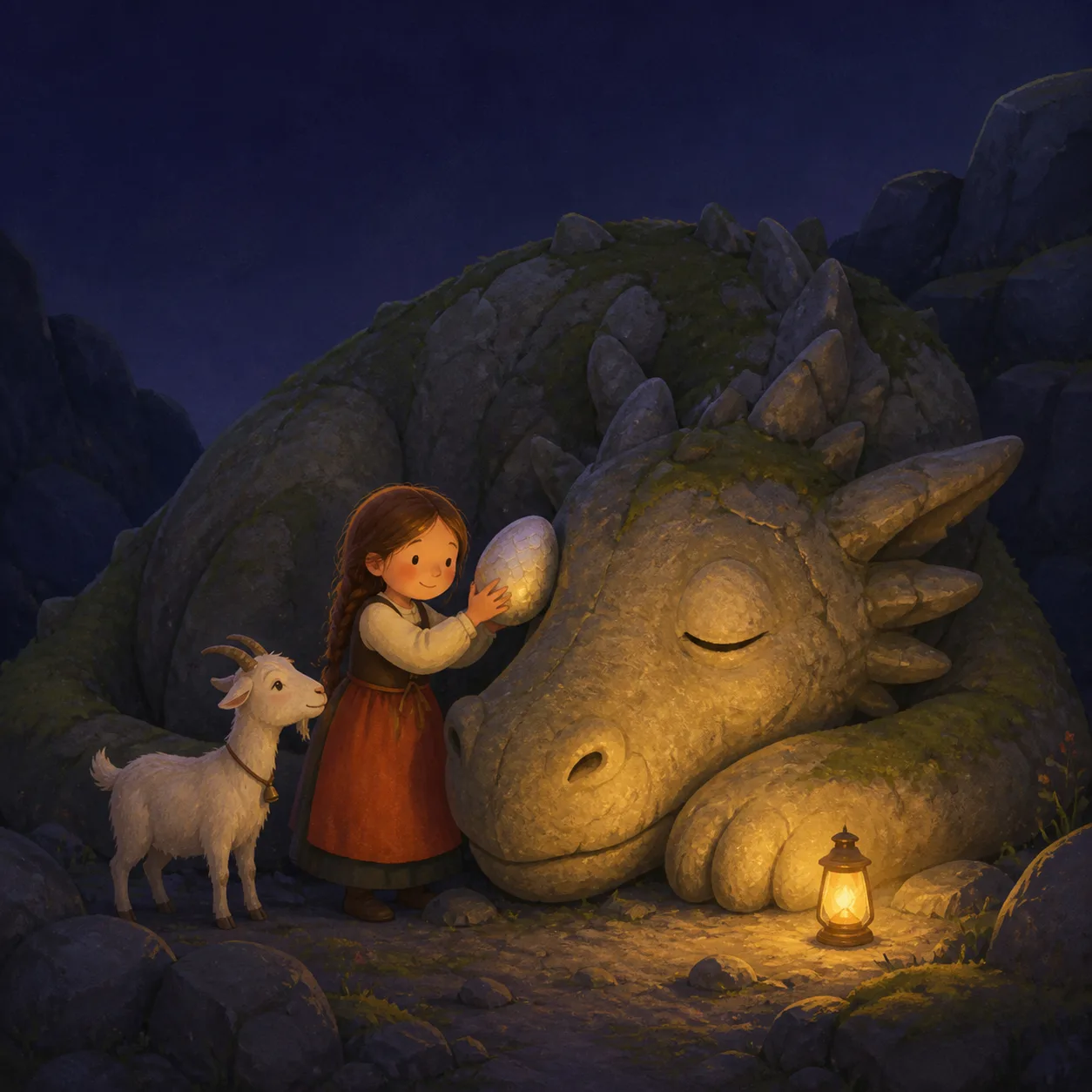
Read the story
Beyond the village, where the meadows smelled of wild thyme and the mountains wore caps of cloud, Anežka tended a small herd of goats. The smallest goat was named Bělinka. She had horns like two little hooks and always wanted to go wherever Anežka was not going.
One morning, Bělinka stopped by the stream. She stuck her muzzle between the pebbles and sneezed so mightily that she splashed Anežka’s skirt. Among the grey stones lay an egg as large as a loaf of bread. Fine blue veins ran across its silver shell.
Anežka carefully picked up the egg. She expected it to be heavy, but she could barely feel it in her hands. It was as warm as a mug of milk. “Who could have left you here?” she whispered. Something tapped softly inside. Bělinka stretched out her neck, sniffed the shell, and for once did not even bleat.
Grandfather, who had come with an empty basket for herbs, examined the egg for a long time. “Dragon,” he said at last. “Do you see those blue threads? Mountain dragons’ eggs have those. Sometimes the spring floods carry them all the way down here from their nests.” Anežka looked up at the high hills.
She wanted to carry the egg back to the cottage, but she had taken barely three steps towards the village when her arms began to ache. The egg weighed as much as a full bucket. She turned towards the mountains, and suddenly it was light again. She tried taking a step to the side. It grew heavy. A step towards the mountains. Light as a feather.
“It knows where it lives!” she gasped. Grandfather brought her some bread, a piece of cheese, and a bottle of water. He promised to watch the herd. He wanted to take Bělinka away too, but she dug in all four hooves and would not move until Anežka said, “Then come with us, you stubborn thing.”
Anežka wrapped the egg in a scarf and slung it over her shoulder. They set off along a sunken lane between the hazel bushes. When they headed the right way, the scarf barely fluttered against her side. When they took a wrong turn, it sagged down and tugged at her shoulder. They needed no better guide.
Before long, they reached an orchard surrounded by a crumbling wall. But it was no ordinary orchard. The trees had stone trunks, stone leaves, and stone pears hanging from their branches. The wind neither sang nor rustled among them. Now and then, it merely chimed against a tiny twig like a spoon against a cup.
Bělinka took a fancy to one of the pears. She stood on her hind legs and tried to taste it. Clack! She jerked back in surprise and looked at Anežka as though such a rude pear were her fault. “You won’t find a snack here,” Anežka laughed, offering her a piece of bread.
In the middle of the orchard, the path divided. A fine, straight footpath led to the right, while fallen stone branches lay to the left. Anežka tried the right-hand path. The egg immediately dragged her towards the ground. “All right, all right,” she sighed. “We’ll go over the branches. But I hope your mother doesn’t live in a tree.”
Climbing over them was slow work. Anežka protected the egg with both hands, and Bělinka’s eagerness was more hindrance than help. Then the goat stopped beside a low gap beneath the branches. She squeezed through and bleated triumphantly. Anežka knelt down and crawled after her on her hands and knees.
Beyond the orchard, a grassy slope opened before them. The sun was warm there, bees buzzed, and three taps sounded from inside the egg. Anežka sat down in the grass. “Are you looking forward to it?” she asked. She laid her palm against the shell and felt something stir ever so slightly inside.
She divided up the bread and cheese, took a drink, and poured a little water into her palm for Bělinka. The goat drank it all, then thoroughly licked Anežka’s fingers. The egg rested on the scarf between them. Its blue veins glowed faintly, even in the sunlight.
In the afternoon, they reached the mountain pools. They lay among the rocks like round mirrors, each holding a different patch of sky. A dragonfly skimmed over the first pool. A small cloud bathed in the second. At the third, the footpath ended so suddenly that it seemed someone had snipped it off with scissors.
Anežka set off around the pool to the left. The egg grew heavy. She tried the right. It grew heavier still. Only when she turned directly towards the rock face did it become light again. But thick ferns grew before her, and behind them stood the rock, tall and straight as a closed door.
“We can’t possibly go this way,” said Anežka. Bělinka disagreed. She spotted a green leaf behind the ferns, pushed her head after it, and disappeared all the way up to her tail. The hollow tapping of hooves sounded from beyond. Anežka parted the leaves and discovered a narrow cleft, completely hidden from the path.
Natural steps led through the cleft. Anežka climbed them carefully, holding on to the rock with one hand and supporting the egg with the other. Bělinka always waited one step higher. Whenever Anežka looked up, the goat presented her backside and marched importantly onwards like an experienced mountain guide.
At the top, they found an abandoned quarry. Pale boulders lay at the bottom, with bellflowers growing among them. It was so quiet that Anežka could hear her own breathing. The egg trembled slightly in the scarf. Tap. Tap-tap. This time the tapping came faster, almost impatiently.
Anežka looked around for a nest, but saw none. A long, mossy mound rose by the quarry’s far wall. It had two points at one end, an arch in the middle, and a long, curling ridge at the other. Bělinka leaped onto the ridge and tore off a clump of grass.
That was when Anežka noticed the closed eye. It was as large as her straw hat. The points were horns, the arch was a folded wing, and the curling ridge was a dragon’s tail. Beneath the moss lay an enormous stone mother dragon. One paw was stretched out before her, as though she were still searching for something in her sleep.
“Mrs Dragon?” Anežka called. “We’ve brought you an egg!” Nothing moved. She tried calling louder. Bělinka added her most piercing bleat, and the sound echoed from every wall of the quarry. But the mother dragon slept on. Not even a single cushion of moss trembled on her nose.
Anežka stroked the cool stone muzzle. Then she brushed off part of the paw and tried rapping on it with her knuckle. It sounded like knocking on a garden wall. Wearily, she sat down beside the dragon’s head. They had come such a long way, and the mother would not wake up.
Then a very soft tap, tap-tap came from the scarf. Anežka held her breath. The egg was not calling loudly. It tapped quietly, like someone at the door who did not want to wake the whole house. Above the dragon’s cheek, she glimpsed an ear beneath the moss, curled like a large stone leaf.
She carefully pulled the moss aside and held the egg right against the ear. “Try once more,” she whispered. For a moment, there was silence. Then the little dragon tapped. Tap. Tap-tap. A blue vein lit up in the stone ear. It raced down the neck, across the wing, and all the way to the tip of the tail.
The mother dragon slowly opened her eye. It was golden and sleepy. When she saw the egg, she breathed out so gently that only the ribbon in Anežka’s hair stirred. “My little one,” she murmured. She raised her head, the moss slipped from her horns, and Bělinka jumped down from her tail, just to be safe.
The mother dragon told them that after the great rain, she had found her nest empty. She had searched for the egg beside every stream and beneath every rock. At last, she had fallen asleep from exhaustion in the quarry. And stone dragons sleep so deeply that not even a thunderstorm can wake them. Anežka placed the egg between her front paws.
The shell cracked. A tiny muzzle peeped out, then two horns, and finally a little dragon, grey and smooth as a warm pebble. He pressed himself against his mother’s cheek. Bělinka sniffed him. The little dragon sneezed and blew out a bluish bubble that burst right on her nose.
When the sun dipped low, the mother dragon spread her stone wings. They were as thin and light as leaves of slate. Anežka and Bělinka settled into the soft moss on her back, and the little dragon curled up behind one of his mother’s horns. They flew home over the pools and the stone orchard.
Grandfather was already waiting by the pasture. The mother dragon landed so quietly that she did not even wake the goats. Before they flew away, the little dragon leaned over and tapped his horn three times against his mother’s horn. Anežka answered by tapping her finger against the gate: tap, tap-tap. On the way to the goat shed, Bělinka sniffed every pebble. What if one of them needed to be carried home too?