The Tuesday That Ran Away from the Calendar
ages 5–1013 minutesmagical, gentle, and playfully suspenseful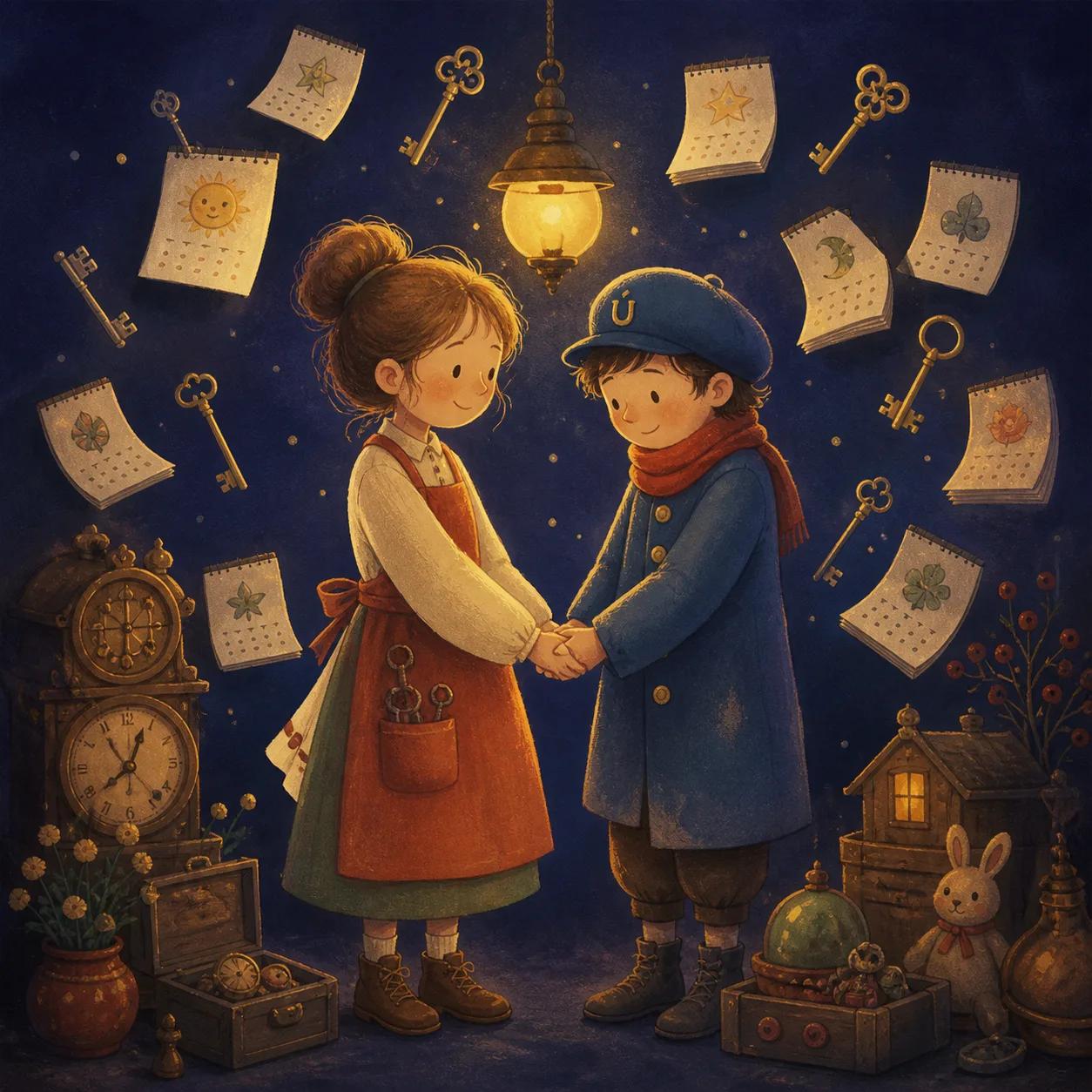
Read the story
Turn on sounds to bring the bold words to life. Each sound plays once per reading.
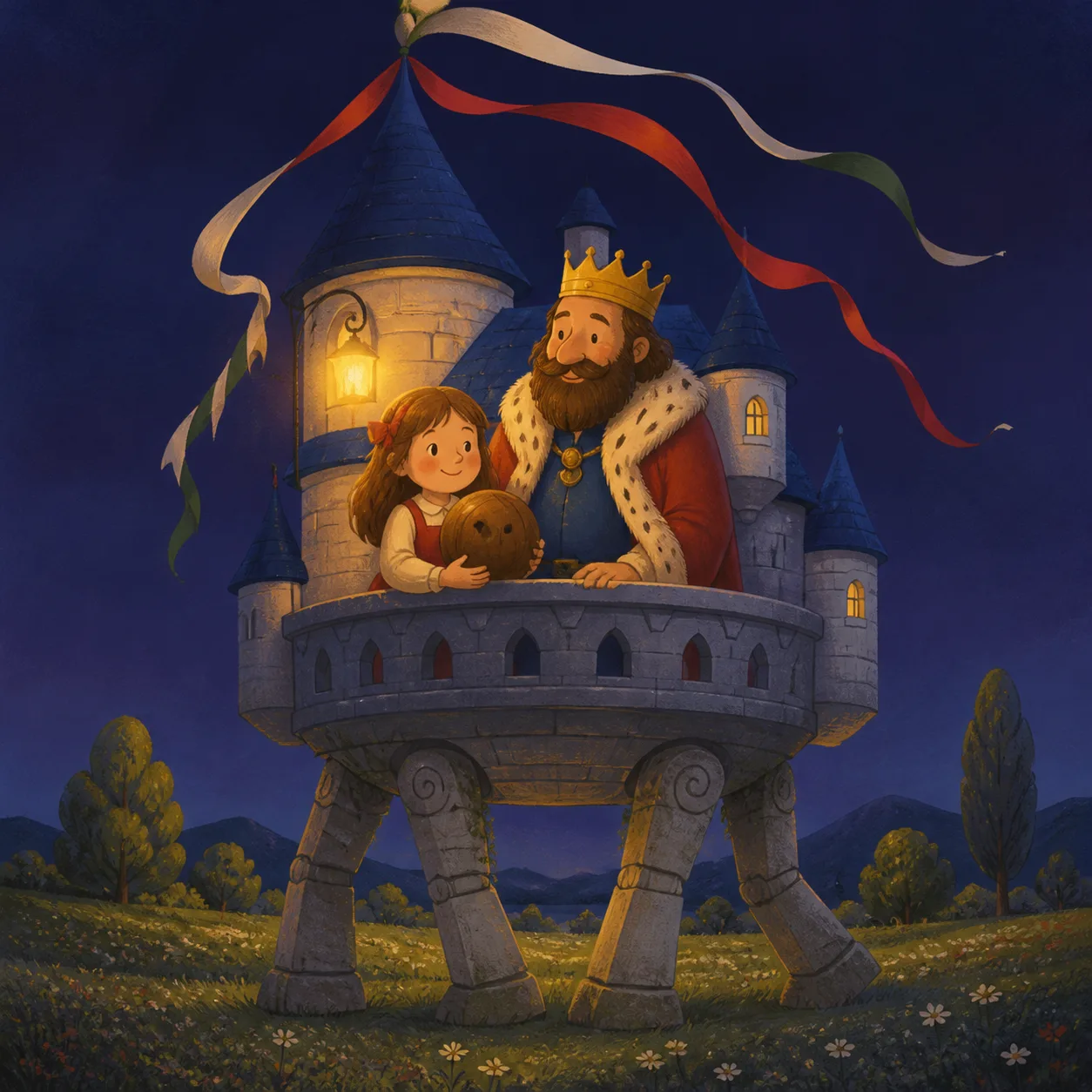
In the kingdom beneath the Blue Hills, a magical calendar hung on the castle tower. It was as large as a gate, and every evening a golden cricket moved its hand to the next day. At that moment, the pages of all the little calendars throughout the kingdom turned. No one had to turn them by hand, which especially pleased the bakers, because otherwise they would have left floury fingerprints on them.
The calendar was cared for by Master Tick the clockmaker and his apprentice, Bára. She could find a stray cog just by its sound, but what she liked best was oiling the cricket’s knees. One Monday evening, she overheard the cook outside the window: “Tuesday again tomorrow. Nothing interesting ever happens then.” “You’re right,” the gardener agreed. “It’s neither the beginning of the week nor the end. Just an extra day.”
Bára wanted to point out that the pink hibiscus would bloom on Tuesday, but the cook and the gardener had already gone. A faint sniffle came from the calendar. The apprentice looked behind its frame. She found only a drop of ink that looked like a tear. She wiped it away with the corner of her apron and hurried downstairs, because Master Tick had just burned the soup in the glue pot.
Morning came, and it was Wednesday. So said the castle calendar, the calendar in the bakery, and the tiny calendar the king carried in his pocket. “Monday yesterday, Wednesday today,” the king counted on his fingers. “That was rather quick.” The golden cricket on the tower helplessly rubbed its hind legs together. Between Monday and Wednesday was an empty white square, and beneath it lay a piece of snapped blue thread.
It soon became clear that a missing day was no small matter. The dough mixed for Tuesday’s rolls sat in its trough like an offended stone. The Tuesday stagecoach kept circling the lime tree in the village square: once, twice, ten times. By then the horses knew every branch. And a little girl waiting for her grandfather’s Tuesday visit had Wednesday on her calendar but Monday’s sadness in her eyes.
Master Tick opened an old book about mending time. “A day cannot be brought back by force,” he read. “It must return willingly and touch its name in the calendar. Then the calendar will remember it again.” Bára ran her finger over the empty square. Beneath the white, the word TUESDAY showed faintly through. “So its name is still there,” she said. “I’ll find it.”
She packed a screwdriver, a magnifying glass, a piece of bread, and a small bottle of clock oil into her satchel. In the village square, she stopped the stagecoach by standing in front of the lime tree. The coachman gratefully pulled on the reins. “If you’re looking for Tuesday, take these to him,” he said, handing her a bundle of letters. “Perhaps they’ll remind him that he has work to do as well. And if you happen to meet a road that doesn’t go around the tree, give it my regards.”
The blue thread from the castle tower led across the courtyard and on between the houses. Bára found little pieces of it on a fence, on a blackberry bush, and on a stone beside the stream. Beyond the last garden, the thread rippled in the air like a wisp of smoke. There stood a gate that certainly had not been there yesterday. A sign hung on it: THE MARKET OF LOST THINGS. OPEN AS LONG AS SOMETHING IS MISSING.
Beyond the gate, lost keys jingled, and forgotten songs fluttered on strings. An old woman was selling socks without their matching socks. At the next stall, courage lost before a trip to the dentist huddled in a basket. “Don’t touch it with a wet hand,” the stallholder warned Bára. “It will tickle you, and you’ll start laughing even while the dentist is drilling.” Bára thanked him, but she was looking for something else.
At the end of the market, she saw a skinny boy in a blue coat. His sleeves were frayed at the ends, and a familiar thread dangled from one of them. A small T was embroidered on his cap. He stood before a stall filled with signs bearing names. “I’d like to be Sunday,” he was saying. “Everyone likes Sunday. It smells of sweet buns and gets to sleep late.”
Behind the counter sat a merchant named Šmodrcha. His moustache curled like two receipts, and his waistcoat was covered in pockets. “Sunday is expensive,” he said. “For your name, the most I could offer you is the Day Before Yesterday. It’s a little dusty at the moment.” The boy lowered his head. “But I don’t want to be Tuesday anymore.” “So I’ve found you,” Bára breathed. Tuesday jumped and hid his cap behind his back.
“If you’ve come to take me back, I’m not going,” he said quickly. “Everyone says I’m unnecessary. Monday begins everything, Friday ends everything, and Sunday has cakes. What do I have?” Bára sat down on an upturned crate. She could have promised a celebration, music, and flags, but then she would have had to explain at the castle who was going to arrange it all. And more importantly, it would not have been true.
So she took out the bundle of letters. “You have this letter, for one thing,” she said. “May I?” She pointed to an envelope that had torn on the way, with a picture peeking out. Tuesday nodded. Bára pulled out a sheet of paper with a cat drawn on it. Beneath the picture were the words: Grandma, on Tuesday I’ll show you that I can write my whole name now. Please come soon. Your Anežka.
Tuesday looked more closely. Anežka had written one letter in her name backwards, and the last one had not fit on the line. “She worked hard on that,” he murmured. “And she’s waiting,” Bára replied. The next envelope said: For the gardener. Bluebell seeds. Deliver on Tuesday. Tuesday ran his thumb over the postmark. “That’s the one who said I was extra.”
“Perhaps he forgot what he was looking forward to,” Bára said. “Every Tuesday, Master Tick lets me mend a small clock by myself. The baker makes poppy-seed swirls. And the laundress’s sister comes to visit her. They sit on the steps, share an apple, and laugh so loudly that we can hear them across the street.” Tuesday was silent for a moment. Then he asked, “Is all of that mine?” “It happens on your day.”
The boy slowly put on his cap. “Then perhaps I might go back. Not because of the gardener. Well… for him too, if he really needs those bluebells.” Just then, the merchant Šmodrcha slammed a thick book down on the counter. “Too late, my friends! The vacant place in the castle calendar has already been sold.” From beneath the counter, he pulled out a document with a huge red seal.
“To whom?” Bára blurted out. A tall gentleman in a grey coat stepped out from behind a curtain. He carried a heap of tasks under one arm, and on every button he had a tiny alarm clock. They were all ringing at once. “To me. I am Second Monday,” he announced. “First Monday never gets enough work done. With me, there will be twice as much getting up, twice as much sweeping, and twice as much searching for the left shoe.”
Bára did not like the sound of that at all. “But Tuesday wants to come back.” “A deal is a deal,” Šmodrcha declared. “We are going to take possession of the purchased space.” He snapped his fingers, and a passage opened between the stalls. At the far end were the stairs of the castle tower. The merchant apparently knew shorter routes than the blue thread did. Second Monday set off so quickly that his list of duties streamed behind him.
Bára took Tuesday by the hand and ran after them. At the top of the tower, Master Tick was already holding the calendar steady as it trembled with agitation. The grey gentleman spread himself across the empty Tuesday square. He was suddenly as thin as paper, but his coat stuck out on both sides. “I shall stay here,” he announced. “And tomorrow will be Monday too. At least to begin with.”
Tuesday pressed close to Bára. “I can’t reach my name through him.” The apprentice examined the document that the merchant had ceremoniously unrolled. It said: I hereby sell one vacant space in the magical castle calendar, large enough for an entire day. Beneath that, in tiny letters, it said: Before the sale is completed, the buyer has the right to request a trial of the goods. Bára took out her magnifying glass.
“Mr Second Monday,” she said, “isn’t it a little cramped in there?” “Not at all,” the grey gentleman grumbled, though one sleeve slipped across the middle. “And can you fit all your duties in there? Two mornings of getting up, two lots of sweeping, both left shoes?” Second Monday began to look uncertain. He tried to stuff his list into the square. The paper curled up and smacked him on the nose.
“Is the space truly large enough?” he asked the merchant. Šmodrcha bowed. “Guaranteed. Just as the contract says.” “Then I demand a trial!” Second Monday ordered. “I will not pay for a space with my tasks sticking out of it.” The merchant rolled his eyes. “Very well. Step out for a moment. I’ll take the measurements.” From his pocket he pulled a measuring tape that wriggled like a yellow worm.
“The tape will measure the square,” Bára remarked, “but it cannot tell whether an entire day will fit inside. You must test it with a day.” Šmodrcha hesitated. But Second Monday was already nodding importantly. “Correct. A proper trial. The contract allows me one.” Bára pointed to the blue coat. “We have a day right here. He is just as long as all the others.”
The merchant narrowed his eyes suspiciously. “Just in and straight back out,” he ordered Tuesday. “No making yourself at home.” Tuesday looked at Bára. She squeezed his hand and whispered, “Remember Anežka?” The boy nodded. “And the poppy-seed swirls,” he added quietly. At last, Second Monday peeled the final corner of his coat away from the square. “Hurry up, then. I have a great deal of work.”
Tuesday placed his palm on his faded name. “I want to come back,” he said. The blue letters began to glow. The boy turned into a streak of morning sky and slipped into the calendar. The square filled with colour, like blueberry juice being poured into a glass. The golden cricket chirped joyfully, and the hand jumped back one place from Wednesday.
“Now come out!” Šmodrcha shouted. But the calendar was already holding firmly on to its Tuesday. A quiet sputter came from the document. The word VACANT turned red, the red seal cracked, and the entire contract folded itself into a tiny paper hat. “Goods not as described,” it said in a thin little voice. “The space is not vacant. The sale is cancelled.” The hat landed directly on the merchant’s moustache.
Second Monday stamped so hard that the weight of the tower clock began to swing. “I want my space!” “I have one for you,” said Master Tick. He turned several pages in the calendar and pointed to the following week. “The second Monday of the month. Proper, roomy, and in no one’s way.” The grey gentleman put on his spectacles. “And will I really be second there?” “Count and see.”
Counting the Mondays kept him so busy that he forgot to stamp. At last, he climbed contentedly into the correct square and began arranging his tasks into neat piles. Šmodrcha tried to slip away unnoticed behind the clock weight, but Bára blocked his path. “And the mail coach?” The merchant sighed, took a curled-up road from his pocket, and straightened it over his knee. Down in the village square, a triumphant horn sounded.
The dough in the bakery leaped so suddenly that it lifted the cloth covering it. The coachman finally passed the lime tree and waved goodbye to it. Bára ran down from the tower and returned the letters to him, and he drove off to Anežka’s grandmother and the gardener. The king corrected the date on his morning decree. Instead of a Wednesday meeting, he had a Tuesday breakfast, which had been waiting in the kitchen beneath a lid.
No one held a grand celebration. There were no fireworks and no parade with trumpets. The gardener simply poured the seeds into his palm and said, “Tuesday at last.” The laundress set two mugs on the steps. Anežka ran to meet her grandmother with the paper held above her head. And the baker saved the biggest poppy-seed swirl for Bára, because in his opinion, the rescuer of a day needed a proper snack.
That evening, Bára climbed the tower and oiled the cricket’s knees. The tip of a familiar cap peeked out from the blue square. “Was it good?” Tuesday asked. Bára licked the last poppy seed from her finger. “Very. And I mended a clock that was running backwards all by myself.” “Then again next week?” “Next week,” she promised.
Then the golden cricket moved the hand to Wednesday. This time, no gap was left anywhere. Tuesday curled up contentedly beneath his name and fell asleep. He dreamed of bluebells, an apple divided in half, and a slightly crooked letter at the end of Anežka’s name. And beneath his cap, he had hidden one tiny poppy-seed crumb.