The Castle That Took Offense
ages 5–1012 minutesmagical, adventurous, and gently humorous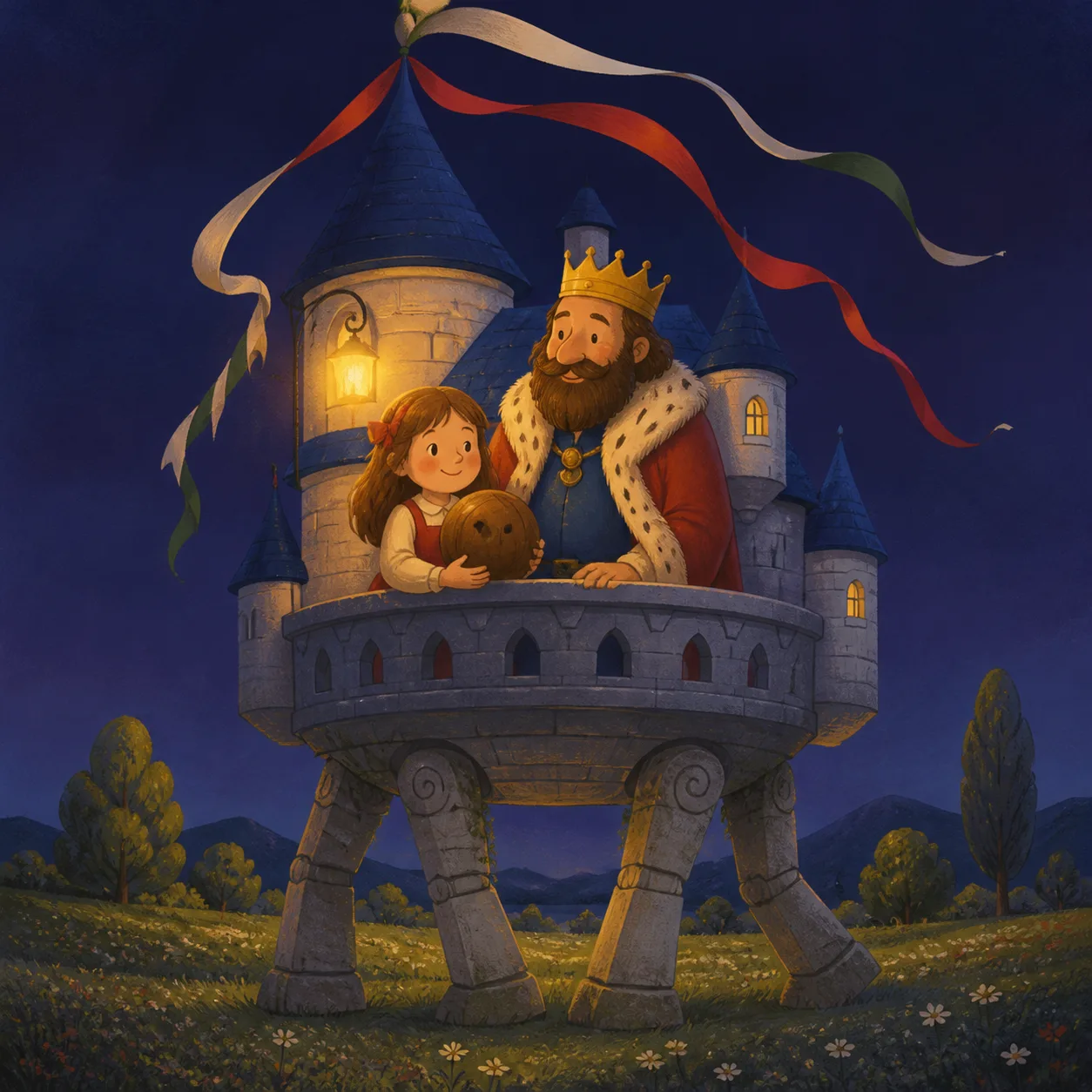
Read the story
Turn on sounds to bring the bold words to life. Each sound plays once per reading.
On a hill above the town stood a castle with blue turrets, a golden rooster, and a very peculiar nature. It liked the ringing of morning bells, the smell of poppy-seed buns, and King Matthias. It loved the king so much that it could be cheerful for him, sleepy for him, and even offended on his behalf. And it was the taking offense that caused trouble.
Whenever the king lost a game, the castle rolled up its drawbridge like a pancake. Then it pulled in the stairs, scowled with its shutters, and leaped up on four tall stone legs. Jars clinked in the pantry, pegs fell in the laundry room, and the castle clockmaker had to straighten all the pendulums again. Worst of all was when the cuckoo popped out backwards.
The courtiers soon found an easy solution. They let the king win. When they played cards, they forgot the best cards up their sleeves; during races, they tripped over their own shoes; and when solving riddles, they claimed they did not know what had needles and grew in the forest. Each time, the king received a golden ribbon. He already had a drawer full of them.
Only Julča, the gardener’s daughter, found this strange. When she played marbles with her father, sometimes he won and sometimes she did. And when she made a splendid shot, her father rejoiced even though he had just lost his finest glass marble. Julča could not understand why everything had to be different at the castle.
One day in June, the castle was preparing a celebration for the whole town. The bakers brought pastries, the musicians polished their trumpets, and the gardener hung green garlands around the courtyard. Julča helped carry strawberries. She was looking forward to the evening so much that she had been humming into the empty baskets since morning.
Before the celebration, there was to be a royal game of skittles. It was played in three rounds, with each player getting one throw in every round. The chamberlain was supposed to play against the king, but his heavy ceremonial wig slipped down over his eyes. Before they could free him from it, Matthias pointed to Julča. “Will you play with me?”
“Gladly,” Julča replied, placing her basket beneath a bench. The chamberlain winked furiously at her from under his wig. She thought powder had fallen into his eye, so she handed him a handkerchief. Meanwhile, the king knocked down five skittles. Julča knocked down three. Everyone applauded, and the castle shutters clapped shut contentedly.
In the second round, however, the king’s ball bounced off a plank and knocked down only one skittle. Julča took aim, released the ball close to the ground, and knocked down seven. “The second round is mine!” she cried happily. The king looked at the scoreboard. “That isn’t fair. The ball didn’t obey me!”
Something boomed beneath the courtyard. The drawbridge rolled up, the stairs disappeared into the wall, and the castle rose so high that through the window the gardener saw the top of a pear tree instead of his roses. “Stay calm,” said the chamberlain. “It usually settles down again.” But this time the castle did not settle down. It took a step.
Then another. And a third. The benches bounced in the courtyard, the festive pennants flapped, and the pudding in its bowl rippled like a pond in the wind. The castle stepped over the garden wall and set off across the meadow, away from the town. Below, in front of the gate, the first guests stood waiting with flowers and mouths open in astonishment.
Julča grabbed hold of a bench. “But we haven’t finished the game yet!” she cried. The king, however, was staring over the wall at the town square receding into the distance. “Go back at once!” he ordered the castle. It answered by slamming all its northern windows. “I’m not angry at all!” The castle took such a long stride that the chamberlain’s wig slipped down over his nose again.
The cook ran out of the kitchen carrying a wooden spoon. Her pastries were sliding across the table, and soup was splashing over the rim of the cauldron. The king turned pale. “Careful! Don’t let anyone get hurt!” he said, this time in a completely different voice. The trays stopped shaking. Wooden rails slid out from the walls and caught the dishes.
Julča noticed. When the king gave orders, the castle stamped its feet. When he was truly afraid for the cook, the kitchen stopped shaking. The girl peered through a narrow doorway into the corridor. “We have to find out how to reason with it,” she said. The king wanted to call for the builder, but he was waiting with everyone else at the foot of the hill.
So Julča took a lantern from its hook. The king followed her, because staying in the bouncing courtyard seemed even worse. With every step the castle took, the corridor tilted first to the left and then to the right. Portraits of long-dead rulers swayed on their nails as though shaking their heads in disbelief.
They reached the staircase, but the steps had been drawn in. All that remained was a smooth stone slide. “Come out!” Matthias thundered. A single step slid from the wall, then withdrew in a huff. Julča sat down on the floor and thought. Above their heads, a chandelier tinkled. Each tinkle was accompanied by the distant thud of a stone foot striking the ground.
“I’d like to get downstairs so I can help,” she said quietly. The king looked at her. The lantern in her hand seemed enormous, and a strawberry had been squashed on her skirt. Suddenly he felt sorry that she had to wander through the castle because of his skittles game. “Please make us a safe staircase,” he asked.
One step slid out from the wall, then a second, a third, and finally the entire staircase. A handrail even appeared, though there had never been one there before. Julča tapped it. “Did you hear that? This time you truly meant it.” The king frowned. “I meant it before as well.” But he was no longer shouting.
Downstairs, they found a small round room. In the middle hung a huge bell without a clapper, and silver strings stretched from it into the walls. A different light trembled faintly along each one. When the king thought of his bad throw, one string turned red. The castle stamped. When he looked at Julča’s scraped fingers, another glowed with a soft golden light.
On the pedestal beneath the bell, an inscription had been carved. Julča read it slowly: “What the king holds in his heart, my stone shall carry out.” Matthias took off his crown. “So that’s why,” he murmured. “I thought it was protecting me from those who spoil my fun.” Julča tilted her head. “Was I trying to spoil it?”
The king remembered how the girl had jumped up when the skittles fell. There had been nothing wicked in it. Only pure joy at making a good throw. Even so, the memory brought the familiar stab beneath his ribs. The red string blazed. The castle stepped over a stream, and the water beneath the little window splashed all the way to a willow.
“I simply don’t like losing,” Matthias admitted. The castle slowed a little. “Neither do I,” Julča said. “Once, because of a game of marbles, I hid behind the compost heap. But Father came after me with some bread. And then we played again.” The king rubbed his chin. The scent of hay drifted in from outside. The town was almost out of sight.
“I’ll set up all the skittles again,” Julča suggested. “We’ll play the last round.” The king’s face lit up. “And will you let me win?” The golden light faded. Julča shook her head. “Then it wouldn’t be a proper game.” For a while, all they heard was the thunder of footsteps. Then Matthias slowly nodded. “A proper game, then. But I still don’t know whether I can manage it without getting angry.”
They returned to the courtyard. The cook had tied the soup ladle to the handle of the cauldron, and the musicians sat astride a chest of sheet music. Beyond the wall, the forest was drawing near. The castle was too wide to pass between the trees. “We need to stop,” said the king. “We want to finish the game. Fairly. And I would hate to break all those beautiful oaks.”
The stone legs stopped. The castle swayed slightly and settled at the edge of the meadow. It remained high in the air, but the courtyard was as level as a table. Julča set up the skittles. The chamberlain hurried over with the scoreboard. After two rounds, the king had six points and Julča had ten. Each of them had one throw left.
“I would advise the young lady to close her eyes,” the chamberlain whispered. “And preferably turn her back as well.” Matthias heard him. He was just about to pretend he had not, but then he remembered the drawer full of identical golden ribbons. “No,” he said. “No one will deliberately throw wide today.” One shutter opened a crack.
The king took the ball in both hands. This time he did not hurry. He noticed the knot in the plank that had made his ball bounce away before, and he aimed along a different path. The ball sped forward, the skittles crashed, and eight of them fell. Matthias let out his breath. “That was my best throw!” Julča applauded so enthusiastically that he smiled.
Now it was her turn to throw. To win, she needed to knock down at least five skittles. The king stood beside the scoreboard and felt the familiar stab. If she knocked down only three, the ribbon would be his. If her ball rolled away into the grass, it would certainly be his. Beneath the paving stones, something cracked softly.
“I’m afraid of losing again,” he admitted aloud. Julča looked at him and did not release the ball. Matthias slowly took a breath. He saw how intently the girl was aiming, how she was remembering her father’s advice, and how hard she was trying. He still wanted to win. But at the same time, he wanted to see whether she could make a good throw.
“Watch out for that knot on the right,” he told her. It was not a grand speech. Just a small piece of advice, the sort one player might give another. Julča nodded, bent her knees, and released the ball. It rolled straight, veering only slightly just before the skittles. Four fell at once. The fifth wobbled but remained standing.
The king gripped the crown he was holding beneath his arm. The fifth skittle leaned over once more. “Come on,” he breathed. And he truly wanted it to fall. The skittle tapped the sixth, and both toppled onto the planks. “Six!” Julča cried. “I won!” Matthias burst out laughing. “I saw! That last one certainly took its time deciding!”
Somewhere deep beneath them, the bell without a clapper rang. Its voice was round and warm, like sunlight shining into honey. All the shutters opened. The stairs slid out from the walls, and the bridge unrolled into the air. The castle rose on its stone legs, but this time it neither knocked anyone over nor frightened them.
“Home, please,” said the king. The castle turned so carefully that not a single strawberry moved on the table. Then it headed back across the meadow. The musicians climbed down from the chest and began to play. The cook untied the ladle. Julča and the king stood by the wall, watching for the town’s tower.
“I’m still a little sorry that I lost,” Matthias said after a while. Julča nodded. All the while, the castle kept walking calmly on. The king was surprised, and then he smiled. He did not have to be happy about his own defeat. It was enough that, beside his disappointment, he had found room for Julča’s joy as well.
Before sunset, the castle reached its hill. It carefully placed all four legs into the old stone foundations and settled down. The bridge landed precisely in front of the waiting guests. The gardener embraced Julča, and a cheer of relief swept through the crowd. Only the clockmaker immediately hurried off to check the cuckoo.
The celebration began a little later, but the pastries were still soft. The king pinned a golden ribbon on Julča and told everyone about her final throw. He did not forget the fifth skittle, which had taken so long to make up its mind. He laughed as he told the story, and the castle quietly tinkled its little panes of glass.
From that day on, games at the castle were played for real. Sometimes Matthias won, sometimes the chamberlain did, and very often Julča. Now and then, when the king lost, one shutter would close crookedly. But then it would open again. And whenever someone made an especially fine throw, the castle bell rang, even though no one was pulling the rope at all.