The Hare Who Hurried the Carrot
ages 4–95 minutesgentle, cheerful, and heartwarming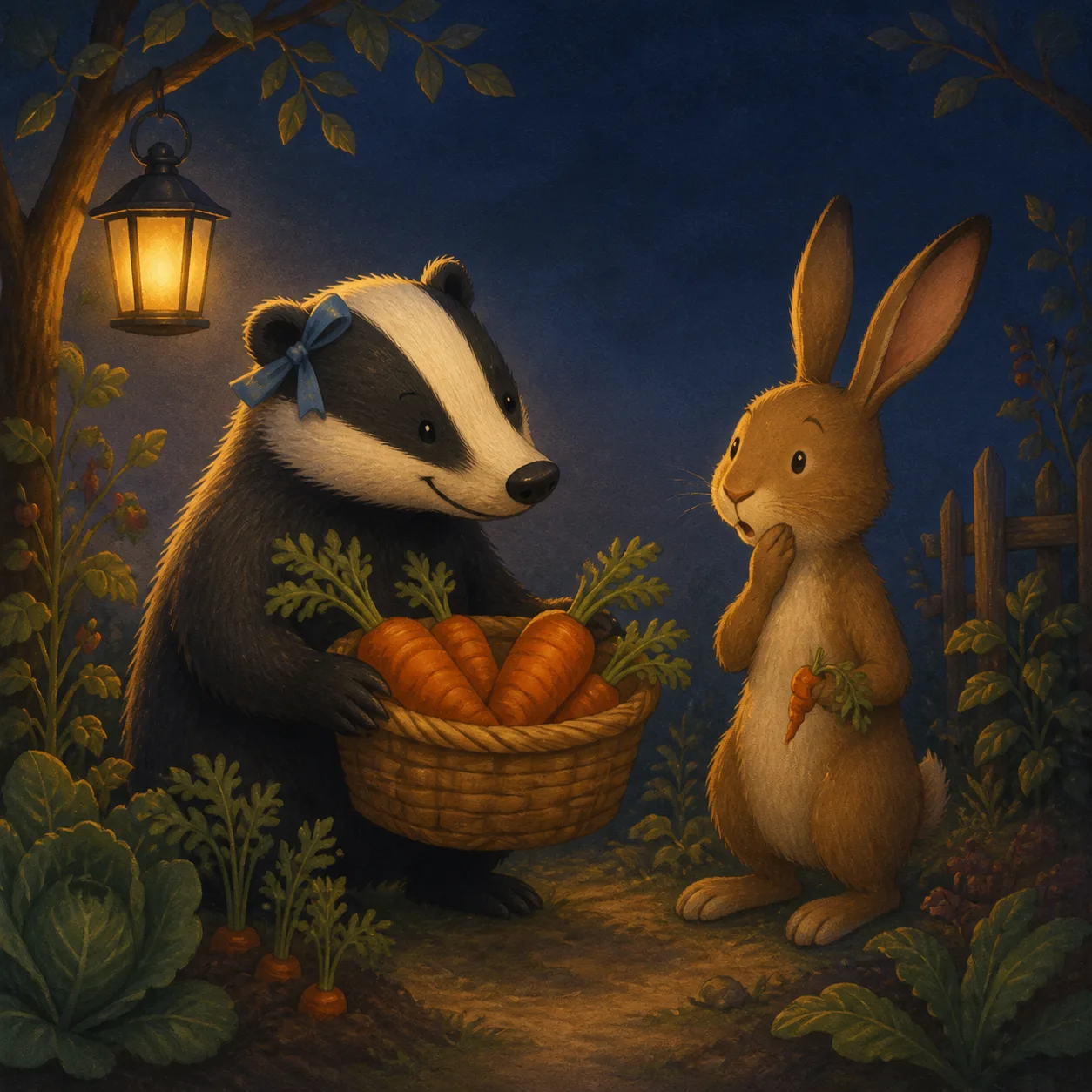
Read the story
Play videoTurn on sounds to bring the bold words to life. Each sound plays once per reading.
At the edge of the forest, where the sun shone warmly from morning until supper, lay two small garden beds. One belonged to Long-Ears the hare, and the other to Frederick the badger. Long-Ears had a new rake, a shiny watering can, and grand plans. Frederick had an old hoe, a battered bucket, and spent a little time in his garden every morning before breakfast.
One spring day, Long-Ears brought a packet of carrot seeds. “Shall we see who can grow the bigger carrot?” he called over the fence. “The winner gets a blue ribbon and will be gardener of the year!” Frederick smiled. “Agreed. But the carrots must stay in the ground until harvest.” The hare was already hopping toward his garden bed, however, and barely heard the last sentence.
They both loosened the soil, made shallow rows, and sowed their seeds. Frederick gently covered the seeds and watered them. Long-Ears did the same, only much faster. Then he brought over a stool, sat down beside the row, and waited. After a while, he leaned closer. “Well? Are you growing yet?” The soil was silent. So the hare tapped it encouragingly with his finger.
A few days later, the first green leaves peeped out. Long-Ears was so delighted that he ran around the garden three times. But the next morning, they looked exactly the same to him. “We’ll never win the contest like this,” he muttered. He took hold of one plant by its leaves and carefully pulled it up. Beneath the leaves hung a slender root, scarcely thicker than a thread.
“Is that all?” the hare wondered. “I suppose you don’t like it here.” He dug a new hole closer to the fence and transplanted the little carrot. As he worked, a piece of its delicate root broke off. Long-Ears did not notice. He was thinking only of making sure the carrot got as much sun as possible in its new spot.
Meanwhile, Frederick watered when the soil was dry and pulled up the weeds. When the plants grew larger, he left plenty of room between them. Then he put down his hoe and went to make breakfast. “Are you finished already?” Long-Ears asked in surprise. “You haven’t even checked your carrots!” The badger pointed to the fresh green leaves. “I’ve looked at them. They have everything they need for today.”
The hare did not believe him. Every morning, he pulled one of his carrots out of the ground. He moved one beside the path, another under a bush, and a third back again. When the wind blew, he searched for a sheltered spot. When a cloud appeared, he searched for sunshine. More and more holes appeared in the garden, and the hare’s paws were always covered in soil.
One day, Frederick saw his neighbor carrying a wilted plant across the entire garden bed. “Roots are fragile,” he told him. “If you keep pulling them up, they get damaged. Leave the carrot alone for a while.” Long-Ears stroked the drooping leaves. “I’m only finding it a better home. Then it will surely grow faster.” And he planted it beside a stone.
Summer smelled of grass and warm earth. Frederick’s carrot tops grew thick and green. Long-Ears’s were sparse and yellow in places. The hare got himself a ruler and complained every day, “You’re still so small!” He even clapped for the carrots to encourage them. But neither clapping nor measuring could heal their torn roots.
At last, harvest day arrived. Long-Ears brought the blue ribbon, laid it on the fence, and smiled bravely. Frederick loosened the soil around his biggest carrot, grasped the leaves, and pulled. Out of the garden bed came a long, thick carrot, as orange as the evening sun. One of the hare’s ears drooped in surprise.
Then Long-Ears harvested his carrots. The first was tiny and crooked. The second had several thin little legs. The third was no bigger than his thumb. The hare laid them beside Frederick’s carrot and was silent for a long time. “I ran around so much,” he finally whispered. “I wanted to help them grow. But I kept tearing their roots.”
Frederick did not make fun of him. He sat down on the grass beside his neighbor, and for a while they looked at the two garden beds together. Then he slid his basket closer. “I have enough carrots for both of us. Will you help me wash them?” Long-Ears nodded. But first he stood up and tied the blue ribbon around Frederick’s ear. It was a little crooked, but it suited him very well.
That evening, they cooked a large pot of carrot soup together. Long-Ears added his small, crooked carrots too. When he tasted the first spoonful, he finally smiled again. Frederick divided the rest of the harvest between two baskets and handed one to the hare. “For the winter,” he said. Long-Ears quietly thanked him.
The following spring, the hare sowed a new row of carrots. He tied a wooden sign to his watering can: “Water, weed, and let grow.” When the first leaves peeped out of the ground, he almost reached for them. But then he read the sign, gently watered the garden bed, and went to invite Frederick to breakfast. Meanwhile, the carrots stayed safely in the soil.
Watch the story
An illustrated video — for the moments when eyes refuse to sleep yet.