Rozárka and the Weather Oven
ages 5–1012 minutesmagical, cheerful, and gently suspenseful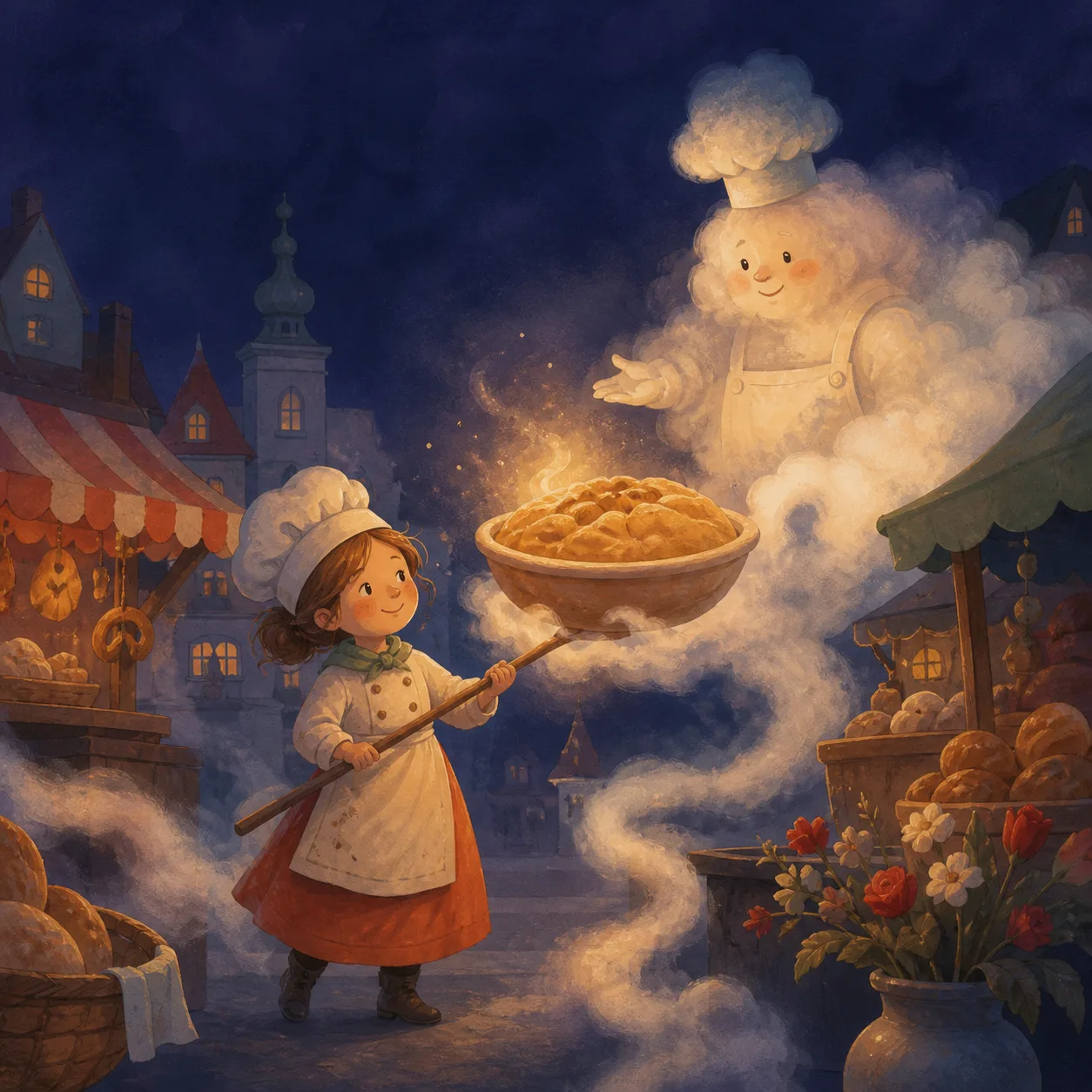
Read the story
Turn on sounds to bring the bold words to life. Each sound plays once per reading.
In the little town of Podlipí stood a bakery with an oven so large that a giant could have slept in it, slippers and all. Every morning, the smell of bread drifted from it, and every Saturday, the smell of poppy-seed rolls. Rozárka, the baker’s apprentice, could braid a bread roll with six fingers, scratch her nose with the seventh, and never stop talking for even a moment. At least, that was what Master Matěj, who was teaching her the baker’s trade, claimed.
Before the autumn fair, Rozárka was cleaning behind the oven. Her broom caught on something, and a book with blue covers slipped out of a narrow gap. A silver ear of wheat gleamed on the cover. Rozárka blew off the dust. Strangely, it did not smell of soot, but of rain on a sun-baked road. “Master, I’ve found a recipe book!” she called. Matěj was loading loaves onto a cart. “Then take good care of it. Old recipes are sometimes worth a whole sack of gold.”
Rozárka opened the book. Wind Crescents, said the first page. Next came mist buns, rainbow pretzels, and a storm cake with a crisp crust. “Those must be names based on their shapes,” she decided. After all, bear paws did not have bears in them either. She resolved to make something for the fair that no one in Podlipí had ever tasted before. Matěj went off to set up the stall, leaving her one mixing trough and the smaller oven.
First she mixed a batch of yeast dough according to the recipe on the endpaper. Flour, milk, yeast, butter, and three turns of the wooden spoon toward the east. The last instruction seemed odd, but she gave it three turns. The dough needed to rest, so she set the bowl on the cool windowsill. Then she began making the crescents. She left a little hollow inside each one, as the book instructed, and whistled softly while brushing them with water.
The mist buns were filled with cottage cheese whipped until it was so light that it nearly floated off the wooden spoon. The storm cake was filled with plum jam, cinnamon, and roasted nuts. Rozárka cut a zigzag across the top. At the bottom of the page it also said: Serve high up. So she would put it on the highest shelf in the stall. The remaining pages were stuck together with something sweet, but there was no time for them now.
When she took out the last baking sheet, a faint rumble came from the oven. “That’s your stomach growling,” Rozárka told it, and added a log. She loaded all the pastries onto the cart and wheeled it out of the bakery and straight onto the village square. She did not remember the forgotten bowl by the window. The fair was already jingling, fragrant, and rustling. The ribbon seller was unwinding colorful spools, and the potter was arranging blue jugs on wooden planks.
The mayor bought the first crescent. He sniffed it, nodded in satisfaction, and bit off the tip. Whoooosh! Wind burst from the crescent, lifted his mustache, and carried his hat straight into a basket of onions. The mayor’s eyes bulged. “Miss Rozárka, this one is a little too fresh!” The crescent whistled again in his hand and flipped every postcard at the stall opposite face down.
Rozárka grabbed the remaining crescents, but squeezed two of them as she did so. One blew to the left, the other to the right. The ribbons twisted like colorful snakes, and a straw hat flew into one of the potter’s jugs. Matěj was just arriving with coins for change. For a moment, he watched the mayor’s mustache streaming in the opposite direction from the pennants. Then he asked cautiously, “Rozárka, what recipe did you use today?”
Before she could answer, a little boy at the next counter broke open a mist bun. A white cloud rolled out of the cottage cheese, spilled over the edge of the stall, and spread across the paving stones. In a moment, only the church tower and the top of Matěj’s cap could be seen. “I’m over here!” called the potter. “And I don’t know where I am!” replied the mayor. The mist smelled of vanilla, and it made everyone’s mouth water a little.
The market sellers set about catching the weather. The potato seller opened a sack and scooped a generous helping of mist into it. No sooner had he tied it shut than the white vapor began escaping between the threads. The seamstress tried to catch the wind in a duvet cover. The cover swelled, leaped, and dragged her three steps behind it. “I’ve got it!” she cried happily. Then she sneezed, let go of one corner, and the wind fluffed up all her hair.
Just then, from the highest shelf came: rumble, rumble, RUMBLE. The storm cake trembled. A tiny blue spark leaped across the zigzag cut. Rozárka took it down at once and carefully placed it on an empty counter. “Please don’t touch this one,” she said. The mayor raised the knife he had meant to use to divide his bun. The cake gave a threatening boom. The mayor put the knife down again. “Actually, I think I’d rather have some bread.”
Rozárka ran to fetch the recipe book and returned so quickly that her apron slapped against her knees. Meanwhile, Matěj covered the crescents with a large lid. The lid bounced like a dancer. “Those pages that were stuck together,” Rozárka remembered. She dampened the corner of a clean cloth and pressed it against the dried sweet stain. The paper slowly came loose. Beneath it appeared tiny silver writing and a picture of a baker standing on a cloud.
Property of the Cloud Bakery, Rozárka read. Pastries intended to be served in the sky. Do not cut the storm cake near the ground! Beneath the crust are rain, thunder, and three bolts of lightning. “Three,” Matěj repeated, looking at the fairground awnings. One tiny spark had just poked its tip out of the cake and slipped back inside. Rozárka read on: Carry the finished cake aloft before the crust cracks by itself.
“But how?” she whispered. In the picture, an enormous cloud was carrying the cake, but they had nothing like that. Matěj brought a ladder. Rozárka climbed to the third rung and immediately came back down. Even the tallest chimney was not the sky. The potter offered a long pole, but the cake was heavy and the pole bent. Meanwhile, the crust gave a quiet crack. A single raindrop peeped out of the crack and splashed onto the mayor’s shoe.
Rozárka needed to free her hands. She carried the book into the bakery, laid it on the table, and looked around for a sturdy board. Then she noticed the bowl on the windowsill. “I completely forgot about you!” The dough was still cold and had not risen. She set it on the bench beside the oven to warm up and pulled out a round board. Behind her came a gentle clink. The bowl lifted away from the bench.
At first it rose only an inch. Then the width of a hand. Rozárka stood with her mouth open. The dough was rising, and the bowl was rising with it! When she moved it away from the oven, it slowly sank. When she returned it to the warmth, it began rising again. Rozárka opened the book to the endpaper. Beneath the recipe, hidden under a folded corner, was an added note: Lifting dough. Keep warm. Tie a string to the bowl.
“Master!” she shouted so loudly that outside, the lid on the crescents gave a jump. Matěj came running, and together they tied a strong string around the bowl. Rozárka placed the board on its rim. The bowl swayed, but it held the board up. They added one pot, then another. It kept rising. “It can carry the cake too,” Rozárka breathed. Matěj smiled. “Then we’ll get it ready for takeoff. We just have to make sure it doesn’t change its mind about where it belongs along the way.”
They removed both pots and wrapped the bowl in a thick cloth warmed beside the oven. Outside, the sun had climbed above the rooftops, though the vanilla mist still lay close to the ground. Matěj held the string while Rozárka carried the storm cake onto the board. It rumbled inside, like someone rolling a barrel across an attic. The dough bulged, strained, and lifted the whole load to the height of Rozárka’s eyes.
The trouble was that the bowl was rising straight toward the awning of the bakery stall. “To the left! A little farther!” called Matěj. But the wind was swirling between the houses and pushing the cake toward a post. Rozárka reached under the lid, pulled out one wind crescent , broke off its tip, and aimed the opening at the bowl. Whoooosh! The bowl obediently floated away from the awning. One more careful puff, and it was in the middle of the village square.
Matěj let out the string. The bowl rose above their heads, above the stalls, and then above the bakery roof. There, the sunlight warmed the cloth, and the dough began rising even more eagerly. Rozárka watched the board grow smaller. The cake thundered so loudly that the little bell in the tower began to ring. And from somewhere high above came a surprised voice: “Who’s sending me a snack with the weather included?”
A huge flour sifter sailed out from behind the chimney. Standing inside it was a baker in an apron as white as fluffy clouds. His beard was gray and curled into tiny spirals. With one hand he caught the bowl, and with the other he held on to his cap. “Storm cake, with cinnamon!” he cried happily. Then he saw the mist on the square and the lid bouncing on the stall. “Ah. It seems someone has found my recipe book.”
“I did,” Rozárka admitted. “It was behind the oven.” The cloud baker nodded. “It fell down the chimney last week when I leaned over to smell your bread. I’ve been baking from memory ever since, and yesterday I made hailstones as big as buttons.” He transferred the cake onto a small gray cloud. The crust was already taut and golden. “First we’ll take this over the harvested fields. The rain won’t spoil anyone’s fair there.”
With a wave of his long baking peel, he sent the cloud beyond the town. In the distance, lightning flashed, thunder gave three friendly rumbles, and silver rain poured down over the stubble fields. Then the cloud baker landed in the square, climbed out, and turned the sifter upside down. The mist on the square stretched into white ribbons, rose into the air, and settled on his sieve. The potato seller hurriedly untied his sack. “Here’s another bit! We wouldn’t want you to lose any!”
The baker shut the remaining wind crescents inside a tin box with a tight-fitting lid. He left one little gust for the children so they could spin their paper pinwheels. Then he returned the bowl and the board to Rozárka. From the dough, he conjured six small bread rolls and placed them in a basket. “These don’t fly anymore,” he assured Matěj. “They only give you light and airy dreams.” Even so, Matěj kept one firmly under his thumb.
Rozárka brought him the blue recipe book. The cloud baker stroked its spine and, as a reward, wrote her a recipe for ordinary honey knots. At the top, in large letters, he added: SUITABLE FOR THE VILLAGE SQUARE. Then he climbed into the sifter and rose among the clouds. The fair began jingling again, the mayor found his hat, and Rozárka still had time to bake two trays of honey knots. They did not thunder, blow, or make mist. But they vanished from the basket faster than all the magical pastries.
That evening, Rozárka and Matěj sat on the step outside the bakery and shared one dream roll. Above Podlipí floated a little cloud, as round as a bowl. A thin line hung from its edge, looking very much like a string. Rozárka waved to it. The cloud tilted slightly, and from far away came a contented rumble. This time it was not thunder. After a long day, the cloud baker’s stomach was finally growling.